
A Quantum Computer’s Only Job Here Was to Roll Weirder Dice

Say you hand two chefs the same recipe and the same kitchen, but you give each of them a different mystery basket to start from. They use the same technique and a different first ingredient, and end up with a wildly different dinner. That’s a bit like what a team from the Technical University of Denmark, ORCA Computing, and Sparrow Quantum just did to an AI, except the dinner was immune-targeting peptides and the mystery basket came from a photonic quantum computer.
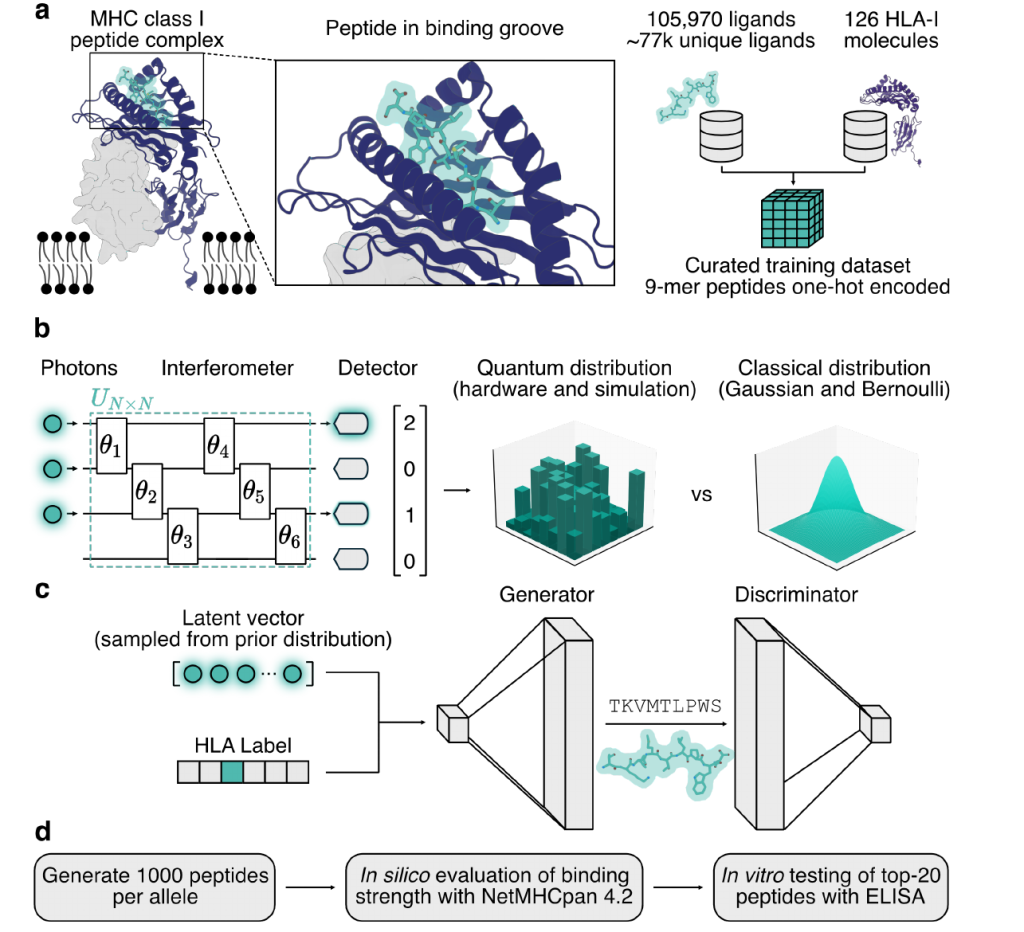
Quick definitions, because this only works if you have the handles. Peptides are short chains of amino acids. Your cells display them on their surface like tiny signs, held up by proteins called HLA, and passing T cells read those signs to decide whether a cell is healthy, infected, or cancerous. Design a peptide that clips firmly onto the right HLA and you have an early ingredient for a cancer vaccine or a T-cell therapy. Finding those peptides is a nightmare search: even a nine-amino-acid peptide has an absurd number of possible spellings, and almost none of them stick.
Generative AI is good at this kind of search, but it always starts from a random seed, usually plain statistical noise shaped like a bell curve. That seed is the mystery basket. The team swapped the boring bell-curve noise for patterns from a quantum device doing something called Gaussian boson sampling, which sends particles of light through an optical maze and records where they come out. Because photons interfere with each other, those outputs are correlated in strange, structured ways rather than just scattered. Weirder dice, basically.
The gains showed up exactly where you’d want them
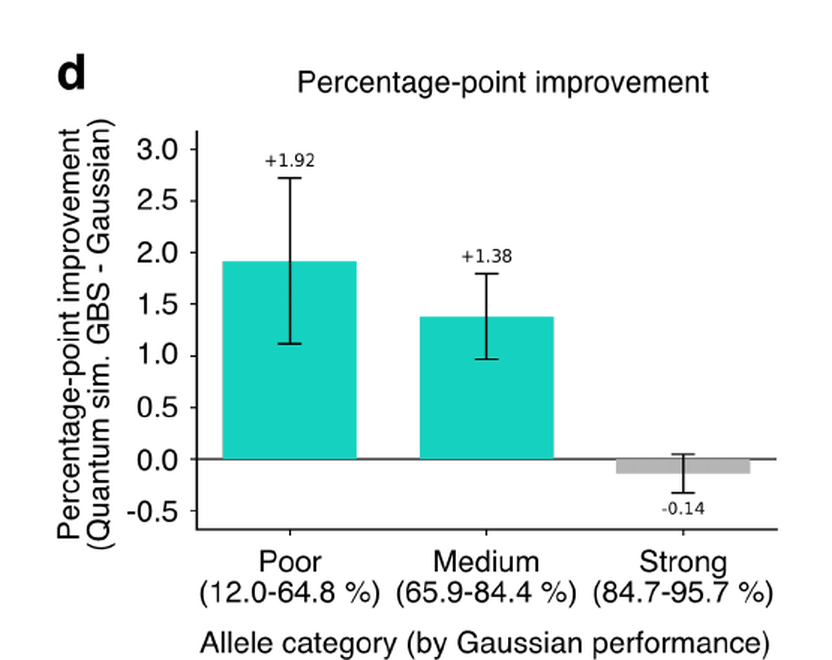
Here is the part that made me sit up. The overall improvement was small. Read only the headline number and you would shrug.
What difference does it make anyway?
Turns out, a big one, because the gains were not spread evenly. They piled up on the HLA variants that barely have any training data, the rare immune types where AI usually flails and where personalized medicine actually needs the help. The quantum-seeded model produced a handful more strong-binding candidates per thousand, beat the standard method on 63% of variants, and for one poorly-studied type generated around twice as many likely binders. It also wandered through a wider range of sequences without dropping the specific amino acids that do the actual gripping. More creativity, same discipline.
This is the rare quantum-biology paper that didn’t stop at a prediction. They synthesized 20 of the top peptides for each of three rare HLA types and tested them physically. For two of the three, all 20 formed stable complexes. The third, a notoriously awkward variant, came back mixed. The single best peptide for each type came from the quantum model, though on average the quantum and conventional winners landed in similar territory.
The part where I pump the brakes
The researchers are refreshingly upfront, so I will be too. This is a preprint, not peer-reviewed. It doesn’t show quantum advantage, and the setup was small enough that an ordinary computer could simulate the entire thing, just slower. A fancier classical noise recipe might do the same job. And binding is only step one. A peptide that clips onto HLA can still completely fail to wake up a T cell, which is the entire point of a vaccine.
So no cancer cure was invented this week. What happened is smaller and more interesting. A quantum computer found a genuinely useful side gig as the thing that rolls the dice, and the dice came up better exactly where we needed them to.