
What Is Quantum Key Distribution (QKD)? The No-Math Version

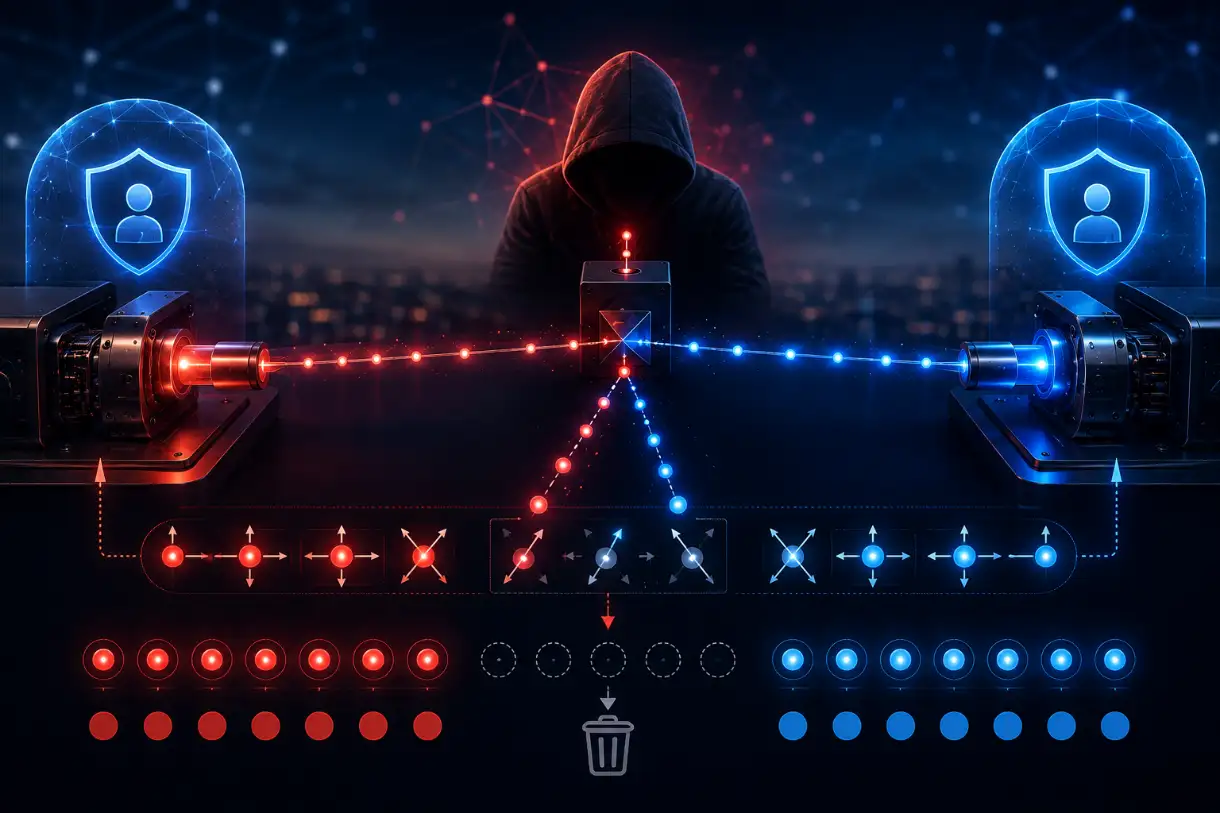
Quantum key distribution, or QKD, is a way for two people to agree on a secret encryption key by sending quantum signals, usually single photons or faint pulses of light, down a fiber or through the air. Its selling point is one ordinary cryptography can’t offer. If someone tries to intercept the key in transit, the attempt tends to leave a mark, and the two parties can catch it by measuring how disturbed their signals are. That detection is statistical, and it only holds when the hardware is built correctly, but where it works an eavesdropper can’t quietly copy the key without giving themselves away. If the disturbance looks too high, the two sides throw away what they have and start over.
Most crypto holders want one question answered before anything else, so here it is. QKD won’t protect your wallet. It secures a key moving between two points on a network. It doesn’t make a blockchain signature quantum-resistant, and it doesn’t guard a private key sitting in your custody. The fix for that problem is post-quantum cryptography, a different tool entirely. QKD is worth understanding because you’ll keep seeing it in quantum-security headlines, and knowing what it does keeps you from mistaking it for a solution to a problem it doesn’t touch.
The problem it solves
Almost all the encryption protecting your traffic relies, at some point, on two parties sharing a secret key that scrambles and unscrambles the data. The hard part has always been establishing that shared key over a network where someone might be listening.
Today it’s handled with math: key-exchange algorithms whose security rests on problems that are hard to solve. The word doing the work there is “hard,” and hard is a long way from impossible. A large enough quantum computer running Shor’s algorithm would turn some of those hard problems easy, which is the whole reason Q-Day worries people.
QKD takes a different route to the same goal. Instead of trusting that a math problem stays hard, it leans on physics.
How QKD works, without the math
The original recipe is a 1984 protocol called BB84, named for Charles Bennett and Gilles Brassard. The idea has held up for four decades.
Alice wants to share a key with Bob. She sends a stream of photons and encodes each bit in a property of the photon, its polarization, the angle at which its light wave vibrates. For each photon she picks the angle at random from one of two sets of orientations. Think of them as two different rulers she could measure with.
Bob doesn’t know which ruler Alice used for any given photon, so he guesses, picking a ruler at random and measuring. When his ruler matches Alice’s, he reads her bit correctly. When it doesn’t, he gets a random result. Afterward, over a public channel, they compare which ruler they used for each photon, never the bit values themselves. They keep the photons where the rulers matched and drop the rest.
From raw bits to a shared key
What’s left isn’t the finished key yet. It’s a raw draft that still carries errors. Some come from noise or imperfect gear, some possibly from a listener. So they run two more steps. They reconcile their two versions to fix the errors, then they shrink the result through a process called privacy amplification, which crushes whatever an outsider might have learned down to something negligible. The shorter string that survives is the shared key only they hold.
One requirement is easy to miss: that public channel has to be authenticated. If Alice and Bob can’t be sure they’re truly talking to each other, an attacker in the middle can run a separate QKD session with each side and relay between them. QKD keeps the key from being copied, but it still needs conventional authentication, from a pre-shared secret or a signature scheme, to prove the endpoints are who they claim to be.
Why an eavesdropper can’t hide
This is the physics that makes it work. A rule called the no-cloning theorem says you can’t make a perfect copy of an unknown quantum state. In the simplest attack, an eavesdropper (call her Eve) measures each photon in transit and passes one on to Bob. She can’t measure without choosing a ruler, and she doesn’t know which one Alice used. Every wrong guess disturbs the photon and changes what Bob reads.
So Eve’s snooping pushes up the error rate in the key. When Alice and Bob sacrifice a batch of their bits to estimate that rate, a clean, low number lets them go ahead with error correction and privacy amplification. A number that’s too high means the security test failed. They can’t tell why. It might be Eve, or it might be nothing worse than noise and a misaligned detector. They don’t try to diagnose it. They abort and start again.
Eve may have skimmed a little information off the raw key, but privacy amplification is the step that reduces what she knows about the final key to nothing worth having. And no-cloning is only part of the story. A determined attacker can do subtler things than intercept and resend, which is why the full security proofs go well beyond this sketch.
Where it falls down
The physics is elegant. The engineering is where it gets hard, and this is the part the headlines usually skip.
Distance is the first wall. Single photons get absorbed and scattered as they travel down a fiber, and the loss piles up fast, so the usable key rate drops steeply with distance. Deployed links generally run from tens of kilometers to a few hundred. Labs have pushed much further. A 2023 experiment sent keys over 1,002 km of ultra-low-loss fiber with no relays at all, though the key rate was far too slow for any practical use.
To go farther in practice, you relay the key through waypoints called trusted nodes. The key doesn’t travel end to end untouched. Each segment of the path makes its own QKD key, and the nodes hand the key material along hop by hop. Because a trusted node handles that material in the clear, it could read or alter it, which is exactly why it has to be trusted. That undercuts the original promise, which was to trust physics instead of people. A quantum repeater would fix this by extending range without ever reading the key, but working repeaters aren’t ready for deployment. Until they are, long-distance QKD leans on trusted nodes or on satellites beaming photons down from orbit.
Then there’s cost and reach. QKD needs specialized optical hardware at each end. It often wants its own fiber, though some systems let the quantum and classical signals share one fiber on different wavelengths. Either way it secures a point-to-point link between two equipped endpoints. It doesn’t scale to the way most encryption gets used, with billions of devices talking to servers they’ve never met before.
QKD versus post-quantum cryptography
Post-quantum cryptography and QKD attack the same threat from opposite ends. PQC is new math that runs on the computers and networks you already own, and it protects the same kinds of things classical cryptography does, including the digital signatures that secure a blockchain transaction. It isn’t free to adopt. Rolling it out still takes software and firmware changes, sometimes down to the hardware security modules. But it needs no special quantum gear.
QKD is new hardware that protects one link at a time and offers a physics-based detection guarantee in exchange.
Why the agencies picked PQC
The trade-off explains why the two get treated so differently. The U.S. National Security Agency has declined to recommend QKD for protecting national-security systems, and it’s specific about why: QKD still needs separate authentication, it depends on special-purpose hardware that can’t be patched like software, its trusted relays add insider risk, physical devices drift from the idealized physics, it costs a lot, and a link that halts on detected interference is easy to knock over with denial-of-service. The agency’s stated direction is post-quantum cryptography instead. That guidance is aimed at U.S. National Security Systems, and the wider commercial market sits outside its scope.
Other governments are building QKD anyway for a handful of high-value links. The EU is assembling EuroQCI, a quantum-communication infrastructure meant to span fiber and satellite links across member states. China has gone furthest, stitching more than 700 fiber links and two satellite connections into a network spanning 4,600 km, held together by trusted relays and serving banks and government users. Both things can be true at once: QKD is genuine and useful for a few, and post-quantum cryptography is the answer for nearly everyone else.
The takeaway for a crypto holder
If you’re a crypto holder, QKD is a serious technology built for a genuine problem, but it isn’t a general answer to Q-Day, and it isn’t guarding your coins. It can lock down quantum-safe key delivery on specific links. It can’t replace the post-quantum signatures your wallet will need. When you want to know whether your wallet survives a quantum computer, the section to read is post-quantum cryptography.