
QKD Hardware, Explained: What’s Inside the Box

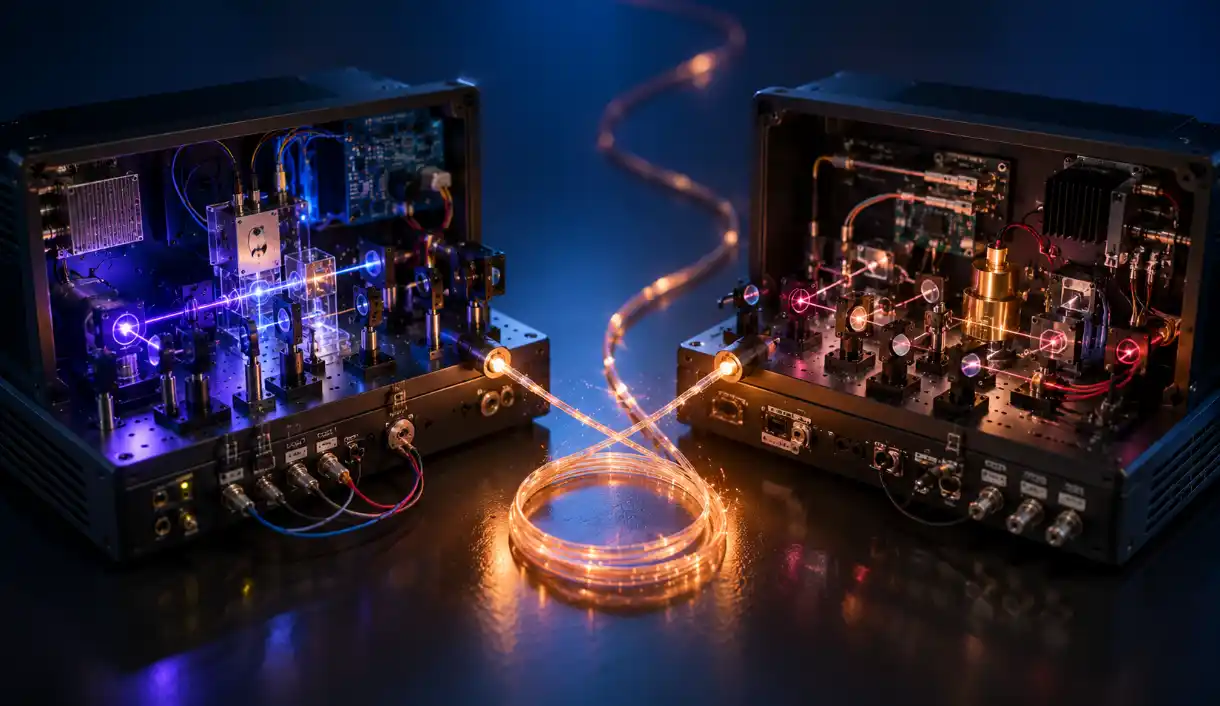
QKD’s reputation as a costly, point-to-point technology comes straight from what sits inside the box. The physics is simple, but the equipment is fussy and expensive. Open up a common QKD link and you find a transmitter that makes faint random light, an optical channel, a receiver full of delicate detectors, and a software layer that stitches the entire thing into a normal network.
Do note that QKD isn’t a single design. The hardware below describes the most common kind, a fiber-based system that sends dimmed laser pulses and measures them one at a time, known as discrete-variable, prepare-and-measure QKD. Other families, including continuous-variable and entanglement-based designs, use noticeably different parts.
Here’s the common box, and why its hardware is the reason QKD doesn’t scale the way a software upgrade does. None of it, by the way, signs your transactions.
The transmitter: making faint, random light
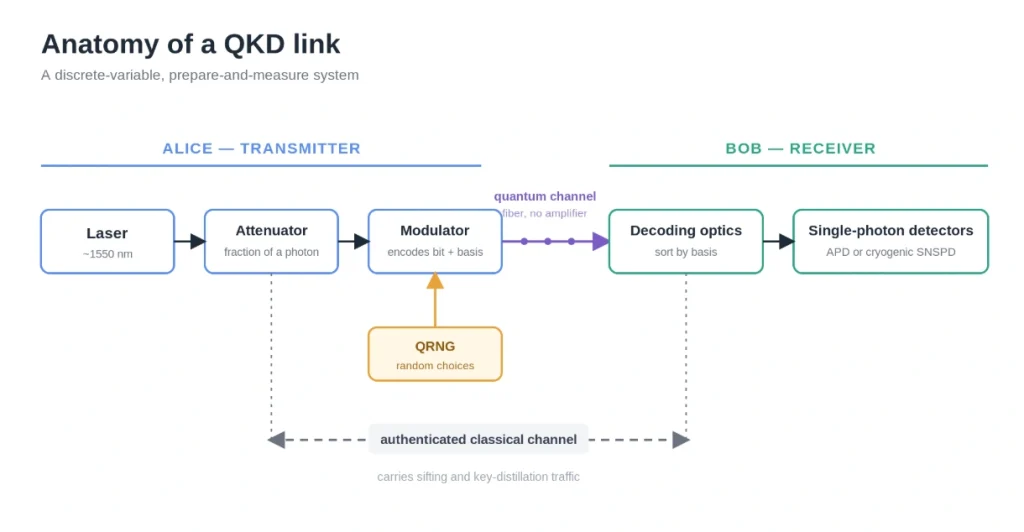
By the usual convention, the two ends of a QKD link are Alice, the sender, and Bob, the receiver. Alice’s end starts with a telecom laser, the kind that carries internet traffic around 1550 nanometers, where fiber loss is low. A variable attenuator dims each pulse to a fraction of a photon on average, so the multi-photon pulses an eavesdropper could exploit stay relatively rare.
That fraction is deliberate: the pulse isn’t a clean single photon but a faint one whose photon count varies, which is why these systems lean on decoy states to stay safe. A modulator then stamps each pulse with the bit and basis Alice picked.
Those choices have to be unpredictable. If an attacker could guess Alice’s settings, the security can be compromised, so implementations feed the modulator from a strong entropy source. That’s often a quantum random-number generator, sometimes a smaller generator whose output is stretched to the rate the protocol needs. QRNGs have also escaped the QKD box and reached consumer devices on their own, in a specialist line of security phones and hardware modules.
The channel: one path you can’t amplify
Between Alice and Bob runs the quantum channel, most often an optical fiber and sometimes a free-space or satellite link. It’s frequently provisioned apart from ordinary traffic, though the quantum signal can also share a fiber with classical data on separate wavelengths. The hard limit comes from the rule that makes QKD secure: you can’t copy an unknown quantum state, so you can’t drop in an amplifier to boost the signal the way telecom networks do.
Loss builds up and the usable key rate falls steeply with distance. Conventional long-distance fiber networks commonly relay through trusted nodes to reach across a country, though experimental methods like twin-field QKD have demonstrated secure key distribution over more than 1,000 kilometers of fiber, at a tiny key rate.
The receiver: catching one photon at a time
Bob’s end contains some of the trickiest hardware, at least in this discrete-variable design. First come decoding optics that sort each incoming photon by basis, using beam splitters and polarization parts in some systems and interferometers in others. Then come the single-photon detectors, and here builders usually pick between two families.
Avalanche photodiodes are the cheaper option, cooled only modestly, but they’re twitchy and afterpulse-prone, and they were the targets of the landmark detector-blinding attacks against commercial QKD systems. Superconducting nanowire detectors are the high-end choice, with excellent efficiency and very low noise, though they need cryogenic cooling down near a few kelvin, which means a cryocooler humming next to the rack. Continuous-variable QKD skips single-photon detection altogether and uses balanced photodetectors closer to those in ordinary optical receivers.
The layer that turns photons into keys
Raw detections aren’t a usable key yet, and the steps that finish the job rely on a classical channel between Alice and Bob. That channel has to be authenticated. QKD doesn’t prove who’s on each end by itself, so without authentication an attacker could pose as Alice to Bob and as Bob to Alice, and the whole exchange falls to a middleman. Implementations handle this with a pre-shared key or a signature scheme, post-quantum ones included.
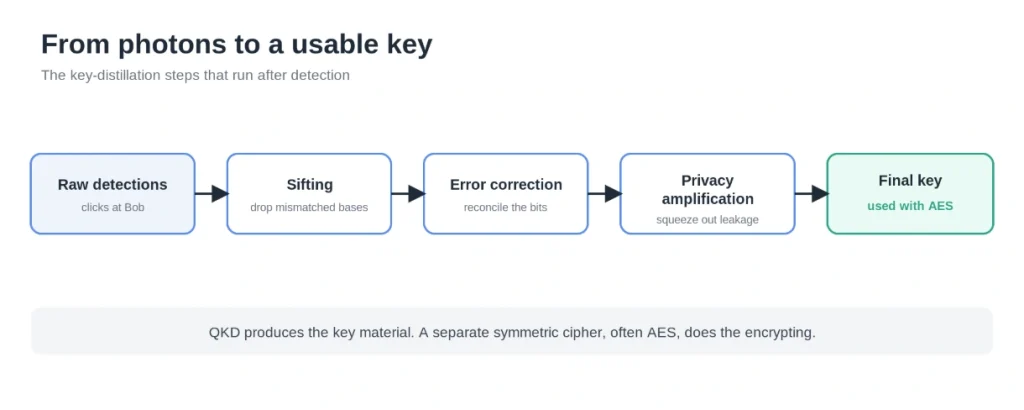
With that in place, Alice and Bob compare bases and drop the mismatches. In textbook BB84 that throws away about half the detections, though efficient modern variants bias the basis choice and waste far fewer. They then run error correction to reconcile the surviving bits, followed by privacy amplification, which shrinks the result to squeeze out anything an eavesdropper might have learned. A key-management system stores the finished keys and hands them to ordinary encryptors. QKD produces key material. Standard symmetric encryption, often AES, does the protecting with it.
Why the box keeps QKD niche
Add it up and the picture is clear. A typical DV-QKD link means precision optics and stabilization, a strong entropy source, an optical path you can’t amplify, and, in the high-performance versions, cryogenic detectors.
That’s a set of specialized equipment at each end, against post-quantum cryptography, which for many users arrives as a software or firmware update on hardware they already own. The gear is costly and short-range, and the key rate falls off steeply with distance. That combination is the concrete reason several major Western cybersecurity agencies file QKD under niche and send most buyers toward PQC.
What it means for you
The box establishes key material for a link between two machines. It doesn’t sign your transactions, and no amount of exotic optics changes that. There’s one component worth pulling out, though. The quantum random-number generator inside some transmitters is one QKD-related technology that has already reached consumer devices, and strong randomness is exactly what your wallet needs when it generates a key or a seed phrase.
To be clear, that randomness doesn’t have to be quantum. A properly built cryptographically secure classical random-number generator does the job, and has for years. The reason it earns a mention is the failure case. Weak randomness has left wallets open to theft before, most famously a 2013 flaw in Android’s generator. When a quantum computer threatens the signatures that guard your coins, the fix is still a post-quantum signature scheme the chain has to adopt. Nothing in this box helps.