
Ripple Partners With Project Eleven to Quantum-Proof the XRP Ledger


Crypto company Ripple and quantum security firm Project Eleven have launched a full security audit of the XRP Ledger, covering validators, custody systems, wallets, and networking layers, with the goal of making XRPL production-ready against quantum computing threats well before they materialize. The collaboration includes building hybrid signature systems, real-world performance testing, and a prototype quantum-secure custody wallet. The partnership marks the first major blockchain project to move post-quantum security from academic discussion into active engineering.
What the Audit Covers
According to the May 19 announcement, Project Eleven is reviewing every critical layer of the XRPL stack. The firm plans to deliver working code and a concrete deployment roadmap. Hybrid signature systems will pair existing cryptographic standards with quantum-resistant protections to give the network a transitional architecture that doesn’t require a hard break from current security models.
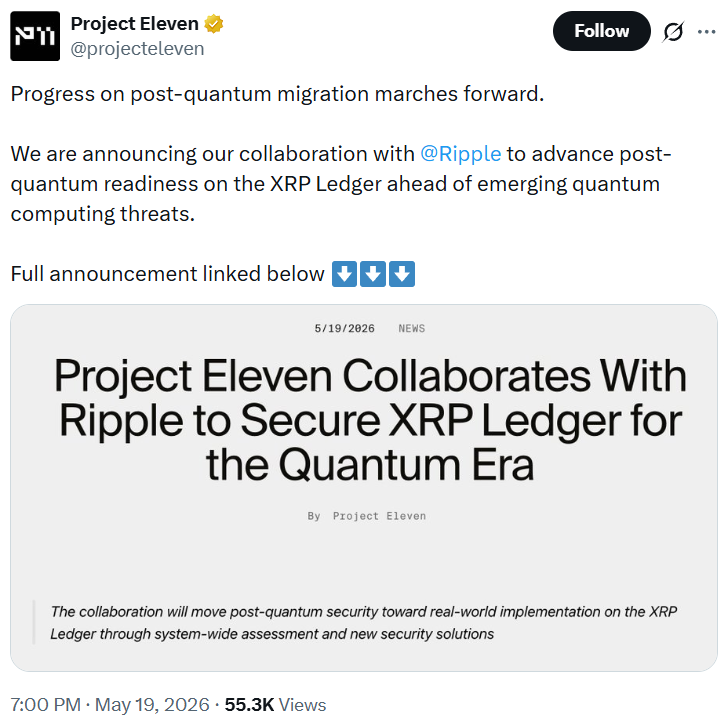
Alex Pruden, CEO of Project Eleven, said most blockchain conversations about quantum risk have stayed theoretical. Ripple is treating it as an engineering problem with deadlines attached.
“Every major blockchain is exposed to the same cryptographic vulnerability, but most of the response has stayed at the research stage. (…) This engagement is about execution. Ripple is treating quantum risk as a practical engineering problem. That’s the right approach.“
The U.S. government has set 2035 as the cutoff for federal systems to abandon encryption standards vulnerable to quantum attacks. Google and Cloudflare are both targeting 2029 for their own migrations. Blockchain networks can’t just push a software update the way a centralized service can. Coordinating thousands of validators, wallets, custody providers, and all the other elements takes years of preparation.
XRPL’s Structural Head Start
The XRP Ledger Foundation pointed out that XRPL already supports key rotation and coordinated validator upgrades at the protocol level. That means users and businesses can switch to quantum-resistant signatures without changing their existing r-addresses, the wallet identifiers their customers already recognize. Avoiding address migration removes one of the biggest friction points in any cryptographic upgrade.
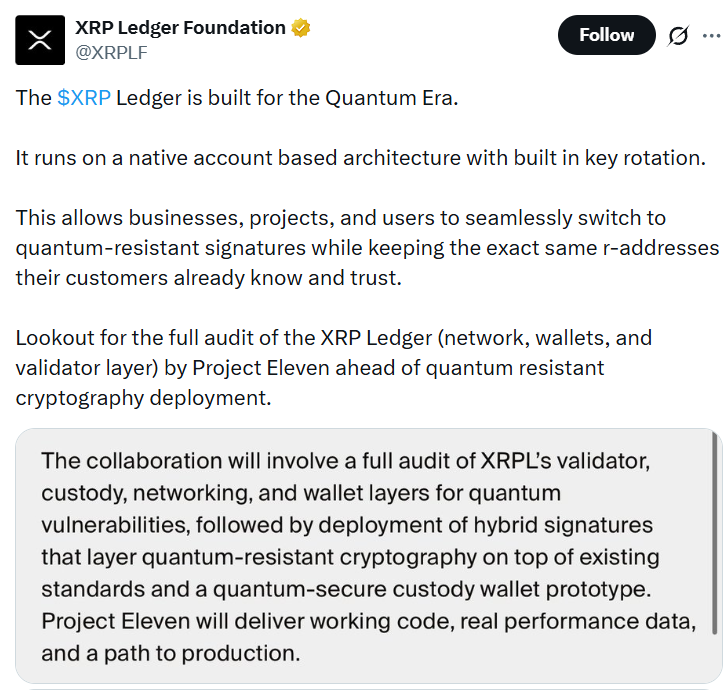
J. Ayo Akinyele, head of engineering at RippleX, confirmed the target is to have everything production-ready before quantum threats pose any real danger:
“The quantum threat isn’t hypothetical. It is an engineering challenge with a clear timeline. What puts XRPL in a strong position is that we are not starting from scratch. We already have core capabilities like key rotation and a validator network that can coordinate upgrades at scale. Working with Project Eleven helps us move faster and more rigorously as we test and implement post-quantum approaches across the stack. The goal is to be production ready well before we need to be, not reacting when Q Day arrives.”
Broader Industry Implications
Project Eleven called this its most comprehensive blockchain security engagement so far. The cryptography running behind Bitcoin, Ethereum, Solana, and XRP all shares the same fundamental vulnerability in the form of sufficiently advanced quantum computers eventually being able to break it. Ripple moving first on a concrete deployment plan puts pressure on other Layer 1 networks to follow with their own timelines. For XRP holders and institutional users building on XRPL, the work signals that long-term infrastructure resilience is being treated as a near-term priority, not a distant concern.