
Monad Proposal Could Let Wallets Upgrade for Quantum Threats


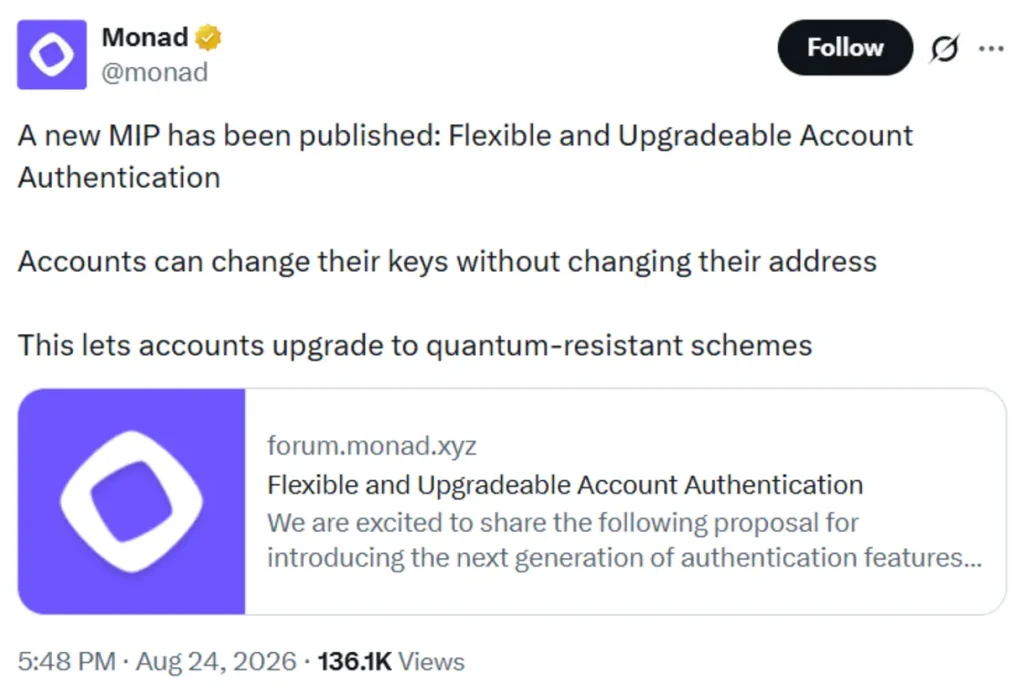
Monad developers have introduced an early-stage proposal that would enable an account to swap its signing keys without changing its address. The authors suggest this change could facilitate the future integration of post-quantum schemes. Indeed, published on the Monad forum on August 24, the draft aims to separate a wallet’s permanent address from the credentials used for transaction approval. This design would allow for the installation of a quantum-resistant scheme. Nothing in this proposal is finalized or specified.
Understanding the proposal
Specifically, authored by researchers Kushal Babel and Jan Camenisch, the Monad Improvement Proposal outlines an account model where the address remains constant, and it’s possible to add, replace, or retire the underlying keys. In contrast, most Ethereum-compatible wallets bind an externally owned account to a single private key, meaning loss of the key results in loss of assets. This draft would sever that link, allowing users to regain control through an alternative configured method, implement multisignature authorization, or add passkeys, all without transferring tokens to a new address.
Monad’s official X account framed the report around the ability to “upgrade to quantum-resistant schemes.” This framing originates from the project itself, with the post-quantum aspect listed as one potential use case alongside recovery and passkey support.
The document is currently a draft. Babel and Camenisch stated that it covers the general design, with the implementation specification yet to be written. Any changes would progress through Monad’s formal stages: Draft, Review, Last Call, and Final. Core changes would also require client implementations before achieving final status. Existing accounts would continue to function following the proposal’s potential adoption.
The quantum claim in context
Currently, no cryptographically relevant quantum computer exists. The concern centers on “harvest-now-decrypt-later” scenarios, where a sufficiently powerful future machine could potentially break the digital signatures that blockchains use to prove ownership. Monad’s draft doesn’t name a specific scheme, cite NIST’s finalized PQC standards (FIPS 203, 204, and 205), or commit to any particular algorithm. Instead, it describes an account structure that could accommodate a post-quantum method once the community choses and develops one. This represents a design that permits future adoption, which is distinct from actual adoption.
Similar account migration efforts have appeared elsewhere in the crypto space. In July, we covered AmericanFortress and its Zero-Knowledge Proof of Seed Provenance concept, whose own paper acknowledged the conjectural nature of its post-quantum protection and indicated that network-level upgrades would be necessary for enforcement.
Monad launched its mainnet in November 2025, following a $225 million funding round led by Paradigm. The current proposal has no set timeline, no detailed specification, and no agreed-upon cryptographic scheme attached to it.