
Quantinuum Hits Nasdaq With $1.68 Billion IPO, One of Quantum’s Biggest Public Debuts Yet

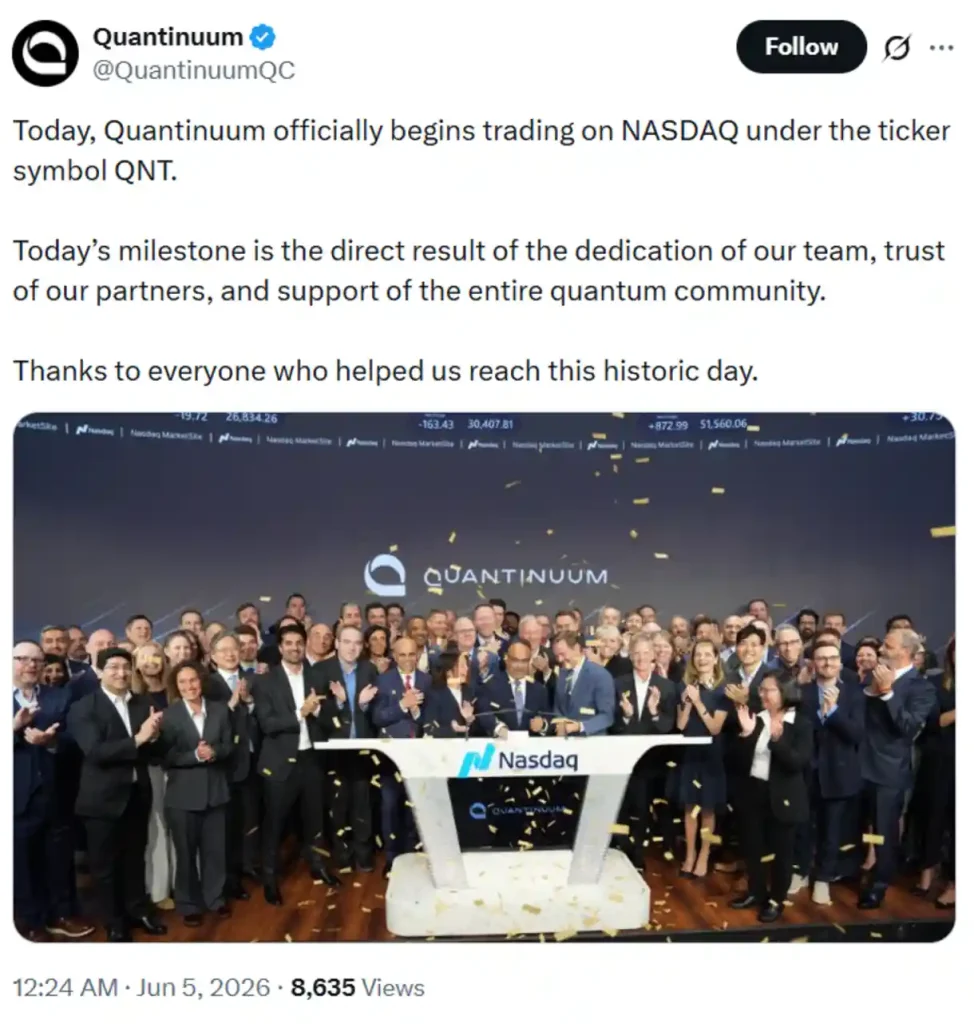
Quantinuum started trading on the Nasdaq on June 4, after pulling in $1.68 billion through its initial public offering. The Broomfield, Colorado company, which now trades under the ticker QNT, sold just about 28 million shares at $60 each, landing it a valuation somewhere around $14 billion to $15 billion. That makes it one of the largest quantum computing IPOs anyone’s seen.
Quantinuum’s IPO Sets a Benchmark for Quantum Stocks
Demand ran hot. According to a June 3 report, Quantinuum priced its shares above an already-bumped marketing range on that day, a sure sign that buyers wanted in on a company many analysts treat as one of the more grown-up players in a still young field.
The timing totally helps, and here’s why. These days, investor appetite for AI and frontier tech has revived a U.S. listings market that struggled for years. Founding shareholders praised the moment.
Zeynep Koruturk and Kris Naudts of Firgun Ventures, early backers of Cambridge Quantum Computing, said in a statement that quantum is “moving from the theoretical to the practical; from the labs to the enterprise.” They credited founder Ilyas Khan and the engineering team behind what they called one of the industry’s leading full-stack quantum solutions.
“As early angel investors, we have had a front row seat to the hard work and dedication of the management team at Quantinuum that has already made the company the largest quantum technology company in terms of valuation. The company’s amazing scientific and engineering team deserves a shout out too for their discipline and commitment to developing one of the leading full-stack quantum solutions in the industry. We saw early on the vision and energy CQC founder Ilyas Khan brought to the company and congratulate him on his incredible success today. We look forward to the next phase of Quantinuum’s growth, when it fulfills its promise, accelerating quantum computing to achieve breakthroughs in healthcare and drug discovery, cybersecurity, energy, and other real-world problems.”
Analysts expect Quantinuum to act as a yardstick. The quantum sector is small in public markets, so a company this size pulls in attention from institutional investors and research firms that mostly skipped the space before. Wedbush analysts told CNBC they expect Quantinuum’s valuation and early share moves “to set the tone in the first day or two of trading, and to ripple across listed peers,” as they pointed to the strong correlation among quantum stock prices.
Backed by Honeywell, but Commercial Quantum Remains a Long-Term Bet
Quantinuum came together in 2021, when Honeywell folded its quantum division into Cambridge Quantum, a U.K. software developer. That gave it hardware and applications under one roof. The company reports rising bookings as governments, research institutions and corporations spend more on quantum, which sets it apart from many publicly traded peers that earn little revenue.
The technology still has a long way to go. Most quantum systems today are experimental, error-prone and expensive to run, and nobody agrees on when large-scale commercial use arrives. That hasn’t slowed the money. Last month, the Trump administration announced plans to take $2 billion in equity stakes across nine quantum companies, Quantinuum included.
Honeywell keeps about 48.1% of voting power after the offering. Khan holds approximately 15%, the largest individual stake, worth more than $2 billion at the IPO valuation. Honeywell’s market cap sits near $150 billion.
For a sector that’s seen wild share-price swings, Quantinuum’s debut gives investors a fresh number to measure against. Whether it holds is another question.