
NIST Tool Lets You Search Cybersecurity Frameworks in One Place


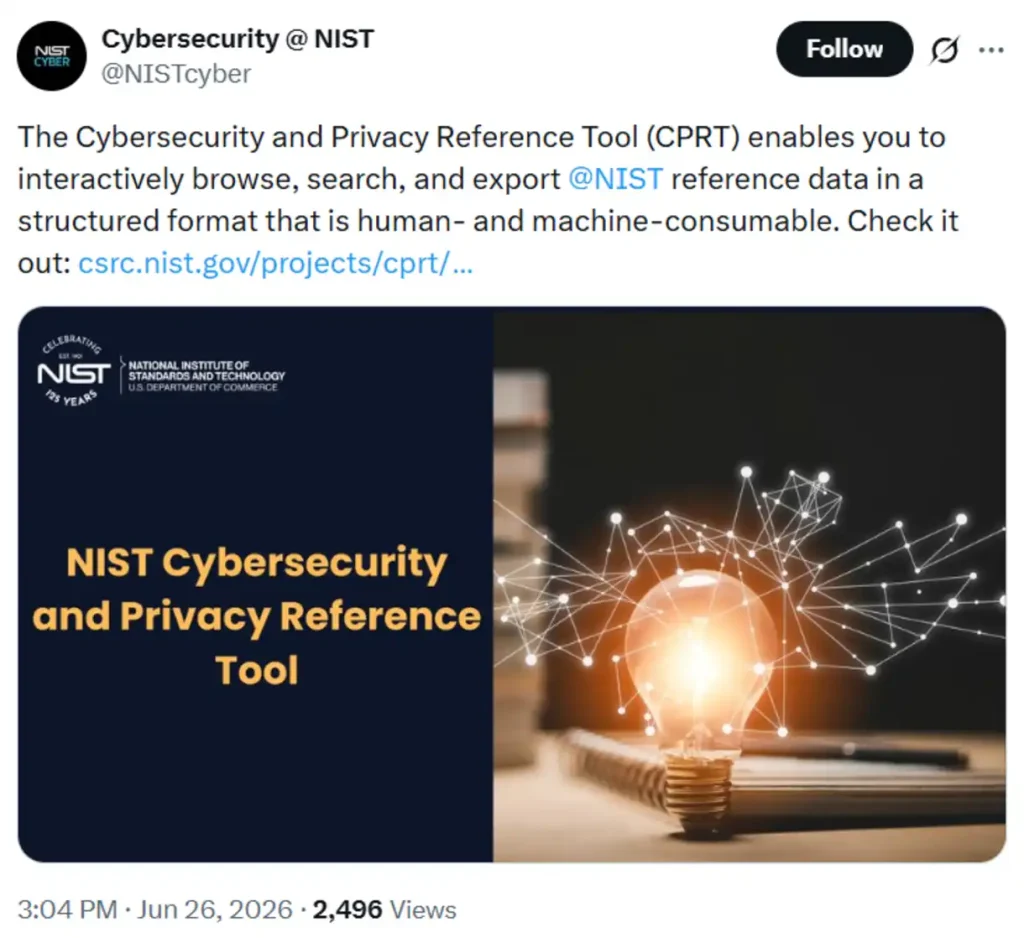
The National Institute of Standards and Technology (NIST) is promoting its Cybersecurity and Privacy Reference Tool, a web platform that lets users browse and export the agency’s reference data. NIST’s cybersecurity team shared the tool through its official X account, pointing followers to the catalog hosted on the NIST Computer Security Resource Center site. The pitch is simple. Security teams and software developers can pull NIST guidance in a format that both people and machines can read.
What the tool does
Specifically, the Cybersecurity and Privacy Reference Tool, known as CPRT, gathers NIST’s reference material into a single searchable interface. Users can filter through frameworks, controls, and related documents without digging through separate PDF files. The data exports in structured formats, which means a developer can feed it directly into other software.
That last point explains who NIST is targeting. A compliance officer might use the browser view to look up a specific control. An engineer building a security dashboard can grab the same data as a machine-readable file and wire it into an internal system. Both groups work from the same source.
The tool lives on the NIST Computer Security Resource Center website at csrc.nist.gov. Access is free and open to the public.
Why NIST built it
NIST has so far been publishing its cybersecurity guidance as long documents. The Cybersecurity Framework, the privacy framework, and the catalog of security controls each ran to dozens or hundreds of pages. Cross-referencing them meant flipping between files and tracking relationships by hand. CPRT replaces that manual work with a database you can query.
The structured export feature reflects how security work happens now. Organizations increasingly automate compliance checks and map their controls against NIST baselines using software rather than spreadsheets. A machine-readable feed of the underlying data fits that workflow.
NIST guidance carries weight well beyond the federal government. U.S. agencies often must follow it, and many private companies adopt the frameworks as a benchmark even when no law requires them to. Contractors who sell to the government frequently inherit NIST requirements through their agreements. That reach makes the reference data useful to a large audience.
The agency hasn’t announced any change to the underlying frameworks alongside the tool. CPRT repackages existing guidance and makes it easier to find. Anyone curious can open the catalog and start searching today.