
StarkWare Lays Out Plan to Shield Starknet From Quantum Attacks

StarkWare has published a three-phase plan to move Starknet, its Ethereum layer-2 network, onto cryptography that quantum computers cannot easily break. The company says parts of the network could be ready for certain quantum threats within months, though the final stage has to wait on Ethereum’s own upgrade. CEO Eli Ben-Sasson framed the work as a way to keep user funds safe whatever the quantum era brings.
What StarkWare will change
According to a June 30 post unveiling the roadmap, the first phase swaps out Pedersen hashing for BLAKE2 in state commitments, contract addresses, and network configuration. StarkWare also wants to add post-quantum consensus signatures, and Falcon-512 is one of the schemes on the list. The reason for the change comes down to how each function is built.
Pedersen leans on algebraic structures tied to elliptic curves, and those are the schemes a strong enough quantum computer could eventually pick apart. BLAKE2 sits in a different category. Quantum algorithms can chip away at a hash function’s security, but not in the wholesale way they threaten elliptic-curve signatures.
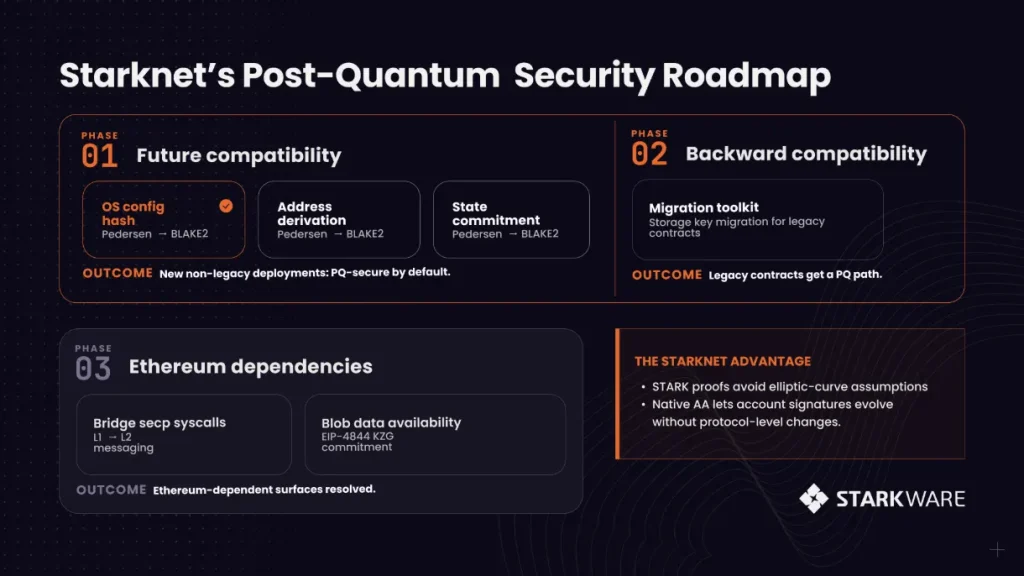
Phase two is about migration tools. Older contracts and wallets need a route to the new cryptographic schemes, and StarkWare wants that route to avoid a sudden break in compatibility for anything already running on the network.
The third phase is the one StarkWare cannot finish alone. It covers Starknet’s ties to Ethereum, including bridge system calls and data availability through blobs. Those pieces sit on the base network, so Starknet can only upgrade them once Ethereum completes its own post-quantum move. StarkWare has called the overall roadmap “the strongest” in the industry.
Why Starknet says it is ready to migrate
Starknet’s pitch rests on how it proves transactions. The network uses STARK proofs, which are built on hash functions rather than elliptic curves, and that makes them post-quantum resistant. Weak spots still exist. Pedersen hashing and the cryptography behind individual accounts both need attention.
The second point in Starknet’s favor is native account abstraction. Signature logic lives inside each account’s smart contract instead of being baked into the protocol, so wallets can switch signature schemes without forcing a network-wide hard fork. StarkWare has already shipped proof of the idea. In April 2026, Starknet developers launched S2morrow, a post-quantum wallet that runs on Falcon-512 rather than the usual elliptic-curve signatures.
Ben-Sasson has a phrase for the confidence people place in the long-term safety of elliptic-curve blockchains. He calls it an “elliptic illusion,” and he argues the industry is moving too slowly even though the cryptographic tools it needs already exist. Some in the market see the sharpest danger in quantum computing paired with AI.
Wider implications
The stakes reach well past one network. Most blockchains rely on elliptic-curve cryptography, and a powerful quantum computer could in theory work backward from a public key to a private one and drain wallets. In March, Google put a number on it, estimating that breaking 256-bit elliptic-curve cryptography would take roughly 1,200 logical qubits, far fewer than earlier figures suggested. Google plans to finish its own shift to post-quantum cryptography by 2029.
Other projects are running similar timelines. The Ethereum Foundation unveiled a quantum-security roadmap in March, with weekly tests involving more than ten client teams and core protection expected by 2029. Ripple followed in April with a post-quantum plan for the XRP Ledger targeting 2028, tested through Project Eleven. In May, developers at Quantus warned that the market is not ready for the transition, since most of it still runs on classical signature schemes such as ECDSA and Ed25519. Given enough power, Shor’s algorithm would let a quantum computer break those schemes.