
The Trusted-Node Problem: Why QKD Still Makes You Trust Someone

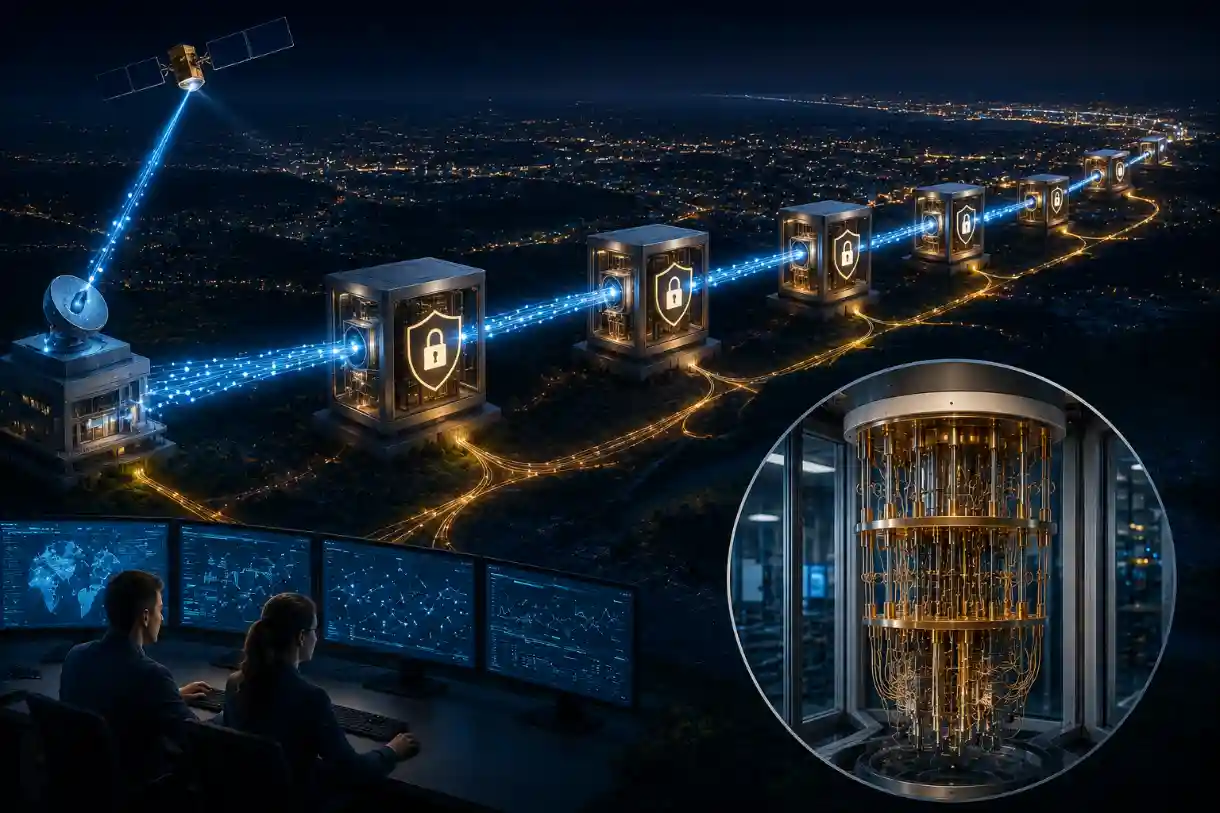
Quantum key distribution sells on a single promise. Two parties can share a secret key whose safety rests on physics, so an eavesdropper on the line can’t copy it without disturbing the signal enough for the two to notice. Over a city-scale link that promise mostly holds. Stretch it to national scale and it breaks down, because the signal can’t travel far enough on its own, and the usual fix is to pass the key through relay stations called trusted nodes.
At each one the quantum link ends and the node handles the key as ordinary classical data. It holds enough key material to reconstruct the end-to-end key, so whoever runs that box could copy it, even when the material stays locked inside hardened hardware. The word “trusted” is doing a lot of work. QKD removes the need to trust the communication line, and a relay network hands that trust straight to every relay operator instead.
For a crypto holder this counts twice over. QKD already does nothing for your wallet signatures. And even for the one job it does have, letting two endpoints establish fresh shared keys, that security stops being end-to-end the moment relays enter the path. Here’s why, and what the field is doing about it.
Why trusted nodes exist in QKD networks
QKD encodes each bit in a quantum state of light, usually a very faint laser pulse operating down at the single-photon level. Send that pulse down a fiber and it can get absorbed or scattered along the way, and the odds of it arriving intact fall off fast as the fiber gets longer. You can’t boost it with an ordinary optical amplifier the way you would a normal signal. A faithful amplifier would have to copy the unknown quantum state, and physics forbids that. It’s the same rule that makes eavesdropping detectable. Real amplifiers just add noise instead of regenerating a clean signal.
For conventional systems, a direct link stays useful across metropolitan and regional distances. Push much farther and the key rate drops steeply with fiber loss until it’s too slow to matter. To span a country you can’t just lay a longer fiber. You have to break the journey into hops and hand the key across the gaps somehow. That handoff is where trust creeps back in.
What actually happens at a trusted node
Picture a link from A to C with a relay, B, in the middle. QKD can’t reach A to C directly, so it runs two separate sessions: one that gives A and B a shared key, another that gives B and C a shared key. Node B now holds both keys. To give A and C a single shared secret, B combines its two keys, typically with a simple XOR, and sends out the result. A and C can then derive the same key, and so can B.
The catch is in that middle step. Node B has access to enough key material to reconstruct that end-to-end key, even when protected hardware processes it. A dishonest operator or a compromised relay can copy it, or quietly disrupt the exchange, and the endpoints’ quantum statistics won’t reveal it, because the betrayal happens inside a node the protocol already treats as trusted. Every relay on the path is another operator you have to trust. Operators can blunt the risk by splitting a key across several independent routes, so no single relay sees the whole thing, but that swaps total trust in each node for trust that not every path is compromised at once. Either way, the controlled sites, the protected key managers, and the insider-threat surface all climb with every hop you add.
The networks running today depend on it
This isn’t a theoretical worry. Long-distance QKD in the field runs on trusted nodes right now. China has the largest example. Its national quantum network now stretches past 10,000 km of fiber through 145 backbone nodes, relayed hop by hop by trusted relays, and it grew out of the 4,600 km space-to-ground network the country reported in 2021.
The satellite side works on the same principle. The Micius satellite set up a separate key with each ground station, then combined the two with an XOR and broadcast the result. Because it knew both keys, the satellite itself had to be trusted, a trusted node in orbit. The early research networks in Vienna and Tokyo were built the same way. Most wide-area QKD backbones in service today rely on trusted relays.
How researchers are trying to eliminate trusted nodes
Researchers have real ideas for cutting the trusted node out. Two matter most. In measurement-device-independent QKD, the middle station only performs a joint measurement and announces the result. It never learns the final key, so it doesn’t have to be trusted. Twin-field QKD is a variant of that same approach. It uses single-photon interference at an untrusted central station to push secure distance much farther, and a twin-field link has already carried keys over 511 km of deployed fiber between two metro areas with no trusted relay. In the lab it has reached 1,002 km, though at that extreme the secure rate was about 0.001 bits per second.
Both are genuine progress, and both have limits. They remove the trusted station across one long span, but they don’t knit a whole continent together at a useful key rate. The clean, general fix is a quantum repeater. It would carry entanglement through the intermediate stations without ever handing them the final key, so nothing on the path has to be trusted. Working repeater networks aren’t mature enough for wide-area deployment, and there’s no reliable date for when they will be.
What it means for you
Strip the trusted-node problem away and QKD is a clean physics story. Put it back and the honest version is narrower. QKD can give you an information-theoretically secure key over a single link, as long as the endpoints and the implementation hold up their end. Chain links together and you’re trusting every relay operator in between about as much as you’d trust a bank or a telecom. That’s a reasonable deal for a government wiring two of its own buildings together. It’s a much weaker pitch for anything spread across ground you don’t control.
None of which changes the wallet answer. Even a flawless, repeater-based, trust-free QKD network would still only establish shared symmetric keys between two endpoints. It wouldn’t sign your transactions. What protects your coins from a quantum computer is the move to post-quantum signatures, plus the wallet and protocol changes that move requires. QKD’s trusted-node problem is worth understanding for a different reason: it’s the quiet catch the “unbreakable quantum network” headlines tend to skip.