
Why “Unbreakable” QKD Still Gets Hacked

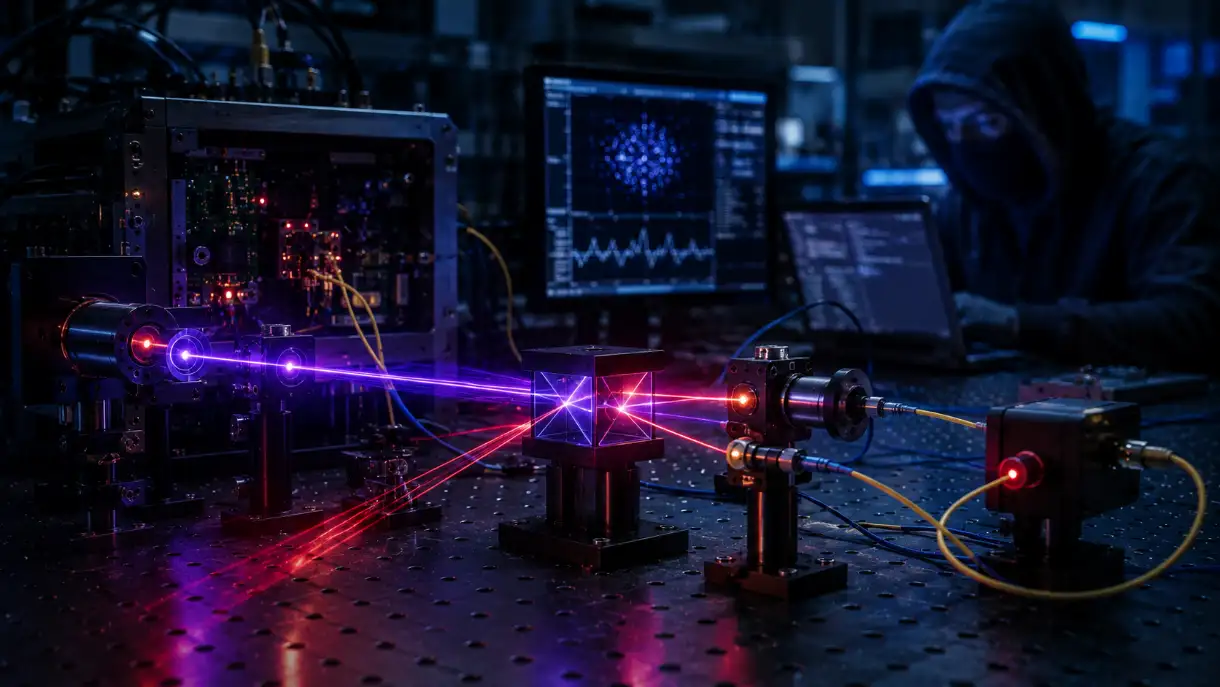
Quantum key distribution (QKD) comes with a bold sales line: security guaranteed by physics. The sharper version is that a QKD protocol can be proved secure, up to a defined security parameter, as long as the devices and operating conditions match the model the proof used. That’s a defensible claim, and it holds.
That said, it doesn’t cover the box on the rack, which never matches the model exactly. Researchers have taken the full key off commercial QKD gear without any monitored statistic showing a breach, by attacking the equipment instead of the theorem. The attacks don’t overturn quantum mechanics, but make the deployed device behave differently from the device the proof assumed.
That issue is a big part of why the security agencies stay skeptical of QKD, and it’s a story anyone in crypto will recognize. Most of these hacks are lab demonstrations and penetration tests rather than thefts from live networks, but they’re the reason the word “unbreakable” needs quotation marks. Here’s how they work.
The proof and the box are two different things
A QKD proof covers a specified model of the equipment. That model can already include ordinary losses, detector noise, multiphoton pulses, and other known imperfections, but only within defined bounds.
Trouble starts when the deployed source or detector behaves in a way the model left out, or when an attacker can force it outside the range it was characterized for. Bright light can turn a single-photon detector into a controllable classical sensor.
Reflected probe light can leak the internal settings. Quantum hacking is the search for mismatches like these. In NSA’s view, the security of a deployed QKD system depends on the engineering as much as the theorem.
Blinding the detector
The most famous attack turns the detector against its owner. In 2010, a team including Lars Lydersen and Vadim Makarov showed that a bright, steady beam could remotely control the single-photon detectors in two commercial QKD systems, which would open a path to traceless key theft.
A separate experiment published in 2011 carried it through against a running QKD link. The beam pushes the avalanche-photodiode detectors out of their twitchy single-photon mode into an ordinary bright-light mode, where they stop reacting to lone photons and click only when a strong pulse arrives. That hands control to the attacker.
In the usual telling, Alice is the sender and Bob the receiver, with an eavesdropper named Eve trying to slip between them. Eve intercepts Alice’s signals and sends faked bright states that make Bob’s detectors record the results she wants. From the public post-processing, she then reconstructs the same final key. None of the statistics Alice and Bob monitor, the error rate among them, reveals the breach. It worked on hardware you could buy.
Reading the device from outside
A second attack ignores the quantum signal completely. Eve shines her own light into Alice’s or Bob’s equipment and studies the faint reflections that come back, which can reveal how the device was set for each pulse. Those reflections might expose Alice’s encoded states or Bob’s basis choice, and depending on the protocol and how much leaks, that can hand Eve key bits or break the security calculation.
The countermeasures include optical isolators and input-power monitors that bound how much light can enter and return. The residual leakage still has to go into the security proof, and the protection has to be tested under deliberate high-power light, because an isolator that behaves in normal use can act differently when someone pushes it hard.
When the source sends too many photons
This one has a clean fix, which makes it the exception. In the idealized version of BB84, Alice sends one photon per pulse. A practical transmitter uses a heavily dimmed laser that now and then packs two or more photons into a pulse. Eve can skim one photon off those multi-photon pulses and forward the rest. She waits for Alice and Bob to announce their bases, then measures what she kept, learning part of the key, masked by the channel’s normal losses.
The answer is the decoy-state method. Alice randomly mixes in pulses of different brightness, and comparing how each intensity behaves lets her and Bob bound how much an attacker could have learned, then shorten or reject the key if the bound looks unsafe. Decoy states are standard now in weak-laser QKD and close this loophole when their source assumptions hold.
There’s a catch at higher power. Researchers have permanently reduced the attenuation of the optical parts that dim the pulses, making a transmitter emit more photons than its calibration claims, which invalidates the intensity bounds the decoy-state proof leans on and reopens the door unless the source is monitored live.
The arms race, and the deeper fixes
Many of these attacks prompted countermeasures, and several of those countermeasures were later probed or bypassed under different operating conditions. That back-and-forth is the normal condition of quantum hacking. Two responses try to change the game instead of trading blows.
Measurement-device-independent QKD moves the fragile measurement into an untrusted middle station, so blinding those detectors gains an attacker nothing, because nobody was trusting them to begin with. It closes the detector side channels behind blinding, though Alice’s and Bob’s sources still have to be characterized and protected.
Device-independent QKD reaches further. A Bell test lets the users certify secrecy from observed correlations without trusting a detailed model of the quantum boxes, but it still assumes secure labs, trusted randomness, authenticated communication, and no hidden channel leaking data out of the endpoints. It’s also low-rate and demanding to build.
Certification narrows the near-term gap without closing it. In 2024, Germany’s BSI certified a protection profile setting evaluation requirements for pairs of prepare-and-measure QKD modules. It gives evaluators a yardstick, though it can’t rule out an unknown attack, and it isn’t a stamp on any finished product.
What it means for you
The lesson generalizes, and crypto already lives it. A system can be secure on paper and still get hacked in the box. QKD protocols can carry rigorous security proofs, but each proof holds only as long as the built system stays inside its assumptions, which is a big part of why the NSA and the agencies behind Europe’s joint QKD position file today’s technology under niche and steer buyers toward post-quantum cryptography. Implementation flaws aren’t the only reason they cite, though they’re a large one.
The answer for your wallet doesn’t budge either. Hacked or hardened, QKD supplies key material for protecting a link between two machines. It doesn’t sign your transactions. When a quantum computer threatens those signatures, the tool is a post-quantum signature scheme the chain itself has to adopt. So, treat the QKD hacking story as the plain-language reason why “unbreakable” has quotation marks.