
Galaxy Commits $5 Million to Get Bitcoin Ready for Quantum Computers


Galaxy Digital is putting up to $5 million toward protecting Bitcoin from a threat that doesn’t exist yet. Its new Bitcoin Quantum Readiness Initiative funds developer grants, a research program, and an advisory council focused on the risk that a future quantum computer could break the cryptography securing the network. Grant applications open immediately.
What Galaxy’s quantum readiness initiative will fund
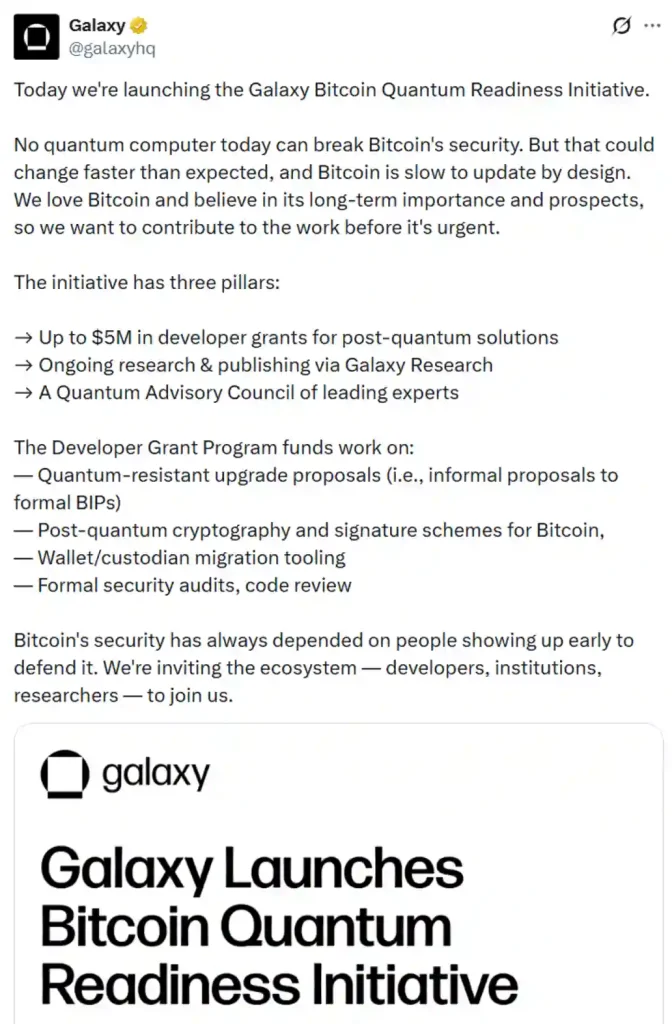
According to the July 21 press release, the initiative runs across three pillars. Grants will support quantum-resistant transaction proposals, post-quantum signature schemes, wallet and custodian migration tools, and security audits. A research arm will publish analysis of the threat for investors and policymakers. And an advisory council, including Barry Sanders of the University of Calgary and Eran Tromer of Boston University, will steer decisions. Galaxy’s research head Alex Thorn framed the goal as bridging a gap between a fast-moving quantum field and a Bitcoin development community only beginning to engage with post-quantum cryptography.
“There’s a gap between the quantum computing world, which is moving fast, and the Bitcoin development world, which is just beginning to engage with post-quantum cryptography in earnest. (…) Galaxy’s role is to bridge that gap through research that makes the threat legible to investors and policymakers, as well as grants that fund the developers doing the hardest technical work.”
Why Bitcoin’s quantum migration can’t wait
Bitcoin’s security rests on elliptic curve cryptography, which is effectively unbreakable for classical computers but vulnerable to a quantum computer running Shor’s algorithm. The particular danger is what researchers call an on-spend attack: when a transaction is broadcast, the public key is briefly visible before the transaction settles, and a fast enough quantum machine could derive the private key in that window and steal the funds.
The urgency stems from a March 2026 paper by Google Quantum AI, the Ethereum Foundation, and Stanford, which estimated that breaking Bitcoin’s cryptography may take about an order of magnitude fewer quantum resources than previously thought. One scenario put a key derivation at roughly nine minutes, inside Bitcoin’s confirmation window. These are theoretical estimates on hardware that does not yet exist. The same paper found about 6.9 million BTC sit in wallets whose public keys are already permanently exposed on-chain.
In terms of proposed solutions, BIP-360 and BIP-361 outline migration paths, but changing Bitcoin’s base protocol requires consensus among miners, node operators, and developers across the network, which takes years. Galaxy’s argument is that waiting until a capable quantum computer arrives would leave too little time to respond. As a Bitcoin-heavy firm, it also has a direct stake in the outcome.