
Why Satoshi Split 1.1 Million Bitcoin Across 22,000 Wallets


A researcher at crypto fund Bitwise says Bitcoin’s creator Satoshi built a quantum defense into the network back in 2010. André Dragosch published archival data on June 25, 2026, supporting the claim that Satoshi Nakamoto spread about 1.1 million coins across 22,000 separate addresses on purpose. The reason, according to the research, was to make any future quantum attack too costly to bother with.
A 2010 Design That Still Holds
Dragosch’s analysis, shared in an X post on June 25, backs up earlier work by analyst Marco Battistoni. Both rely on the “Patoshi pattern,” a documented fingerprint of Bitcoin’s earliest mining activity first mapped by researcher Sergio Demian Lerner. That pattern shows the creator’s coins were never pooled together. Each address holds exactly 50 BTC, and the full stash remains split across more than 22,000 of them to this day.
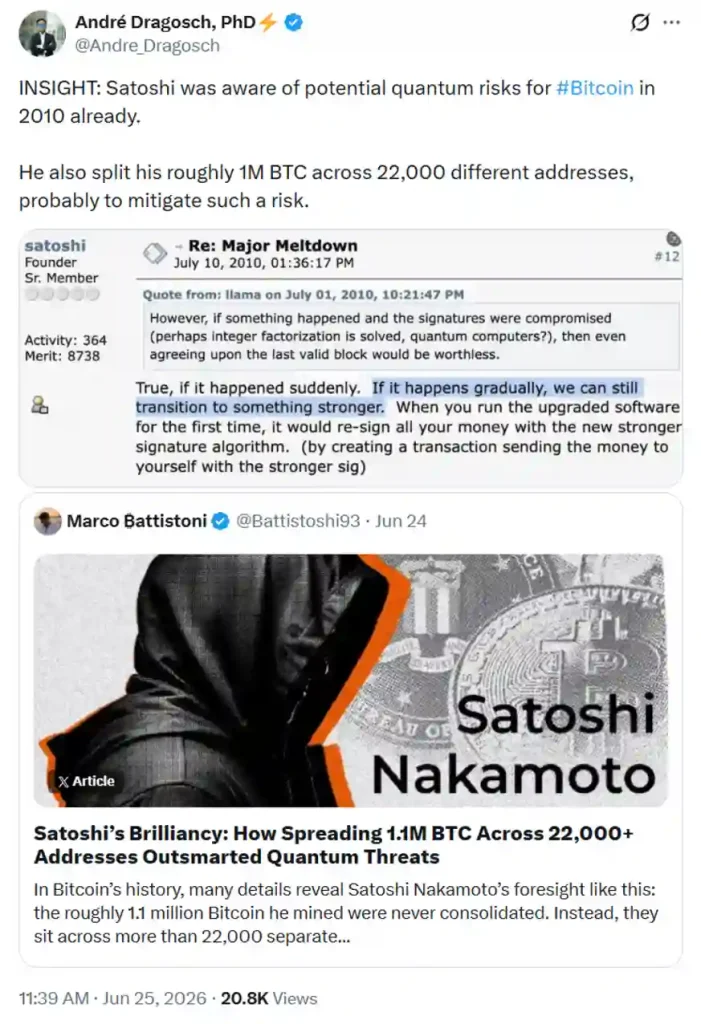
The vulnerability they point to is specific. In the first versions of Bitcoin, an address showed its public key on the blockchain the moment it was created. One giant wallet holding billions of dollars would have been an obvious prize for a quantum machine capable of cracking the cryptography. Splitting the funds removed that single target.
To drain everything, an attacker would have to break into each wallet on its own. That means running an extremely heavy computation more than 22,000 times in a row. Battistoni argues the energy, hardware, and time involved would cost more than the coins pulled out one batch at a time. The math simply doesn’t pay off for the attacker.
The Fight Over BIP-361
The findings landed during a tense split among Bitcoin developers. A proposal called BIP-361 would set a deadline for moving coins to post-quantum signatures. Any inactive Bitcoin left behind after that date would be frozen for good and pulled out of circulation. Supporters frame it as protection for the wider network.
Plenty of developers disagree. Blockstream CEO Adam Back has criticized the plan sharply. Opponents say taking away someone’s access to their own coins breaks Bitcoin’s core promise, which is that no outside authority can touch your funds.
As a counterargument, Dragosch shared a Bitcointalk forum post from Satoshi dated July 2010. Responding to user worries about cracked signatures, Nakamoto wrote, “If it happens gradually, we’ll have time to transition to something stronger.”
There’s another use for those old wallets. If holders eventually move their coins to safer addresses, Satoshi’s scattered network stays put as a passive alarm. The first attempt to break even one of these ancient addresses would signal that a working quantum computer exists. Network operators could then upgrade together, and nobody’s funds would need freezing to do it.