
Zcash’s Tachyon Upgrade Tries to Fix Private Payments at Scale

Zcash is preparing its most ambitious network change yet, an upgrade called Tachyon that aims to let shielded payments grow to thousands per second. The project, led by cryptographer Sean Bowe, went live on a public testnet on May 22, 2026, with mainnet activation expected within weeks from now. According to a CoinDesk Research report commissioned by GenZcash, the upgrade also closes a long-standing weakness against future quantum attacks.
Why scaling encrypted money is so hard
Per the July 1 report, in a transparent blockchain, a wallet asks a server what belongs to a public address and gets an answer instantly. Shielded wallets can’t do that without giving away the privacy they exist to protect. So Zcash wallets have downloaded encrypted outputs and trial-decrypted each one to find their own funds. That cost climbs as the network grows, and every new user slows sync for everyone already there.
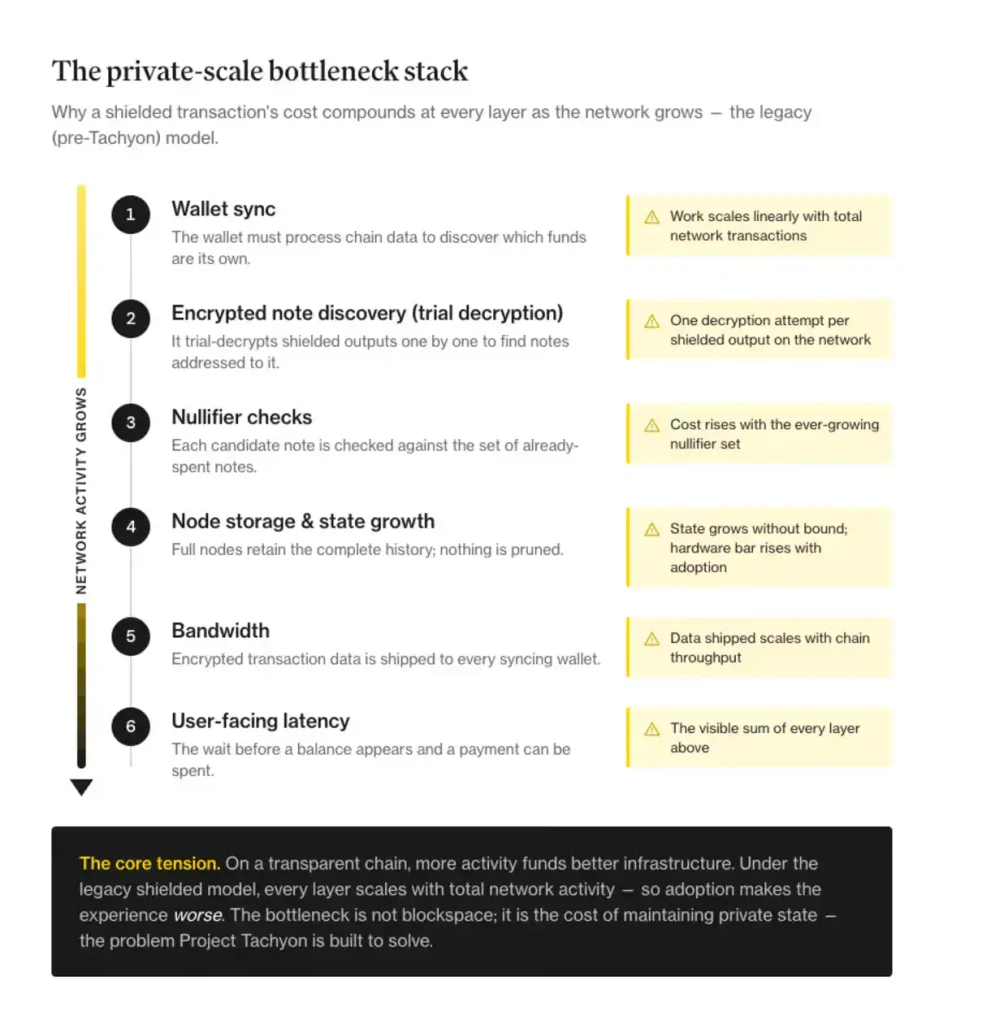
Tachyon rewrites how wallet state works to solve this. Each wallet carries a recursive proof of its own balance, so it attaches evidence of solvency at spend time instead of asking the network to recheck the entire chain history. Full nodes then stop keeping the complete record. They retain the tags that prevent double-spending for a recent window of blocks, then discard older data. Node storage stops swelling without limit, and the hardware needed to run Zcash infrastructure drops.
The recursive proofs run on a Rust framework called Ragu, which the team says is under heavy development and not yet audited. Zcash reports that testnet shielded transactions are several times faster than before. In a February 2026 sentiment poll, Tachyon drew near-universal support across every voting group, which the Zcash Foundation called the clearest signal of the entire process.
Quantum risk and a live security test
Zcash isn’t quantum-safe, and its engineers say so plainly. Founder Zooko Wilcox splits the threat into two parts. An attacker forging coins only causes damage going forward. An attacker who decrypts old data exposes what users did years ago, and no patch undoes that.
Because harvested encrypted data can be stored cheaply and decrypted later, that privacy attack has, in a sense, already started. Tachyon removes readable ciphertext from the chain, cutting off the harvest. A separate proposal, ZIP 2005, gives Orchard notes a recovery path if vulnerable protocols ever need to be frozen.
The plan was put to the test in early June 2026. ZODL disclosed a fixed soundness flaw in the Orchard circuit, found by researcher Taylor Hornby during work funded by Shielded Labs. Such a bug could let an attacker mint counterfeit notes invisibly. The response introduced a new empty pool named Ironwood and submitted the plan to a community vote within a week.