
Airbus and BMW Quantum Challenge Spawns Global Competition


The joint quantum computing challenge between Airbus and BMW Group has evolved from a focused industry experiment into the foundation for a much larger international initiative. The Global Quantum + AI Challenge 2026, which opened applications in April, now invites teams worldwide to apply quantum computing and AI to industrial problems across multiple sectors. The original Airbus-BMW collaboration demonstrated that quantum methods can map onto actual engineering constraints in areas like aerodynamics, materials science, and logistics.
Five Challenge Areas Produced Measurable Results
Specifically, the original Airbus-BMW challenge was structured around five distinct problem areas drawn from the mobility sector. Research teams and industry participants worked on tasks tied to real engineering bottlenecks rather than abstract proofs of concept. The results, as reported by The Quantum Insider on June 3, showed that quantum computing progress in these domains is becoming structured and directional, moving past the purely theoretical stage.
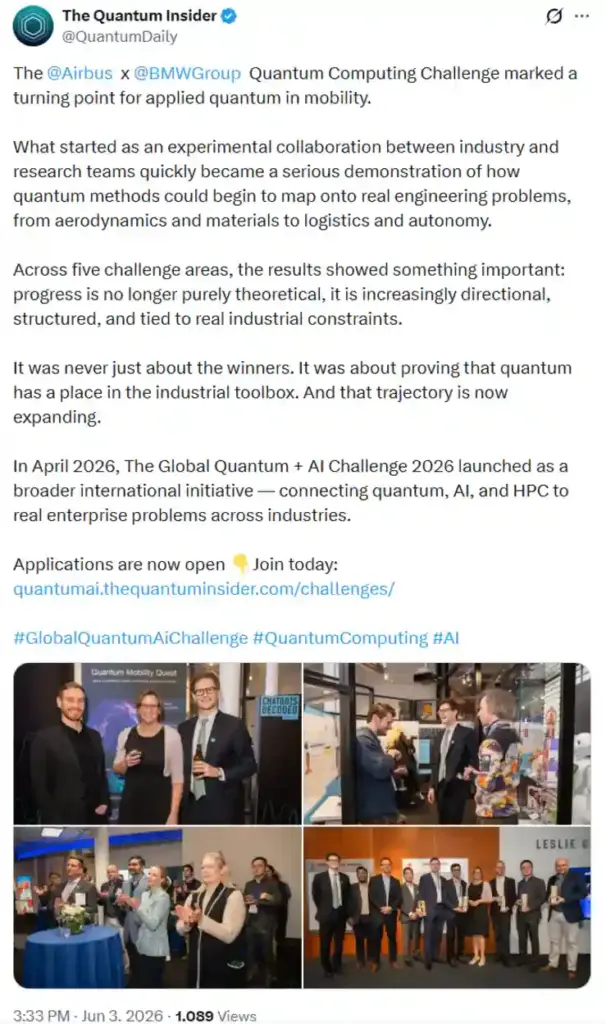
This distinction is indeed important, as quantum computing has spent years in a phase where corporate interest outpaced practical application. The Airbus-BMW challenge produced outputs that could be measured against actual industrial constraints, which gave the effort credibility that a white paper or press release can’t replicate. Teams weren’t just running algorithms on simulators. They were testing quantum approaches against problems that Airbus and BMW engineers deal with on production timelines.
New Global Challenge Expands the Scope
Building on those results, The Global Quantum + AI Challenge 2026 launched in April as an international initiative. It connects quantum computing with AI and high-performance computing, and it targets enterprise problems across industries, not just mobility.
Applications are currently open through the initiative’s website, hosted by The Quantum Insider. The competition structure appears designed to repeat what worked in the Airbus-BMW format: give research teams defined industrial problems with actual constraints, then evaluate the results against practical benchmarks.
Meanwhile, the expansion from a two-company partnership to a global open challenge signals growing institutional confidence that quantum methods belong in applied engineering workflows. Whether the 2026 challenge produces the same quality of results across a wider set of industries remains an open question. But the pipeline from experiment to structured competition to international program is now in motion, and the pace of that progression has been notably quick.