
Europe Is Building Its Quantum Computer in Public, and in Pieces

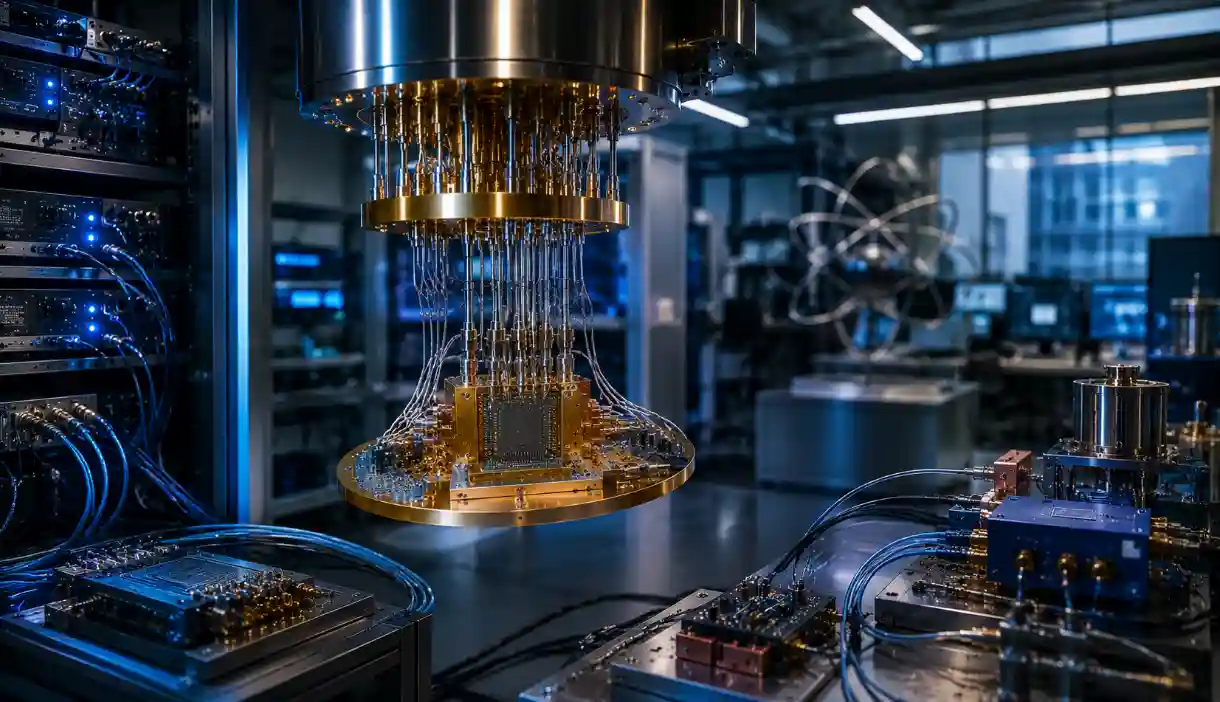
Tuna-17 has 17 qubits. The qubit count is the least interesting thing about it.
Most quantum computing news is a number contest. One company claims 100 qubits, another claims 1,000, and the reader is left to assume bigger means closer to useful. QuTech’s new machine, released through the Quantum Inspire cloud platform, invites a different question: who built the machine, and whether anyone can get in.
The answer to the second question is anyone, for free, with no usage caps. The answer to the first requires some additional attention.
A machine with no single owner
Tuna-17 was assembled, not manufactured. According to the July 10 press release, QuTech and TU Delft designed the processor and handle fabrication, cloud access, and maintenance.
TNO built the compilation layer and co-designed the chip. Orange Quantum Systems supplied the operating system and calibration software. Qblox provided the control electronics, Delft Circuits the cryogenic cabling, and QuantWare the packaging and amplifiers. Six organizations, one machine, each responsible for a layer it can sell to someone else tomorrow.
That is the argument QuTech is actually making. Most advanced quantum systems are vertically integrated, with one company owning the stack from the qubit to the software, which keeps the parts from working with anyone else’s. QuTech is betting the other way.
Its open architecture treats hardware and software layers as interchangeable components with defined interfaces, the way classical computing settled the matter decades ago. The company is going further and standing up a dedicated unit in Delft, with European industrial partners, focused on nothing but open-architecture system integration.
This is a supply-chain strategy wearing a research paper’s clothes, specifically the paper titled “Optimizing the Frequency Positioning of Tunable Couplers in a Circuit QED Processor to Mitigate Spectator Effects on Quantum Operations.” If the interfaces hold, every supplier on that list becomes a business, and Europe ends up with a quantum industry rather than a quantum lab.
The pace is the proof
Skepticism is fair. Open systems are harder to optimize than closed ones, because no single team controls every variable. So the evidence that counts is not the press release. It is the release schedule.
Tuna-17 is the third processor QuTech has shipped in a year, after Tuna-5 and Tuna-9, and Tuna-28 is already in development. That pace is difficult to fake. It suggests the modular approach lets the team improve one layer without rebuilding the rest, which is the entire point of designing for interoperability.
The machine is capable enough, too: 17 qubits and 24 tunable couplers, a universal gate set, and mid-circuit measurements, which together open the door to quantum error correction experiments and low-depth algorithm work rather than parlor demonstrations.
Access as workforce policy
The free-access decision reads like generosity. It looks more like industrial policy. Tuna-17 runs with no usage caps and supports more than 100,000 shots per job, and it is already teaching hardware in TU Delft’s quantum master’s program.
A country that lets students run real quantum circuits before they graduate is manufacturing the engineers it will need to staff the industry it is trying to create. The hardware is the visible product. The trained people are the one that lasts.
None of this guarantees the open bet pays off. A vertically integrated competitor may still post better numbers on a given benchmark, and open interfaces carry coordination costs that closed systems avoid. But QuTech has done something more useful than claim a record. It has shown that a serious superconducting quantum computer can be built by a community, run in public, and improved on a schedule. In a field that trades on promises, that is a rare thing to be able to point at.