
Quantum Computers Could Break Your Crypto – Here’s The Fix TRON Is Building


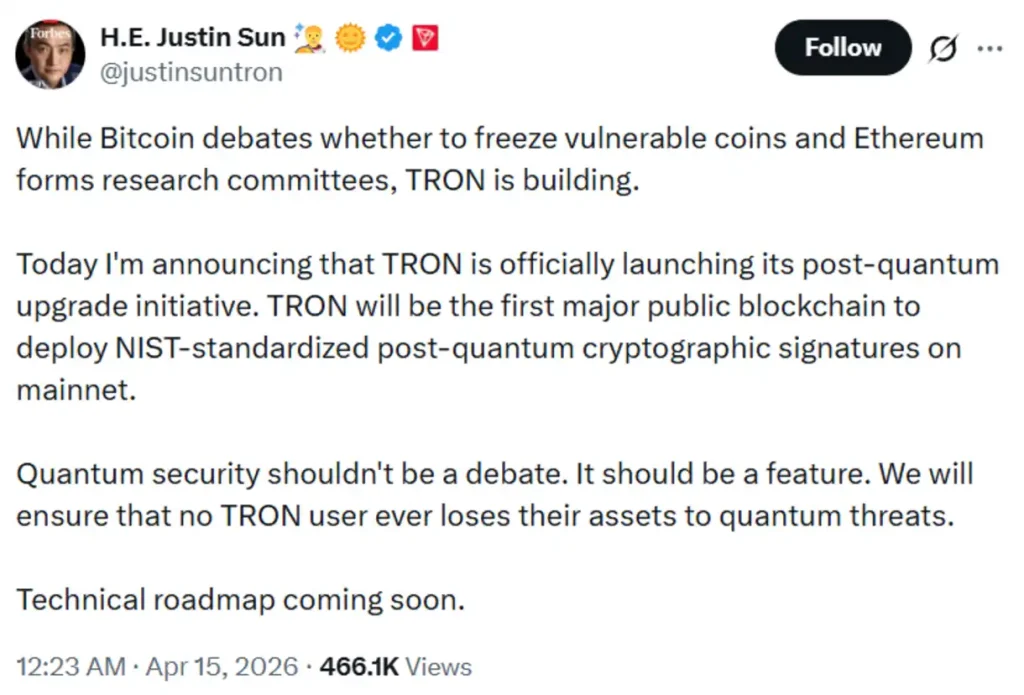
TRON wants to be the first major blockchain to put quantum-resistant cryptography on its mainnet, and Justin Sun said so publicly before any roadmap or governance proposal was out there. The threat that crypto’s entire security model rests on math a quantum computer could eventually undo isn’t speculative anymore, and a great deal of those running a chain don’t have a real plan to deal with it.
Call it the quantum readiness gap, the distance between how fast quantum hardware is improving and how slowly blockchain governance moves. That gap is the story.
What Post-Quantum Cryptography Actually Means
In simple terms, every crypto wallet alive today runs on elliptic curve cryptography (ECDSA). Bitcoin uses it. So does Ethereum, and so does TRON. The design is clean, and involves a private key generating a public key, and verifying the link between them, which is trivial, but working backward from public to private would take a classical computer forever. This asymmetry is the entire reason your funds stay yours.
But the problem is that quantum machines don’t play fair, or at least not by those same rules. Instead of grinding through one calculation after another, they test enormous numbers of possibilities at once. A powerful enough quantum computer running Shor’s Algorithm could reverse a public key into its private key in hours, not centuries.
Why Exposure Is Nearly Universal
The danger starts the moment a wallet touches the chain. Your wallet broadcasts your public key when it sends a transaction, and a hostile quantum machine with enough power could watch that broadcast and reconstruct the private key behind it. Now whoever does that controls the wallet. Almost every active wallet has broadcast at least once, so exposure is the network’s default state.
The U.S. National Institute of Standards and Technology (NIST) took this seriously enough to spend eight years building defenses. In 2024 it published two post-quantum standards, ML-DSA under FIPS 204 and SLH-DSA under FIPS 205. Both are open for any software system to adopt, blockchains included. Research out of Google’s quantum division then pulled expert timelines closer than much of the industry had been assuming.
What TRON Says It Will Build
Sun’s proposal, as described in public, would deploy those NIST-standardized signatures directly onto TRON’s mainnet. This would make TRON a pioneer, as it would literally be the first major chain to offer built-in quantum resistance to ordinary users, which is a genuine first if it ships.
The likely method is hybrid signing. During a transition window, network nodes would validate the old ECDSA signature and the new post-quantum signature at the same time. That setup lets wallets, smart contracts, and decentralized applications migrate at their own pace instead of facing a hard cutover that snaps live systems in half.
As of publication, TRON DAO hadn’t published a formal governance proposal or any detailed technical documentation. What exists is a public commitment from the network’s most visible figure, plus a promise that the roadmap follows. It also isn’t a shipped upgrade, and the difference is where the quantum readiness gap lives.
The Risks The Headlines Skip
The upgrade carries engineering problems that barely make it into the coverage. The NIST post-quantum signatures run approximately ten times larger than the ECDSA signatures in use today. Every transaction on a fully upgraded TRON would haul substantially more data. That hits throughput directly, and throughput is no small concern for a network clearing millions of USDT transfers a day.
The migration problem cuts deeper than data size. TRON hosts some of the most financially loaded infrastructure in crypto, including USDT multisig vaults and tokenized assets like wrapped Bitcoin. Coordinating a cryptographic upgrade across validators, wallets, exchanges, and decentralized applications without opening a vulnerability mid-transition is a problem the industry has never solved at scale.
That last point deserves weight. The transition window itself becomes an attack surface. A hybrid scheme where two signature types coexist is more complex than either alone, and and added complexity widens the attack surface.
What Bitcoin And Ethereum Aren’t Doing
This is the part that gets less attention than it should. Neither Bitcoin nor Ethereum has published a formal post-quantum upgrade roadmap. Bitcoin’s developers have chewed on the problem in research forums for years, and Ethereum’s long-term plans gesture toward eventual quantum resistance, but neither chain has locked in a specific standard or a date.
Bitcoin governance moves slowly on purpose. Major protocol changes have historically taken years of argument before activation, and that conservatism has served Bitcoin well in almost every other context. The flaw shows up only against a clock. A meaningful quantum-resistant upgrade needs a runway measured in years, not months, and if the quantum timeline compresses faster than the industry expects, the chains still debating procedure are the ones holding the most exposure.
So the readiness gap is widest where the most value sits.
The Part That Should Temper The Optimism
TRON announcing before building doesn’t make the engineering easier, and the technical obstacles I described don’t shrink because a figurehead set a date. TRON has bought attention and a head start on the conversation, which has value, but the work that proves the claim hasn’t happened yet.
There’s also a quieter risk in moving early on standards this young. Post-quantum cryptography is finalized at the NIST level, yet its behavior inside a live high-volume blockchain at scale is largely untested. Being first means being the network that discovers the failure modes nobody documented. At the very least, that’s a cost worth pricing in before treating TRON’s announcement as the problem solved.
Where This Goes Next
The quantum threat won’t arrive on a press schedule. It’ll show up as a capability that exists before anyone confirms it does, and the chains that prepared early will look prescient regardless of whether their first attempt was clean. TRON has chosen to be loud about preparing. Bitcoin and Ethereum have chosen to deliberate. Both choices carry risk, and neither has been validated by anything resembling a working quantum attack.
Watch the execution, not the announcements. It’s whether TRON’s testnet actually ships in Q2 2026, whether throughput survives the larger signatures, and whether the migration runs without a single exploited window. Those outcomes will tell you more than any roadmap. The readiness gap closes only when code runs in production, not when a founder names a date, and that gap between announcement and production is where this gets decided.