
A Chinese Team Squeezed a 16-Qubit State Out of Just Four Photons

Photonic quantum computing runs on a resource that’s maddeningly hard to make: entangled photons. Photon sources are inefficient, and the chance of producing many entangled photons at once drops off exponentially, so building a machine with a useful number of qubits means fighting a scarcity problem at every step.
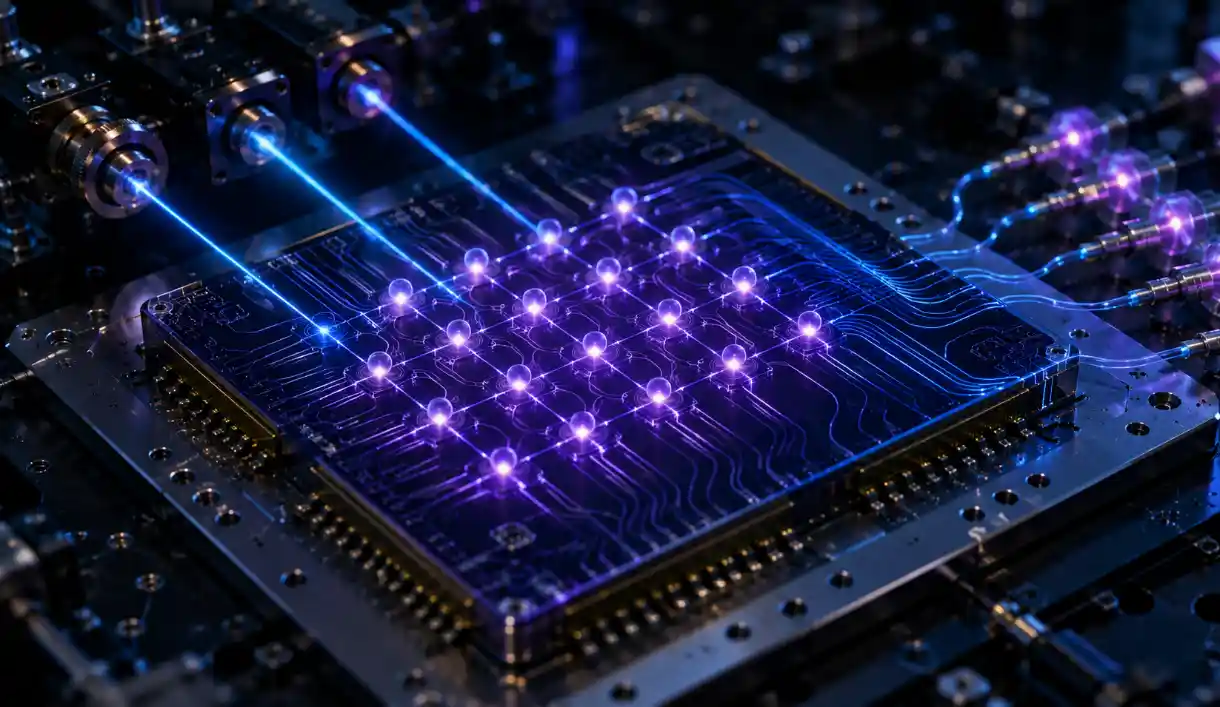
A team from the University of Science and Technology of China and the Hefei chip firm Sizhen has taken a different route around it. Instead of making more photons, they crammed more qubits onto each one, and on a programmable silicon chip they built a 16-qubit entangled state from just four photons, certifying genuine entanglement for ten of them. The work is an arXiv preprint, reported through Chinese trade media on August 10.
Why photons are scarce
Photonics is a tempting platform for quantum computing. Indeed, it works at room temperature and integrates onto silicon chips, the same platform electronics already masters. However, its weakness is that photons barely interact with each other, which makes the two-qubit gates other platforms rely on very hard to build.
Photonic machines get around that by using large pre-built entangled states as their working resource. The catch returns you to the start: those states need many photons, and many entangled photons are exactly what the sources can’t reliably deliver. Every extra photon makes the state exponentially rarer.
One photon, several qubits
The workaround is to let each photon do more. A single photon has properties, degrees of freedom, it’s possible to split them into many finely spaced levels, and those levels can encode several qubits inside one particle. The idea isn’t brand new; a Chinese group built an 18-qubit entangled state this way back in 2018 by using several of a photon’s properties at once.
The problem is that shuttling information between different properties leaks light and degrades quality, which is poison for a chip. The USTC team stuck to a single property, the photon’s path, expanded into high dimensions, and did the rest with routing and layered measurement. The authors describe the swap directly:
“The technically challenging preparation of multi-photon quantum states is replaced by single-photon operations involving high-dimensional expansion, routing, and multi-layered quantum measurement.”
That single-property approach is what makes the scheme friendlier to integrated photonic chips, where converting between a photon’s properties has been a persistent source of loss.
Compute by measuring
The other half of the work is how you compute with such a state. The team uses measurement-based quantum computing, a model where you prepare one big entangled web and then run the calculation by measuring its qubits in sequence, layer by layer. It moves the hard part from performing gates to preparing the state, which suits photonics precisely because it sidesteps the deterministic two-qubit gates photons can’t easily do.
The same idea, in its fault-tolerant form, underpins the optical machines others are chasing. As a proof, the group encoded a four-qubit cluster state on a single photon and ran Grover’s search algorithm on it, picking the right answer 98.7% of the time, on a photonic architecture built around the same cluster-state resource.
What holds up, and what doesn’t
The result deserves a careful read. This is a preprint that hasn’t yet gone through a peer-review, and the “16 qubits” are sixteen qubits packed onto four photons, with multi-qubit entanglement certified for ten of them, which the team calls the largest such state shown on an optical chip. That “on a chip” qualifier is the main part: the 18-qubit state from 2018 was larger but built off-chip, so the advance here is efficiency and integration, not a raw record.
Quality also thins as the state grows, with the measured coherence sliding from the four-qubit case to the ten-qubit one, and the ten-qubit state appears only about once every six seconds, which is slow. The company’s line that the result makes “a million-qubit optical quantum computer feasible” runs light-years ahead of a four-photon chip, the kind of scaling claim worth discounting until hardware backs it, and it lands amid a national push that rewards bold announcements.
Finally, what the paper truly delivers is quieter and useful: a resource-thrifty way to wring more entanglement out of scarce photons, on a chip, with a clean measurement-based demonstration to match. The million-qubit line is marketing. The method itself is a genuine, if early, step.