
Chinese Researchers Test Compact Quantum Magnetometer Outdoors

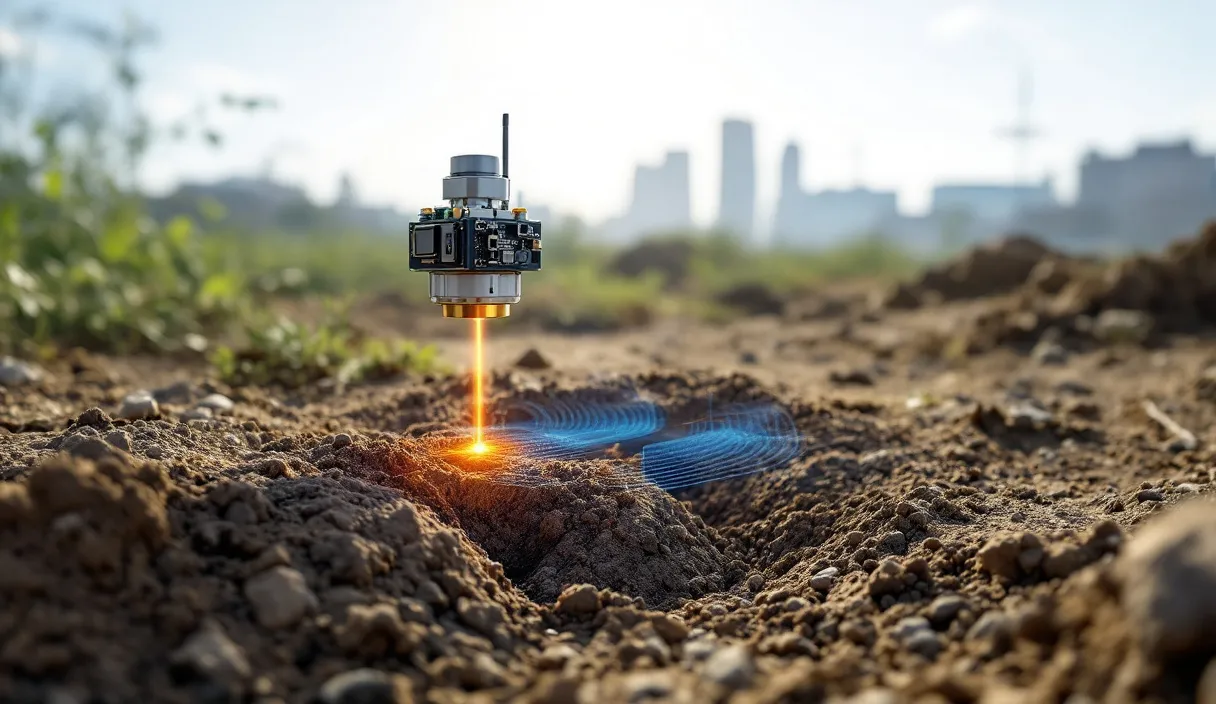
The intriguing aspect of the development you’re learn all about in the next few minutes is not simply detecting a faint signal, but doing so without being overwhelmed by the pervasive ambient magnetic field.
Earth’s magnetic field is tens of thousands of nanoteslas strong, and local fields can fluctuate by over 2,000 nanoteslas per second due to events like a passing subway train. In this context, a team in China reported on a compact quantum magnetometer that maintained its stability amidst these disturbances, yielding valuable readings.
Unlike a metal detector that indiscriminately beeps at any metallic object, this device measures the actual magnetic field, identifying anomalies against a much larger background. The challenge lies in distinguishing a tiny anomaly from an enormous background signal.
What the Test Actually Demonstrated
The research came out in Acta Physica Sinica, a peer-reviewed journal. The English version was machine-translated. Though the underlying paper underwent peer review, the coverage draws on this translation and press accounts, including the South China Morning Post. This attribution focuses on the study itself, naming the journal and affiliated institutions rather than detailing individual test executors.
The scope of the work included three outdoor field experiments and laboratory calibration, not a deployed system or a submarine trial, despite researchers mentioning anti-submarine warfare as a potential application. The paper does not report any underwater tests or military detection ranges.
How the Sensor Reads a Field
The instrument measures magnetic fields by observing their effect on rubidium atoms. Laser light prepares atoms within a small vapor cell. A radio-frequency field then brings these atoms into resonance, matching their natural magnetic rhythm, which in turn alters their light absorption. The frequency at which resonance occurs is dependent on the surrounding magnetic field. By tracking this frequency, the field can be measured.
The atoms serve as the reference. The laser and electronics monitor the response of this reference. Miniaturizing the system introduced challenges. A smaller cell contains fewer atoms, increasing collisions with the walls, which disrupts their behavior. The team finely tuned the feedback mechanism to maintain performance without introducing excessive noise.
The recovery mechanism is particularly ingenious. When the magnetic field changes faster than the electronics can respond, the system loses its “lock,” meaning it can no longer maintain the resonance required for a valid reading. It monitors a light signal at twice the modulation frequency to detect this failure. If the signal drops below a set threshold, it ceases tracking and scans to re-establish resonance. This process is managed by fewer than 30 lines of logic, effectively performing the role of a highly attentive assistant.
Key Numerical Details
- Sensing probe: 3 cm x 1.5 cm x 1.5 cm, approximately 7 cubic centimeters, roughly the size of two dice placed side by side. The rubidium vapor cell inside is 4 mm per side.
- Full system power draw: Approximately 5 watts steady, with separate control electronics.
- Recovery time: Under one second after strong interference is removed.
- Measured noise floor: Approximately five million times smaller than the background field used in tests, established within magnetic shielding.
- Bandwidth: 41.4 hertz, indicating the maximum frequency at which a repeating signal can vary before the response weakens.
- Field events: Included a G4-class geomagnetic storm on June 1, 2025, subway train activity from the surface, and the detection of a buried magnet within a 40-by-25-meter farmland plot.
The evidence does not provide a raw sensitivity figure in fT/√Hz or pT/√Hz, so that specific detail cannot be provided. The magnet was buried approximately half a meter deep, and its location was unknown to the searchers.
Why This Development is Notable
Historically, lab sensitivity has not been the primary limitation for quantum magnetometry; rather, it has been issues like movement, orientation changes, and interference. This research directly addresses these challenges.
Consider the storm test: The device recorded the G4 event, and its readings accurately matched data from the Cheongyang observatory in South Korea, part of the INTERMAGNET network, without losing lock even once. Despite different background fields, the timing and pattern were identical. This represents a robust cross-check against an independent instrument.
The subway test demonstrated the detection of a concealed moving target in an urban environment, correlated with braking and propulsion currents. The map generated from the buried-magnet test revealed the characteristic paired high-low field pattern of a magnet, and the inferred position aligned with the actual burial site. However, no numerical positioning error was provided.
What Remains Unproven
First, due credit: The integration of this size, recovery behavior, and outdoor functionality into a single working device represents a significant engineering achievement. Now, for the limitations.
The farmland chosen for the test had low interference, and the target was deliberately magnetic, not mixed buried debris or unexploded ordnance. The train test did not establish detection distance or differentiate between various hidden vehicles. There were no false-alarm rates, trial counts, or direct comparisons against commercial optically pumped magnetometers, making it impossible to quantify repeatability.
Additionally, the sensor measures magnetic components rather than total field strength, and its signal weakens at unfavorable orientations. The team plans to use a free induction decay approach to extend the bandwidth into the hundreds of hertz, indicating that the current 41.4 hertz is a known limitation.
This sensing development progresses on its own trajectory, distinct from quantum computing headlines such as QuEra’s logical-qubit roadmap on AWS or its HPE partnership for HPC. These involve different physics and promise different outcomes.
A single field test in low-interference farmland provides a data point. It is not a submarine detector, nor does the paper claim it to be. What it does demonstrate is a small atomic sensor that continues to function effectively even when external fields attempt to destabilize it. This particular challenge was significant, and the researchers have made progress in overcoming it.