
Cornell Cuts Tantalum Qubit Fabrication Temperature in Half

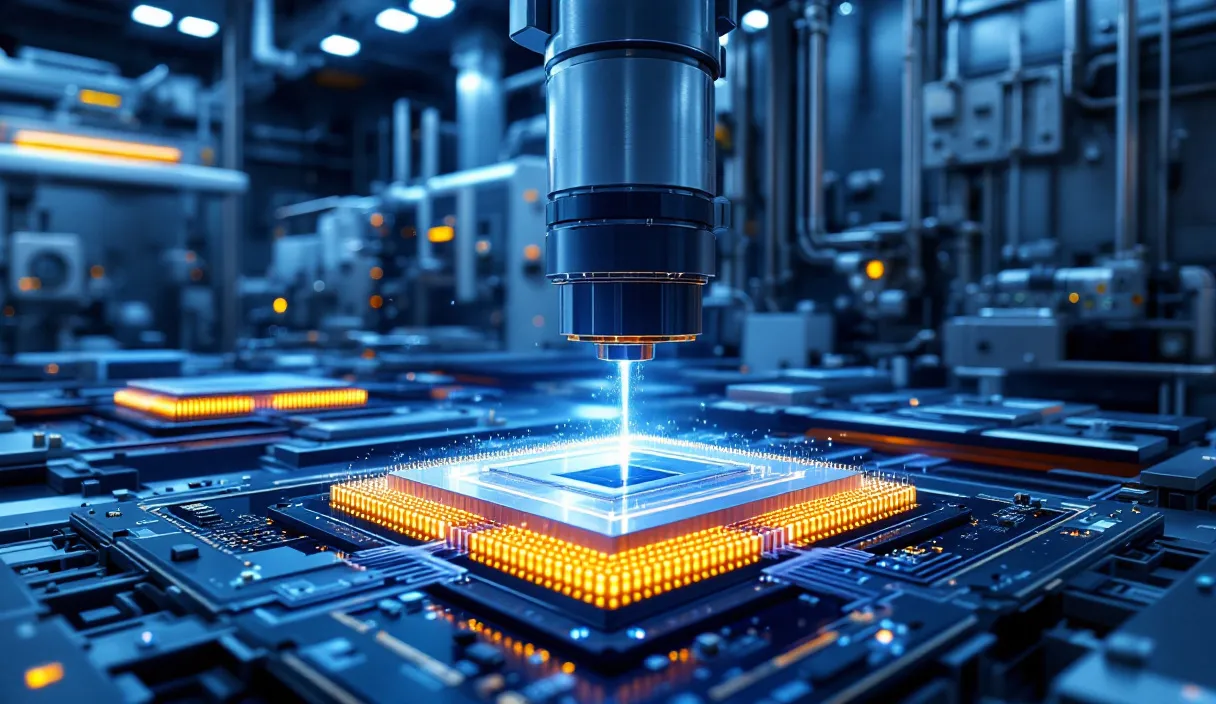
Tantalum is an excellent material for qubits. This metal resists corrosion, retains quantum information longer than most alternatives, and is highly sought after by those building superconducting quantum chips. However, its deposition presents a challenge. To achieve the desired form of tantalum on silicon, the substrate typically needs to bake above 400 degrees Celsius, a temperature many industrial fabrication tools struggle to reach.
Specifically, a Cornell team, led by applied physics professor Valla Fatemi, discovered a method to reduce this temperature to 200 degrees. The key was a single modification to the gas used during deposition. Their findings were published in Nature Materials on August 18, confirming this as a peer-reviewed result.
The problem: Crystal structure, not just the metal
Indeed, tantalum can form in multiple crystal patterns. Only one of these patterns offers the properties quantum engineers require. The other phase detrimentally affects device performance and is the one tantalum typically adopts when deposited at lower temperatures.
Historically, there were two solutions: either heat the substrate above 400 degrees Celsius to force the formation of the desired crystal, or apply a seed layer of another material to guide atomic arrangement. Both methods work in a laboratory setting but are inefficient for large-scale production.
Furthermore, excessive heat introduces another issue. If tantalum is heated too much, it begins to mix with the underlying silicon, creating a thick, blended layer that compromises quantum information and degrades chip performance. This left a very narrow operational window: too cold resulted in the undesirable crystal, and too hot led to a silicon-tantalum mixture.
Why krypton?
The deposition technique employed here is sputtering. This process involves bombarding a slab of the target metal with ionized gas atoms. These impacts dislodge metal atoms, which then drift and form a thin film on the substrate. Argon is the standard gas for this procedure.
Postdoctoral researcher Maciej Olszewski, the lead author of the paper, had a hunch. Krypton atoms are heavier than argon atoms. Heavier atoms possess greater momentum, meaning a krypton ion striking the tantalum target would impart more energy to the tantalum atoms. This increased energy allows the arriving atoms to settle into the desirable crystal phase without requiring extreme substrate temperatures.
Essentially, the concept is to use a larger “cue ball” for a more impactful “break.” Olszewski explained the practical benefit of this temperature reduction:
“There’s this whole set of tooling and fabrication lines that don’t really go above 400 Celsius, and they’re built for that. And tantalum on silicon, when you use the old method, was right on the border of that. There was little margin to do things reliably. Using krypton brought that threshold down to 200 Celsius. So you now have this big window to be able to do reliable fabrication.”
The resulting films were not only easier to produce but also exhibited significantly higher electronic conductivity, indicating clean and well-behaved material.
The Josephson junction: A critical component
A tantalum film alone doesn’t constitute a qubit. A Josephson junction is required, which consists of two superconducting metals separated by a thin insulator. Electrons quantum-tunnel across this gap, and this tunneling effect transforms a metallic lump into a functional quantum bit.
Fatemi’s group observed that their devices had become so sensitive that minute variations in junction formation now clearly impacted performance. This is a beneficial development, as it means the rest of the chip is sufficiently stable that the junction is now the primary factor influencing performance.
Scope and limitations of this advancement
This achievement is a materials and process breakthrough. The team demonstrated high-quality qubits and world-leading film properties in an academic cleanroom, utilizing a modification designed to be compatible with equipment already present in commercial foundries. This is a tangible and measured outcome.
Still, it doesn’t imply the possibility of mass-producing quantum chips on an industrial line next quarter. This process hasn’t been scaled to a foundry level, and the paper doesn’t claim otherwise. All reported results were obtained from lab-scale fabrication at Cornell facilities.
In essence, one team successfully halved a challenging deposition temperature through a gas swap, and still produced excellent tantalum qubits. The transition from a promising cleanroom recipe to a full-scale production line is a considerably longer journey than any single paper can complete.