
Cornell Demonstrates Standing-Wave Cooling for Trapped Ions

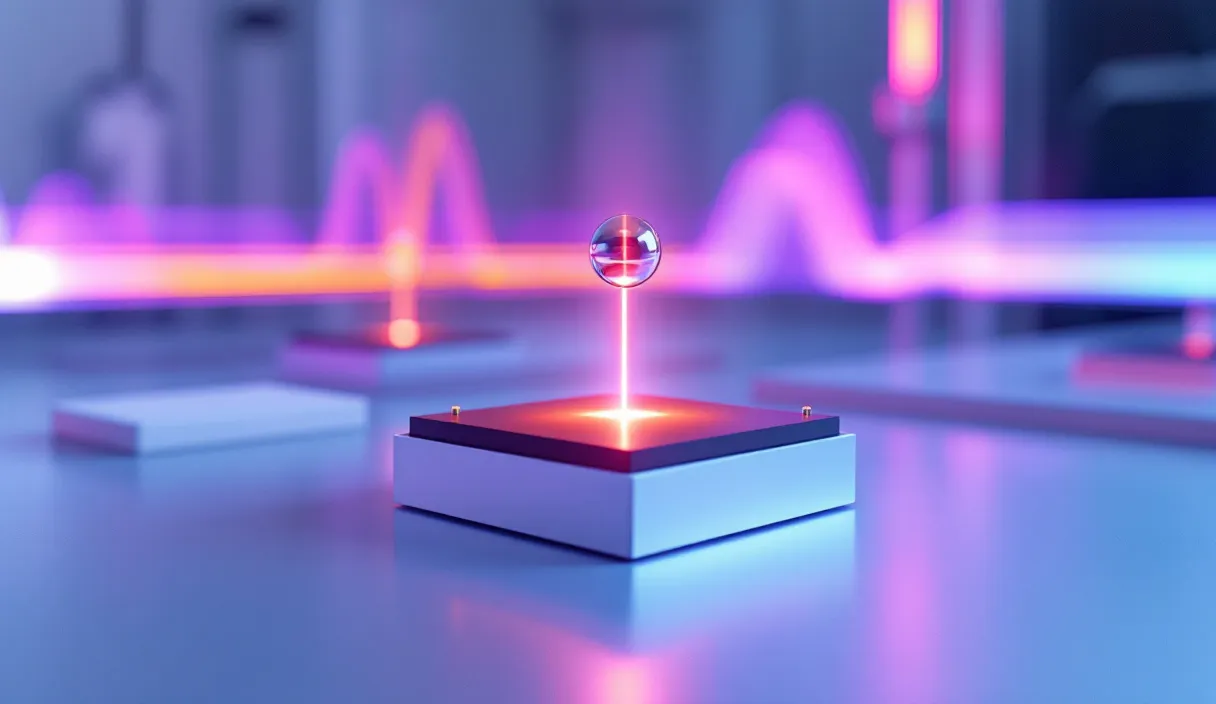
The Cornell team achieved a counterintuitive feat: they cooled a trapped ion by positioning it in a region where laser light couldn’t directly reach it. The ion resides at a node (a dark pocket within a standing wave), yet its motion is still dissipated. This can be conceptualized as a quiet zone within a noisy environment, where the stillness itself facilitates cooling.
This achievement was reported in an arXiv preprint, submitted in December 2025 and last revised in September 2026. The group’s chip-trap design utilized Nullspace ES electrostatic simulation. This work builds upon a theoretical cooling concept first proposed in 1992, taking a significant time to realize experimentally.
A Dark Resonance That Removes Motion
Electromagnetically-induced-transparency (EIT) cooling employs a three-level atomic structure, often referred to as a Lambda configuration. Two laser fields drive an ion into a superposition, creating a “dark state” where it ceases to absorb light. The ion becomes transparent at a specific frequency. Crucially, at the edge of this transparency window, the absorption profile becomes sharply asymmetric. This asymmetry is key: the ion preferentially scatters photons that remove a quantum of vibration (a phonon) and rarely scatters those that add one. Consequently, motion is removed, and the ion remains stationary.
Traditional EIT cooling utilizes a traveling laser beam. Cornell, however, implemented it with a standing wave, a phase-stable ultraviolet field, with the ion situated at a node. The standing wave effectively nullifies the carrier transition, which is the part of the interaction that doesn’t affect phonons and primarily causes heating. What remains is a coupling almost exclusively to the ion’s motion. The paper refers to this as “carrier-nulled cooling,” a name that accurately describes its function.
Demonstrated Scope and Scale
This represents a measured result on trapped ions within a chip-scale surface trap, constructed from planar electrodes patterned on a chip. The Nullspace simulation provided the essential baseline voltage sets, axial confinement, radial mode rotation, and sub-micron positioning necessary to precisely place the ion at the node. Though these aspects were simulated, the cooling numbers derived from the experiment are measured.
The primary finding is a target-mode final occupation of approximately 0.05 phonons. This unequivocally demonstrates ground-state cooling, which means the ion predominantly resides in its lowest vibrational energy level. The technique achieved this across a bandwidth of nearly 5 MHz, indicating that a range of motional modes were cooled simultaneously.
The preprint’s abstract provides the target-mode occupation and bandwidth but doesn’t include a per-mode breakdown for every cooled mode or the full secular trap frequencies in the supplementary materials.
Key Performance Indicators
Multi-mode coverage is the core advantage. Longer ion chains possess more shared vibrational modes, which are packed closer in frequency. Each of these modes must be cooled before a high-fidelity gate operation can be performed. Cooling them one at a time is slow. A method that can cool a ~5 MHz swath simultaneously significantly alters the efficiency of a gate cycle.
The paper directly compares this technique against running-wave EIT cooling, the conventional approach. Standing-wave carrier-nulling demonstrated faster cooling, achieved lower final phonon numbers, and covered more modes. This is the benchmark stated in the abstract.
A direct comparison against resolved-sideband cooling, an older established method, is not included in the Cornell measurement itself. It does, however, appear in a related theoretical treatment of structured-light cooling, which provides context but is distinct from the experimental results.
Relevance for Scaling Quantum Systems
Cooling, while not glamorous, is a crucial precursor to engaging in interesting quantum operations, much like preheating an oven. Still, its cost escalates rapidly as ion chains grow, a scenario increasingly relevant for commercial trapped-ion ventures.
IonQ’s Q2 2026 investor release reported a 99.99 percent two-qubit gate fidelity and outlined a roadmap towards 256 qubits, with Tempo systems deploying and a ClavisXG key-distribution product in development. Every one of these gates relies on cold motional modes. A faster, wider cooling step directly contributes to achieving these fidelity targets.
The surrounding control infrastructure is also advancing. Altera and Riverlane have partnered on FPGA-based quantum error correction, which is essential for real-time decoding as qubit counts increase. EuroHPC has also initiated funding calls for trapped-ion hardware development. Cornell’s cooling result aligns with this broader technological buildout.
Furthermore, the expanding software ecosystem, exemplified by Fujitsu’s move to open-source a quantum application package, is striving to keep pace with rapidly evolving hardware.
Future Considerations
Two primary areas warrant attention. First, whether standing-wave EIT cooling can be successfully applied beyond a single ion to the longer trapped-ion chains used in commercial systems. Second, whether the precise node-positioning required for this technique can be maintained when integrated with gate operations within the same trap. A prediction from 1992 has now been experimentally verified. The question of scalability remains the next chapter, yet to be written.