
Hybrid Quantum Algorithm Beats Standard Approach on Trapped-Ion Portfolio Test


Researchers from JPMorgan Chase, Amazon Advanced Solutions Lab, AWS, Quantinuum, and 55 North Management have demonstrated a hybrid quantum-classical algorithm that solved real-world portfolio optimization problems more effectively than a standard quantum method on its own. The team posted the study on the preprint server arXiv and the work ran in part on Quantinuum’s 98-qubit trapped-ion Helios quantum computer. The researchers wanted to test whether near-term quantum machines work best as helpers to classical computers as opposed to standalone problem-solvers.
How the hybrid quantum algorithm optimized investment portfolios
The algorithm, called qReduMIS, tackled portfolio diversification. Investors generally want groups of assets that don’t move together when markets shift, which lowers the chance of losses. The team framed that goal as a Maximum Independent Set problem. Assets become nodes in a network. Highly correlated assets connect by edges, and the aim is to find the largest group of assets without strong links to each other.
Here’s how the hybrid method differs from asking the quantum computer for the full answer. qReduMIS studies many quantum measurements to spot which variables most likely belong in an optimal solution. Those “frozen nodes” get locked into place. Classical reduction techniques then simplify what’s left before another quantum calculation runs, and the process repeats until it’s done.
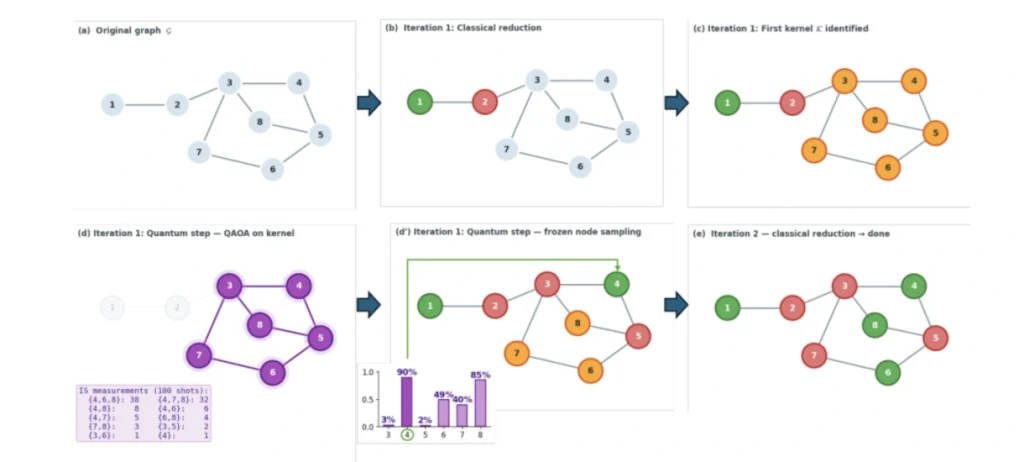
What the results mean for quantum computing in finance
The approach handled problems with as many as 225 financial assets. The largest quantum circuits used 78 qubits and more than 1,000 two-qubit gates, one of the biggest gate-based QAOA demonstrations reported on a practical optimization task.
The results favored the hybrid method. Standard QAOA failed to find the optimal solution for the two largest benchmarks, drawn from the S&P 100 and Japan’s Nikkei 225. qReduMIS solved both far more often. For the Nikkei 225 benchmark, it reached a reported success probability of 95%. The S&P 100 benchmark hit 40%. Across all four indices, which also included Germany’s DAX and the FTSE 100, average approximation ratios stayed at 0.96 or above.
On Quantinuum’s H2-1 noisy emulator, qReduMIS cut the time-to-solution scaling exponent by about a factor of 3.2 compared with standalone QAOA using two-layer circuits.
The researchers stress a limit. The study doesn’t show practical quantum advantage in investing, and simulated annealing solved most of the small benchmarks with little trouble. Today’s quantum hardware stays confined to problem sizes where classical methods still perform well. arXiv is a preprint server, so these results haven’t cleared peer review.