
Quantum Vacuum Breakthrough Could Create Matter From Nothing


A team led by researchers at Oxford and Queen’s University Belfast has demonstrated a method to amplify laser intensity by orders of magnitude using relativistic plasma mirrors, reaching 10²¹ W/cm² in extreme-UV light at the Gemini laser facility. Their approach outlines a plausible path toward the Schwinger limit of 10²⁹ W/cm², the threshold at which the quantum vacuum itself should start producing matter from nothing. If the technique scales as predicted at next-generation petawatt and multi-petawatt laser facilities, we may be within a decade of directly observing one of the most extraordinary predictions in all of physics.
The Vacuum That Isn’t Empty
Most people, including many scientists outside of high-energy physics, still think of a vacuum as empty space. It’s not. Quantum electrodynamics (QED) tells us the vacuum seethes with virtual particle-antiparticle pairs that pop into and out of existence on timescales so short they normally leave no measurable trace.
The Schwinger limit, named after Julian Schwinger’s 1951 calculation, is the electric field strength at which the vacuum can no longer contain these fluctuations. At that point, virtual electron-positron pairs become real ones, pulled apart by the field before they can annihilate each other.
The number attached to this threshold is an intensity of about 10²⁹ W/cm². For context, focusing the entire electrical output of the United States onto a pinhead would still fall short by many orders of magnitude. Nobody has come close.
This is why the result from Robin Timmis, Peter Norreys, Brendan Dromey, and their collaborators is so important. They haven’t reached the Schwinger limit. They have, however, demonstrated a physical mechanism that could plausibly get there, and they’ve shown it working in the lab at intensities that already push into unexplored territory.
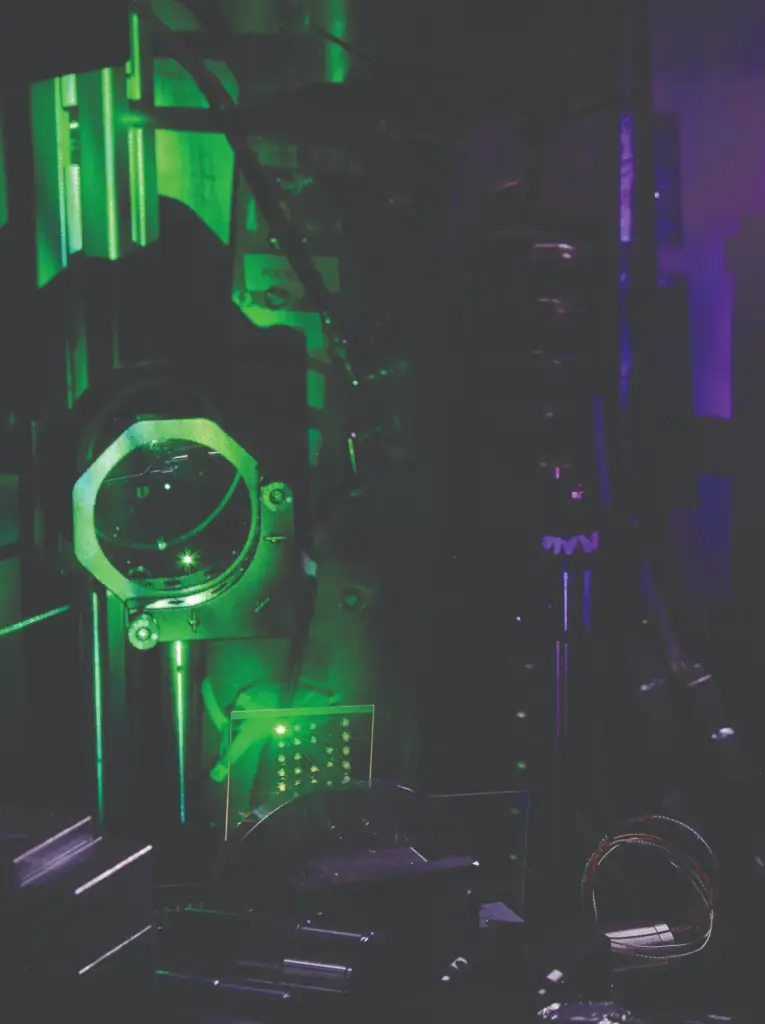
The experiment took place at the Gemini laser system housed at the Rutherford Appleton Laboratory in Oxfordshire. Gemini delivers pulses of about 5 joules lasting 50 femtoseconds, qualifying it as a petawatt-class laser. The researchers directed these pulses onto a glass target.
When a petawatt laser pulse hits glass, it ionizes the surface almost instantly and creates a plasma. Under the right conditions, the free electrons in this plasma oscillate so violently that they approach the speed of light. That is what “relativistic plasma” refers to. It means the electrons’ motion must be described by special relativity, not classical mechanics.
Coherent Harmonic Focusing
Here’s where the physics gets interesting. The same laser pulse that creates the plasma also interacts with it. That interaction generates harmonics of the original laser frequency, much the way plucking a guitar string produces overtones above the fundamental note. In the plasma case, these harmonics extend into the extreme-UV range, at wavelengths far shorter than the original infrared laser light.
Shorter wavelengths can be focused to smaller spots. If the harmonics are coherent, which means their phases are locked together, they combine into a train of attosecond pulses with a dramatically smaller focal area than the original beam. Because intensity equals power divided by area, this spatial compression translates directly into a massive intensity boost.
The researchers measured a coherent extreme-UV beam at 10²¹ W/cm². That’s already a remarkable number. Their simulations of the same interaction suggest that optimizing the process could push the output to 10²³ W/cm² using the Gemini system alone.
Previous attempts at coherent harmonic focusing ran into a stubborn problem of the harmonic spectrum decaying too rapidly at high frequencies. Without enough high-order harmonics contributing to the focused beam, the intensity gain was limited.
The researchers addressed this by engineering a specialized plasma mirror using material coatings on the glass target. A plasma mirror works as an ultrafast optical switch, and toggles between low and high reflectivity on femtosecond timescales. By tuning the reflectivity profile through careful choice of coatings, the team extended the useful harmonic spectrum significantly. More harmonics meant tighter spatial compression, which meant higher focused intensity.
Scaling Laws Favor Bigger Lasers
The coherent harmonic focusing mechanism scales with the intensity of the driving laser. Gemini operates at roughly 1 PW. Several facilities under construction or commissioning will deliver 10 to 100 times that power.
If the coherent harmonic focusing approach produces a 10²¹ W/cm² output from a 1 PW input, then a 100 PW laser applying the same technique could, according to the scaling relationships the authors describe, reach intensities relevant to Schwinger-limit physics. The jump from 10²¹ to 10²⁹ is eight orders of magnitude, which sounds enormous. But the jump from 1 PW to 100 PW is only two orders of magnitude, and the nonlinear nature of the harmonic generation process amplifies each increment in driving power.
This doesn’t mean it will be easy. Scaling arguments in laser physics have a habit of running into unanticipated barriers. Plasma instabilities, target damage thresholds, pulse contrast issues, and diagnostic limitations at extreme intensities all remain open concerns. But the path is at least visible, which wasn’t the case five years ago.
The conventional strategy for reaching extreme laser intensities has been chirped pulse amplification (CPA), which won Gérard Mourou and Donna Strickland the 2018 Nobel Prize in Physics. CPA stretches a laser pulse in time, amplifies it, then compresses it back. It’ is’s brilliant and effective, but it runs into fundamental material damage limits in the optical components that do the compression. There’s a ceiling.
Plasma-based techniques sidestep this ceiling because plasma, unlike glass or crystal, cannot be damaged by high fields. It is already ionized. The approach described by Timmis and colleagues uses the plasma itself as both the amplification medium and the focusing element. That’s the conceptual advance.
What Would We Learn at the Schwinger Limit?
QED is arguably the most precisely tested theory in all of science. Its predictions match experiment to more than ten decimal places for quantities like the electron’s magnetic moment. But those tests occur at relatively low field strengths. At extreme field strengths near the Schwinger limit, QED predicts qualitatively new phenomena, which includes spontaneous pair production from vacuum. Observing or failing to observe this process would constitute a test of QED in a regime where it has never been probed.
This matters because several proposed extensions to the Standard Model predict deviations from QED at extreme field strengths. If the vacuum behaves differently than QED predicts, that would constitute evidence for new physics. If it behaves exactly as predicted, we gain confidence in the theory’s validity across an enormously expanded range of conditions.
Fields near the Schwinger limit exist naturally near magnetars, neutron stars with magnetic fields of 10¹⁵ gauss. Astronomers observe radiation from magnetars that may carry signatures of vacuum birefringence and pair production, but interpreting those observations requires assumptions about the stellar environment. A laboratory source at comparable field strengths would allow controlled study of the same physics.
The Practical Obstacles That Remain
The authors are transparent about the gap between their current result and the target. Eight orders of magnitude isn’t a minor extrapolation. Several specific challenges command attention.
Pulse Contrast
At multi-petawatt power levels, even tiny prepulses, the faint light that arrives before the main pulse, can destroy the target or create an uncontrolled plasma before the main interaction begins. Achieving the extreme pulse contrast required for a clean plasma mirror interaction at 25 or 100 PW hasn’t been demonstrated.
Diagnostics at 10²⁹ W/cm²
Measuring an intensity of 10²⁹ W/cm² is itself an unsolved problem. At that level, any material placed in the beam path is immediately destroyed. Novel diagnostic schemes, possibly based on the pair production signal itself, will need to be developed.
Facility Timelines
The 100 PW Station of Extreme Light in Shanghai and the 25 PW NSF OPAL system at Rochester are both still under construction. Commissioning timelines for such facilities routinely slip by years. The physics described by Timmis and colleagues can’t be tested at full scale until these machines come online.
What This Means for the Field
The significance of this work lies in the specificity of the roadmap it offers. Previous discussions of reaching the Schwinger limit tended toward the aspirational. They described the destination without mapping the route. This paper establishes the mechanism’s viability and provides a framework for future experimental efforts.
The result also represents a convergence of two communities that have historically operated in parallel. This means the high-power laser community and the QED theory community. The former builds the tools. The latter knows what questions to ask. This experiment sits at their intersection.
Whether the scientific community will actually reach Schwinger limit in the next decade remains an open question, hinging on both engineering progress and the underlying physics. Nothing guarantees any of those outcomes. But the direction is clear, and the first experimental step has been taken. The vacuum may not keep its secrets much longer.