
Researchers Demonstrate Programmable Quantum Photonic Chip in Orbit

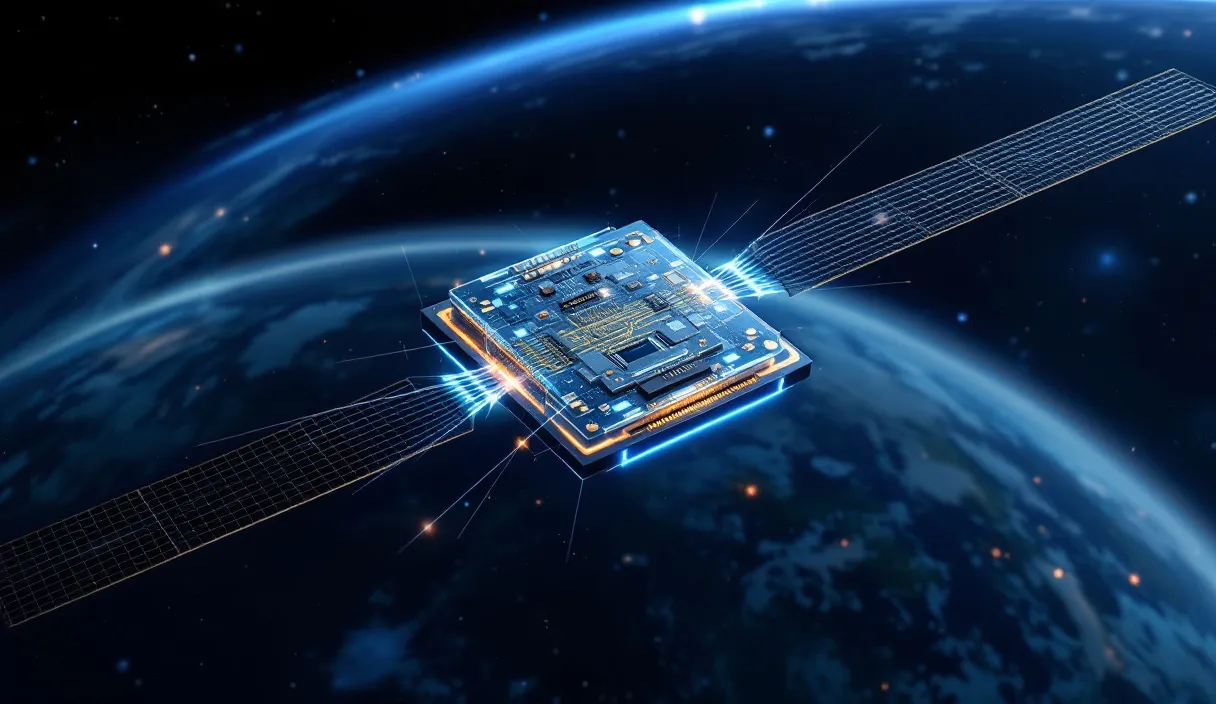
A common misconception about placing quantum optics in space is that the “quantum” aspect is the most challenging; in reality, it’s the “space” part. A collaborative team from the University of Vienna, the German Aerospace Center, and Italy’s National Research Council successfully launched a chip designed to manipulate single photons into orbit.
Strapped to a SpaceX rideshare, the chip journeyed 317 miles into space. From the ground, they remotely programmed it and observed two photons interfering precisely as predicted by quantum optics, despite the harsh conditions of radiation, sunlight, and even broken fibers.
The results are currently available on arXiv as a preprint.
A Programmable Instrument in Space
Many quantum payloads sent into space are akin to music boxes: beautiful, precise, but limited to playing a single, predefined tune. They might generate entangled light, beam it down for key exchange, or conduct a specific physics experiment, but their function is fixed after launch.
This new device, however, is a programmable instrument. Its internal circuit features a mesh of six light-carrying paths. Tiny heaters help subtly adjust the glass, allowing operators to reroute light paths remotely. This reconfigurability, enabling the same hardware to perform different functions, is the project’s most significant achievement, outweighing any single numerical result from the experiment.
Mission Details and Findings
The payload launched on June 23, 2025, aboard D-Orbit’s ION vehicle. The paper details its performance during the first eight months in orbit, demonstrating that a compact system can generate, steer, and detect quantum light even after enduring launch forces, vacuum, extreme thermal fluctuations, and radiation. The goal was not to outperform classical computers, but to prove the entire quantum optical chain remains functional outside Earth’s atmosphere.
Key findings include:
- Photons manipulated in orbit: Two, within a six-path optical circuit (measured in orbit).
- Programmability check across nine settings: An average fidelity of 0.888 achieved (measured in orbit using distinguishable photons). A fidelity of 1 signifies a perfect match between observed and predicted patterns.
- Fidelity with two miscalibrated settings excluded: 0.949 (a subset, not the full dataset).
- Hong-Ou-Mandel interference visibility: 0.908, with an uncertainty of 0.191, exceeding the classical limit by 2.14 standard deviations (measured in orbit, providing strong evidence rather than absolute proof).
- Working detectors after launch: Three out of six.
- Usable measurement window: Approximately 30 minutes per 92-minute orbit, exclusively during Earth’s shadow.
- Payload specifications: Approximately 22 pounds, 6 by 6 by 18 inches, with an average power consumption of 10 watts.
Ground-based photonic processors have reported fidelities exceeding 0.99 in select tests. Though the orbital fidelity of 0.888 is lower, a direct comparison is unfair due to the differing hardware and conditions.
Orbital Processor Functionality
The system operates by using a laser to pump a crystal, generating photon pairs. Then, optical fibers guide these photons into a glass chip containing the six paths. Heaters configure the circuit, and detectors register the photons exiting the chip.
For quantum operations, the two photons must be indistinguishable (same color, polarization, and arrival time). When these conditions are met and the photons enter opposite sides of a balanced beam splitter, they exit together through the same output. This phenomenon causes a drop in detections at two separate outputs, known as the Hong-Ou-Mandel dip, a fundamental test in quantum optics.
The team precisely tuned the crystal’s temperature to about 32.5 degrees Celsius and observed the dip exactly where ground tests predicted, successfully replicating the result on two separate days. They also performed a control experiment where no interference was expected and observed no dip, ruling out simpler explanations like signal loss.
The Impact of Space on Hardware
Space presented its own set of challenges. One detector was non-functional before launch, and two more likely suffered fiber damage during ascent. Direct sunlight bombarded the operational detectors with noise during each orbit. Radiation continuously degraded them, leading to increased dark counts, and laser power diminished due to outgassing from internal adhesives contaminating the optics. The team re-routed light to the remaining functional detectors, effectively utilizing a three-mode segment of the six-mode chip.
This list of challenges is not trivial. Effective quantum processing requires a sufficient quantity of clean measurements to extract signal from noise, a task nearly impossible within 30-minute windows using three unstable detectors. Achieving interference during favorable conditions is a milestone, but sustaining it through prolonged computation remains a distant goal.
Nevertheless, the motivation for this research is compelling. Satellites are inundated with Earth-observation data, consuming valuable downlink time to transmit it all. Processing images directly at collection sites, and only sending relevant information, could revolutionize data management.
In the long term, this photon-friendly hardware also supports space-based quantum networking. This differs from post-quantum cryptography, which is a software problem that NIST already standardized in FIPS 203, 204, and 205. This orbital flight does not accelerate that timeline.
Future Outlook
The team proposes encoding actual image data into the circuit’s programmed operations as the next step, a feat not yet achieved on such a compact chip. This advancement will necessitate improved shielding, enhanced thermal control, radiation-tolerant packaging, and detector annealing to mitigate damage. These are all engineering challenges, and engineering progress is inherently methodical.
Therefore, quantum machine learning on satellites is not imminent. What was successfully flown were two photons, three functional detectors, and a chip capable of receiving new instructions after reaching orbit. This latter achievement, small but significant, is what truly merits remembrance.