
Scientists Solve Decade-Old Topological Nanowire Mystery

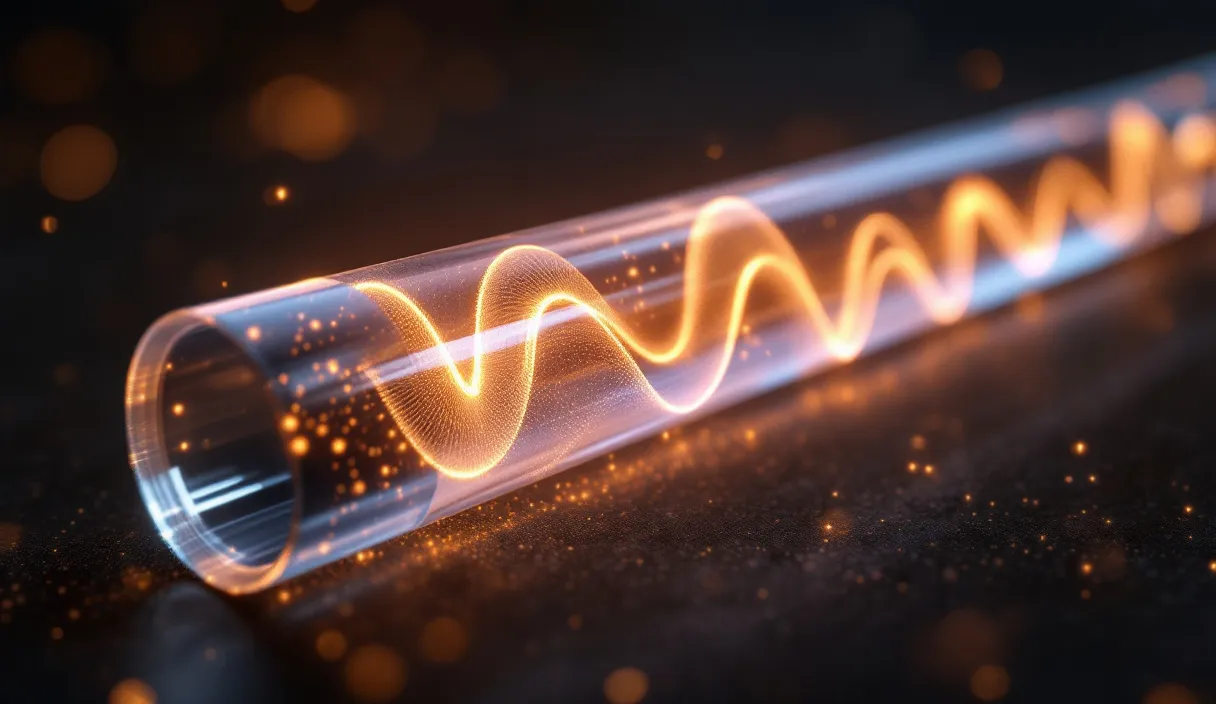
For years, a peculiar rhythm appeared in experiments on topological insulator nanowires, its origin unknown. Now, a South Korean team has identified its source: two distinct populations of electrons circling the wire at slightly different speeds. The interference between these populations creates the previously unexplained pulse. This finding was published in July in Nano Letters, Volume 26, Issue 29, and featured as the cover article. This is a peer-reviewed paper, not a preprint or proposal.
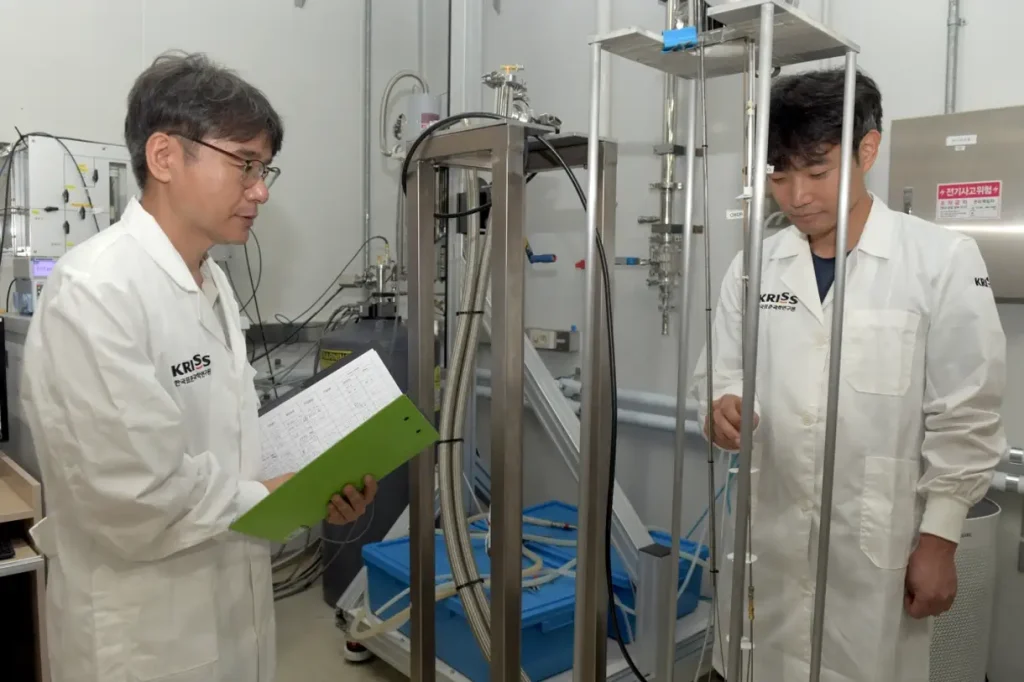
Specifically, the research was conducted by scientists from the Korea Research Institute of Standards and Science (KRISS), the Gwangju Institute of Science and Technology (GIST), and Kongju National University. Much of the initial public reporting originated from the Seoul Economic Daily.
What the wire was supposed to do, and what it did instead
Consider the material: a topological insulator. Its interior poorly conducts electricity, whereas its surface conducts exceptionally well, and hosts a protected layer of electrons not found in ordinary materials. When shaped into a thin nanowire and exposed to a magnetic field, the surface electrons circling the wire interfere with each other. Their conductivity then oscillates at regular intervals. Physicists refer to this as the Aharonov-Bohm oscillation, long considered a definitive sign of the special topological surface state.
However, real nanowires are more complex than idealized textbook examples. Doping the material can introduce a thin layer of ordinary electrons just beneath the surface. Whether this second layer also participated in the oscillation or remained unaffected was an open question. As research has shown, these systems rarely behave as cleanly as diagrams suggest.
The team wasn’t even looking for this phenomenon. They were investigating whether Aharonov-Bohm oscillations could be observed in thermoelectric measurements of an antimony-doped bismuth selenide nanowire. Instead, they discovered a beat.
Why the signal wobbled like two out-of-tune guitar strings
A “beat” occurs when two tones with similar but not identical pitches are played simultaneously. The combined sound swells and fades in a slow cycle, even though each individual tone is steady. This slow throbbing is the beat, and it indicates the overlap of two nearly identical frequencies.
The same principle applies here, but with electrons. One oscillation originates from the topological surface state. The second comes from a two-dimensional electron gas, which is the ordinary electron layer beneath the surface. Each set of electrons traces a loop around the nanowire, but these two loops enclose slightly different areas. Different enclosed areas lead to slightly different oscillation periods, and two slightly different periods superimposed on each other produce the beat.
Once this was understood, the team re-analyzed older electrical conduction data. The same beat had been present in those earlier results all along, hidden in plain sight.
How machine learning split the tangle apart
The two oscillation components had always appeared merged, which is why they hadn’t been separated previously. A group led by Professor Song Tae-geun of Kongju National University employed machine learning to disentangle these frequencies. Each frequency remained distinct even as the beat pattern shifted with changes in gate voltage, confirming that the two sources were genuinely independent rather than a single effect masquerading as two.
Theoretical calculations supported the experimental data. The observed behavior was reproduced, and the researchers subsequently confirmed the entire picture using a second, separate nanowire device. This final step transforms a mere curiosity into a trustworthy result.
KRISS principal research scientist Bae Myung-ho summarized the core finding:
“The work shows that electrons can move between topological states and ordinary electron states and still produce quantum interference.”
What this settles, and what it doesn’t
Here’s the critical implication: The Aharonov-Bohm oscillation has been a primary indicator for confirming topological surface states. This paper demonstrates that ordinary electron states can mimic this same signal. Therefore, anyone interpreting these oscillations as definitive proof of topology must exercise greater caution. This is a significant measurement issue, directly impacting quantum sensing and materials-characterization work that relies on these signatures.
GIST professor Choi Sang-jun suggested that understanding and controlling the interference between electron states could eventually contribute to designing topological quantum devices. That said, this remains a future aspiration, not a current demonstration. No qubit was built, and no device is on the horizon.
What is genuine is a clear explanation for a decade-old measurement mystery, verified across two devices and consistent with theory. What is aspirational is everything beyond that. The beat finally has a name, and that’s the complete story for now.