
Spooky Signals Survived a Trip Through Maryland’s Messiest Fiber

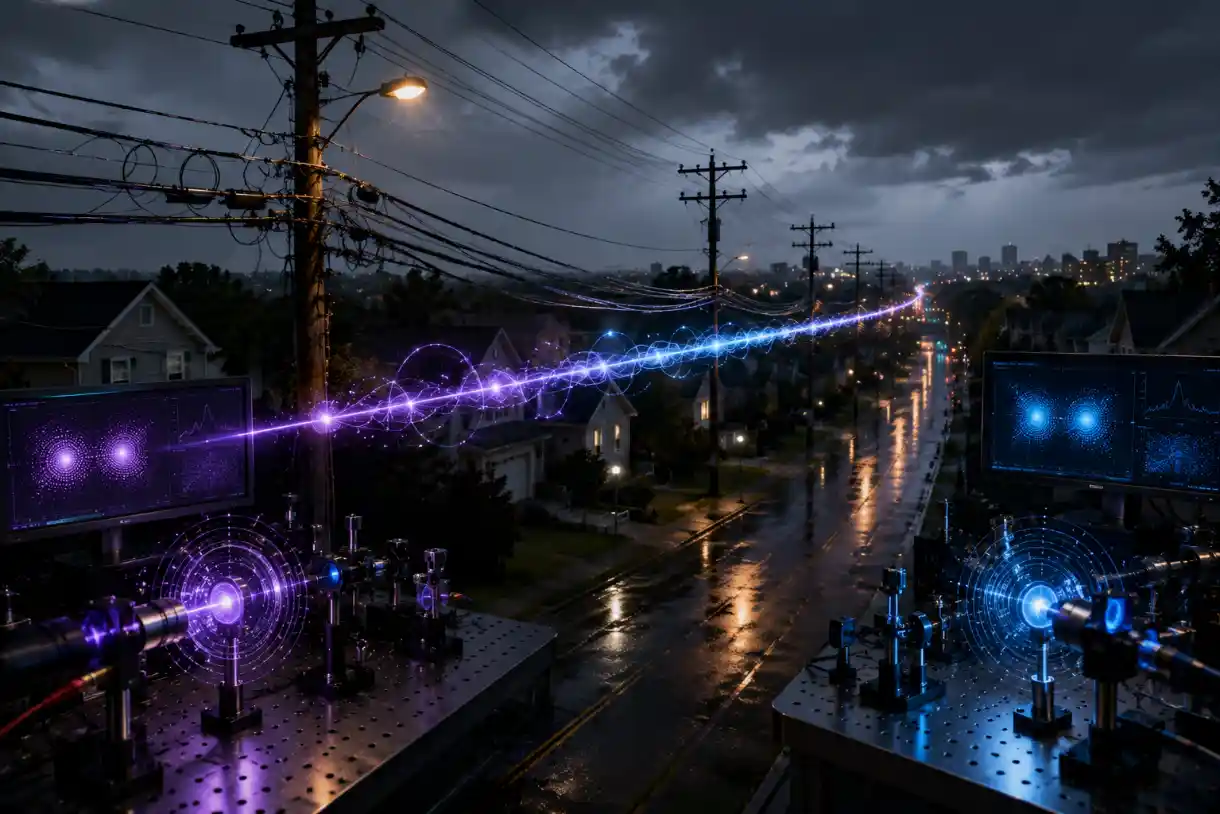
Entanglement is the strangest resource in physics and one of the most delicate. Two photons can share a single quantum state, so that measuring one instantly fixes the other, the effect Einstein dismissed as “spooky action at a distance.” That link is also fragile, easy to scramble the moment the photons leave a controlled lab.
So it counts as a surprise that a team led by NIST just sent one half of an entangled pair through 62 kilometers of ordinary above-ground fiber, the weather-beaten kind strung on poles over Maryland’s suburbs, and kept the entanglement intact for most of a full day.
The result, published in the Journal of Optical Communications and Networking, is a peer-reviewed test of whether a quantum network could ever run on the fiber that already carries the internet. Building separate fiber just for quantum traffic would cost a fortune, so reusing what’s already on the poles is the practical dream. The trouble is that those poles are a hostile place for a quantum state.
Why ordinary fiber is the enemy
Specifically, entangled states here are encoded in polarization, the direction a photon’s electric field vibrates. Classical networks don’t care about polarization; your phone calls and video streams ride on the brightness of the light, which shrugs off a shaking cable.
Quantum links can’t. As fiber heats up in the day, cools at night, sways in the wind, and takes the occasional bird, it twists the polarization of the light inside, and a twisted polarization means broken entanglement. NIST physicist Oliver Slattery, one of the authors, didn’t sugarcoat the setting:
“It’s about as bad a connection as you can possibly have.”
Indeed, that’s the point. Most entanglement demonstrations run on pristine, buried, or spooled fiber. This one ran on the kind of exposed line a real deployed network would actually use.
A fix that runs in real time
The team’s answer, built on hardware from the company Qunnect, is disarmingly clever. Alongside the entangled photons, the system sends ordinary “reference” light down the same fiber. At the far end, it measures how the fiber has mangled that reference light’s polarization, then applies the exact opposite transformation to the signal photons, undoing the damage on the fly. One photon of each pair stayed in the NIST lab for measurement; its partner traveled 62 kilometers to a second lab at the University of Maryland in College Park.
Over 24 hours, the setup delivered entangled photons 92.8% of the time, pausing only about 7% of it to recalibrate, at a rate of 1,500 entangled pairs per second. A statistical test confirmed the photons arriving at each end were still genuinely entangled.
The rate is modest, and the researchers say it would have to climb for a network to be practical, but the kind of reliability they measured is what emerging testbeds like Albuquerque’s ABQ-Net, which runs on entangled particles, will need as they sign up bona fide users.
What it proves, and what it doesn’t
This was not a distance record. A European group sent entangled photons over 248 kilometers of underground fiber back in 2022, four times farther. What sets the NIST work apart is the ugliness of the medium, above-ground line exposed to everything a working network would throw at it. Yicheng Shi, the study’s lead author, put it directly:
“I would call this a stress test of quantum networking systems. We put this to an extreme test in an environment that’s really noisy. Amazingly, it turned out it still worked.”
That framing fits a field that stays candid about its limits. A recent industry roadmap found that of 10 hoped-for quantum network applications, today’s systems can support just two, and only over short hops.
The someday part
The dream on the other side of this work is large. Entangled telescopes could combine light to sharpen images of distant planets, networked sensors could feel for the first tremors of an earthquake, and linked quantum computers could tackle chemistry no single machine can.
The most cited prize is secure communication, where any eavesdropper gives themselves away by disturbing the quantum state, and programs like the NSF’s Project Triad are trying to knit sensing, networking, and computing into one system. All of that is years out. What NIST showed is smaller and concrete: the messiest fiber on the pole didn’t win.