
Stamping Exotic Materials Onto Silicon Chips Could Unlock Better Photonics

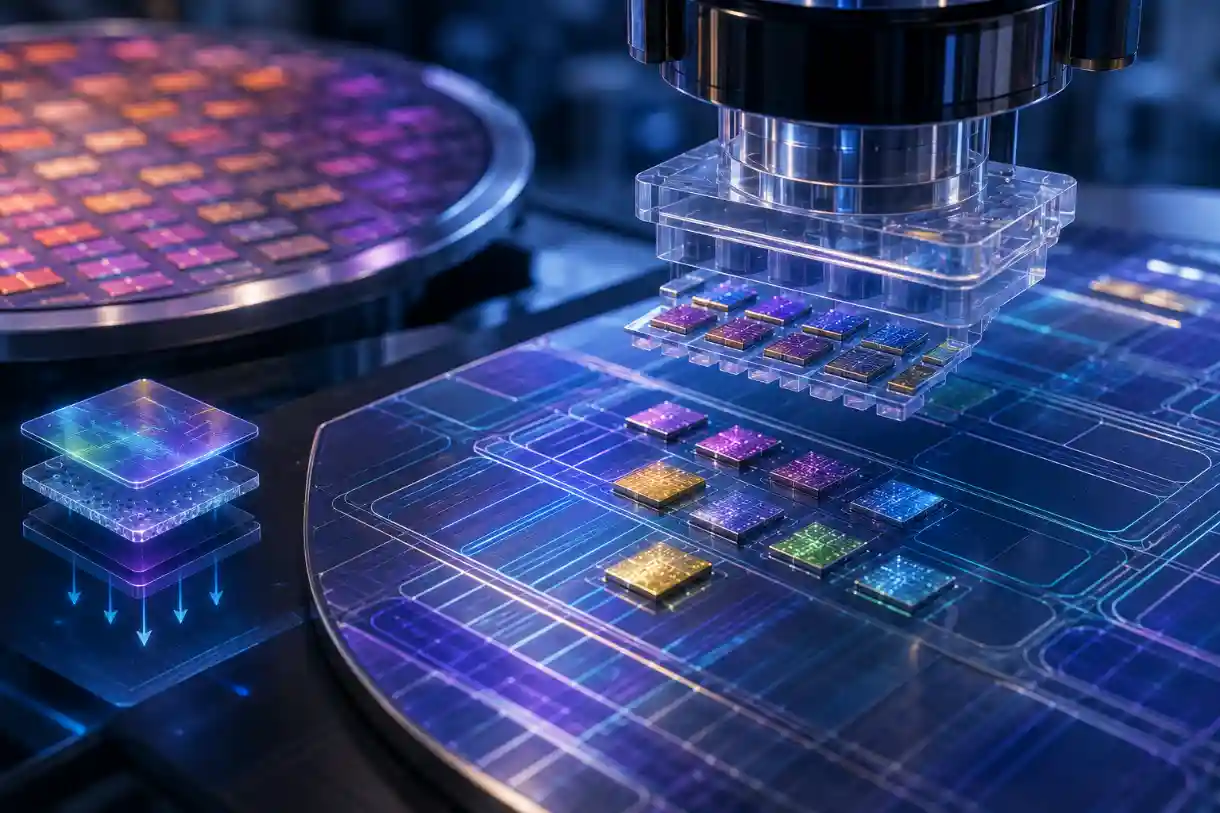
Silicon photonics has a materials problem, and researchers at Ghent University and imec think a printing technique can solve it. Their review in the Journal of Lightwave Technology makes the case for micro-transfer printing, a method for grafting materials silicon fabs cannot handle onto standard photonic chips. It matters for photonic quantum hardware, which depends on getting light sources and modulators onto scalable platforms.
Why silicon photonics needs new materials
Specifically, silicon photonics moves data with light instead of electrons, which is why it’s a popular fix for the bandwidth limits of electrical wiring in AI and telecom systems. Its advantage is that it’s possible to build it in ordinary CMOS chip fabs.
That is also its constraint. Chipmakers tune those fabs so tightly that they cannot handle non-standard materials, and silicon on its own barely generates light on a chip. Materials like indium phosphide and lithium niobate can do the jobs silicon cannot, but getting them onto a silicon wafer is the hard part.
How micro-transfer printing brings them together
According to the July 20 press release, micro-transfer printing borrows from stamping. Engineers fabricate thin-film devices, called coupons, densely packed on a source wafer, then etch away a sacrificial layer underneath to release them. An elastomeric stamp picks up many coupons at once and prints them onto a target wafer, where bonding fixes them in place.
The appeal is that engineers can build each chiplet separately, using whatever process suits it best, then combine them on a CMOS-compatible platform. Demonstrations so far include indium phosphide and gallium arsenide lasers on silicon nitride waveguides and lithium niobate modulators integrated at wafer level.
This is a review of existing work rather than a new result, and the authors are candid about what stands in the way: yield, reliability, throughput, and the lack of a mature manufacturing ecosystem. Ye Chen of Ghent University and imec calls the technology still early in commercial application.