
IBM Connects Two Cryogenic Modules for Future Quantum Systems

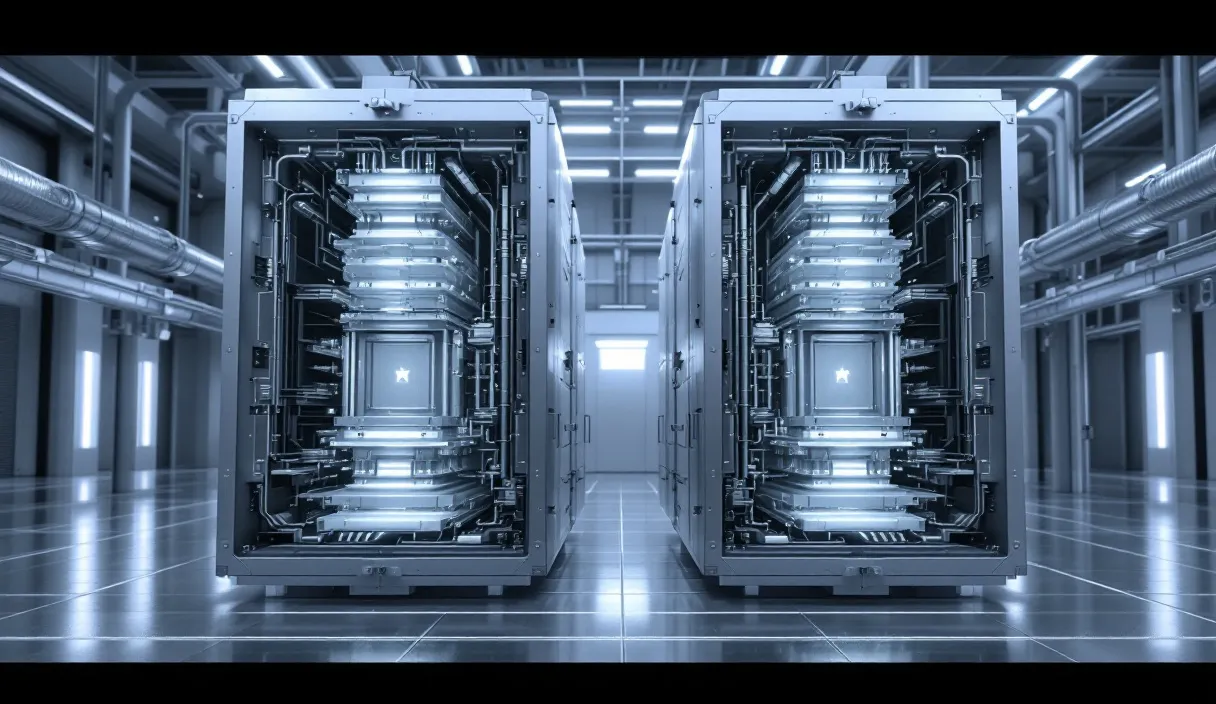
IBM has successfully linked and cooled two modular cryogenic systems within a single environment. The company describes this hardware achievement as foundational infrastructure for future fault-tolerant quantum computers. According to IBM, the two modules reached temperatures below 15 millikelvin after cooling to 4 Kelvin in under five days. This represents a significant milestone in cooling and wiring.
IBM’s achievement: What was built
The announcement, released via press statement on August 19, focuses on the plumbing and cooling aspects rather than the operational qubits. Each module is over eight feet tall and eight feet wide. IBM states that the vacuum enclosure in each module provides up to 12 times more wiring space than its most commonly used quantum systems. This expansion supports IBM’s objective of connecting more chips both within and between modules.
The box-shaped design allows modules to be arranged in a tight row, utilizing what IBM calls “L-couplers” to connect separate quantum processors for information sharing. No qubits have yet operated within this combined system.
IBM plans to integrate its Nighthawk processors into these modules later this year to commence performance testing. Until then, the current claims are based on temperature and wiring capacity.
The press release doesn’t disclose information regarding the modules’ cost, power consumption, or any error rates. Furthermore, it provides no measured performance data from the connected system, as the testing phase has not yet begun.
The roadmap guiding this development
IBM links this development to two specific future targets. By 2027, the company aims to use L-couplers to connect processors into a system featuring at least 1,000 programmable qubits. Additionally, IBM plans to introduce a machine named Quantum Starling in 2029, which it anticipates will be the first large-scale, fault-tolerant quantum computer. Both dates are projections from IBM’s published roadmap.
Jay Gambetta, Director of IBM Research and IBM Fellow, characterized this work as a component of a broader, long-term endeavor:
“Achieving fault-tolerant quantum computers for various industries relies on several fundamental advancements,” Gambetta stated. “The successful connection and operation of these cryogenic modules signify a significant step forward in that direction and will accelerate our progress, alongside ongoing innovations in quantum hardware, software, and algorithms.”
Starling was initially announced last year, coinciding with the publication of an error-correction code by IBM in Nature. The company highlights this track record as evidence of its adherence to its internal schedule. This news, therefore, adds a cooled and wired framework, awaiting the installation of chips.