
New IQM Codes Cut Quantum Errors by 1,000x


IQM Quantum Computers has unveiled a new family of quantum error-correcting codes that it says dramatically improves quantum reliability without requiring new hardware. The company claims its “directional tile codes” can reduce logical error rates by up to 1,000 times compared with today’s widely used surface codes, and they run on existing superconducting processors. This is another step toward practical fault-tolerant quantum computing, a key milestone for scaling future quantum machines.
Directional tile codes target quantum computing’s biggest challenge
Per a June 23 press release, IQM’s newly published research introduces directional tile codes, a family of quantum error-correcting codes designed specifically for processors that use nearest-neighbor connectivity.
According to the company, the approach achieves up to a 1,000-fold reduction in per-logical, per-round error rates compared with conventional surface codes, and uses a similar hardware footprint of around 30 physical qubits per logical qubit.
Unlike many proposed error-correction techniques, the new method doesn’t require additional hardware. Instead, it operates using the nearest-neighbor iSWAP gates already native to IQM’s Crystal superconducting quantum processors.
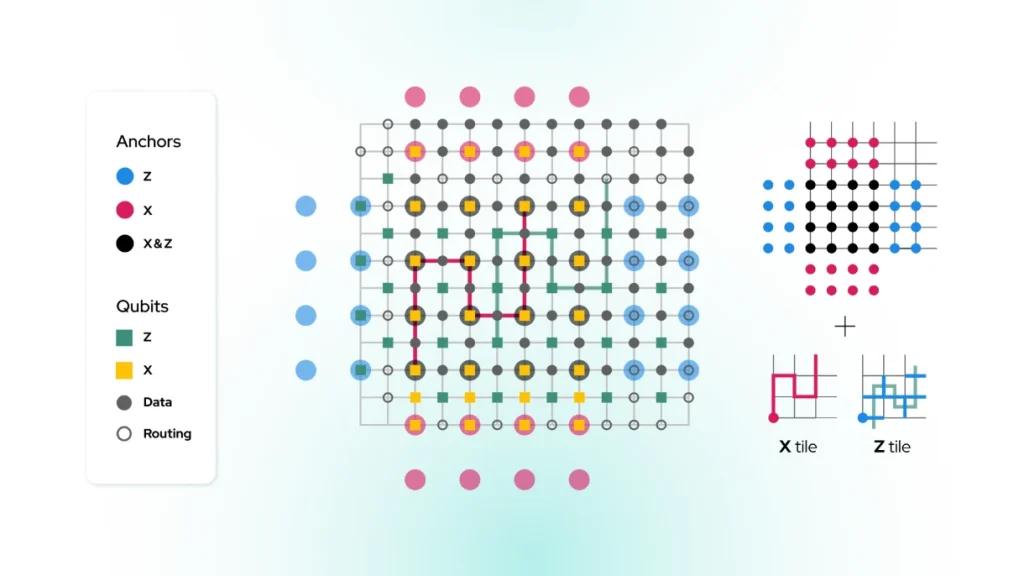
The research was co-authored by IQM scientists alongside researchers from Freie Universität Berlin, the University of Edinburgh, and Johannes Gutenberg University Mainz, and has been published on arXiv.
Supports IQM’s roadmap to fault-tolerant quantum computers
IQM said the breakthrough represents an important milestone in its long-term roadmap to achieve fault-tolerant quantum computing by 2030 and eventually scale systems to one million qubits.
Chief Scientist Dr. Inés de Vega said the work reflects the company’s strategy of co-designing hardware and quantum error-correction methods, allowing more efficient codes to run on practical processor architectures. As she said:
“Quantum error-correction codes should not only be highly efficient; they should also be implementable on scalable and manufacturable hardware architectures. A close co-design of quantum error correction and hardware is a central element of IQM’s strategy. Directional tile codes represent a breakthrough in this direction, delivering up to a 1,000-fold reduction in logical error rates on near-term-sized IQM Crystal hardware while relying only on practical nearest-neighbour connectivity. This is a significant step toward scalable fault-tolerant quantum computing.”
Senior Quantum Error-Correction Engineer Dr. Vincent Steffan added that directional tile codes enable efficient Quantum Low-Density Parity Check (QLDPC) codes on a standard square qubit grid by using dynamic syndrome extraction circuits. As he explained:
“We have been working on tile codes since 2025, as they are promising candidates due to their local checks, great parameters, and the many ways that exist to perform logical computation with them without adding connectivity requirements. The key innovation of directional tile codes is that we are using dynamic syndrome extraction circuits to implement them on a square grid.”
The company noted that quantum error correction remains one of the biggest obstacles to building useful large-scale quantum computers because fragile quantum states must be continuously protected from noise throughout calculations.
Founded in 2018, IQM has delivered 23 quantum systems worldwide to research institutions, high-performance computing centers, enterprises and national laboratories. The company is also preparing to become the first European quantum computing company listed on Nasdaq through its planned merger with Real Asset Acquisition Corp.