
GAO Finds All 24 Federal Agencies Unprepared for PQC


A review by the Government Accountability Office (GAO) found that none of the 24 major federal agencies assessed have fully completed the necessary preparations to protect their systems from future quantum attacks. Indeed, the watchdog’s public report, released on October 7 and based on a sensitive 2025 audit, examined every agency covered by the Chief Financial Officers Act. This report comes at a time when federal systems still rely on cryptography that could eventually be compromised by a sufficiently advanced quantum machine.
GAO Review Findings
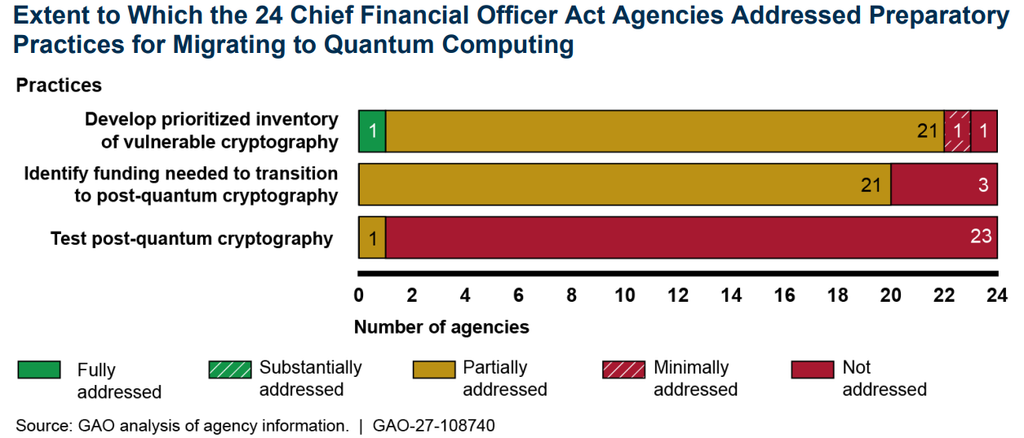
Specifically, the audit evaluated three key preparatory tasks: creating inventories of systems using vulnerable cryptography, estimating migration costs, and testing post-quantum replacements. No agency successfully completed all three tasks, which also highlights significant inconsistencies in their efforts.
- Only one agency had fully developed a prioritized inventory of vulnerable systems. Twenty-two agencies had incomplete inventories that missed some priority systems, and one agency had no inventory at all.
- None of the 24 agencies had fully assessed the funding required to migrate their priority systems.
- No agency had tested post-quantum cryptography within its own environment. One agency conducted market research on vendor options but did not proceed with testing.
- Eighteen agencies reported a lack of expertise in cryptography and inventory management, with no plans to address these deficiencies.
- Only one agency had documented a process for maintaining an up-to-date inventory. Nineteen agencies did not use automated tools to find and verify inventory data.
The Office of Management and Budget (OMB), using agency estimates, provided Congress with an approximate government-wide figure of $7.1 billion for migrating or replacing priority systems. OMB and the Office of the National Cyber Director characterized these figures as rough estimates for senior decision-makers, rather than precise budget allocations, given that vendors are still integrating new standards into products. The GAO made 89 recommendations in its sensitive 2025 report but did not add any in the public version.
The Critical Shortage of Expertise
Migrating to post-quantum cryptography involves more than just selecting an algorithm. Agencies must identify every instance of vulnerable cryptography, prioritize systems for migration, and ensure that hardware security modules and software libraries support the new replacements. This work demands staff with a deep understanding of cryptographic standards, a resource the audit indicates many agencies lack. Some inventories even incorrectly listed symmetric cryptography as vulnerable to quantum threats, which falls outside the scope of GAO’s assessment. Quantum Computing Report points to the OMB’s preparatory practices as a contributing factor to these shortcomings.
The standards themselves are established. NIST‘s signature schemes include ML-DSA and the hash-based SLH-DSA under FIPS 205, which can be implemented on conventional computers. The threat highlighted by the GAO is “harvest now, decrypt later,” where attackers store encrypted traffic with the intent to decrypt it once a quantum machine capable of doing so becomes available. A December 2024 survey of 32 experts estimated the probability of a cryptographically relevant quantum computer existing by 2040 to be over 50%. While federal capabilities lag, private sector solutions are emerging, such as BitGo’s quantum-risk wallet tools and identity schemes like TIP Protocol, demonstrating progress outside government.
For more information on PQC migration and quantum security, follow QNews.