
Ciena and Toshiba Test 1.6 Tb/s Quantum-Safe Encryption

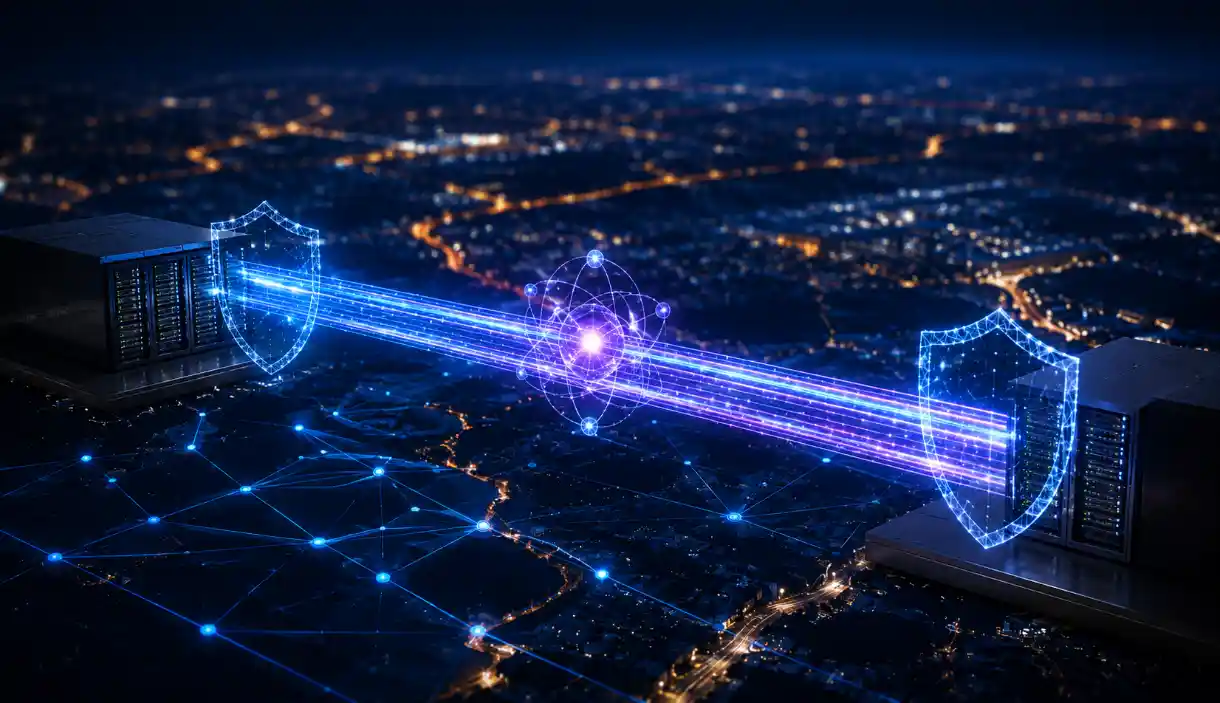
Ciena, Toshiba, and the network operator Quantum Corridor have run 1.6 Tb/s of quantum-safe encrypted traffic across a live commercial network in the US Midwest. The trial paired two different defenses against a future quantum computer, post-quantum cryptography (PQC) in Ciena’s optical gear and Toshiba’s quantum key distribution (QKD), on links between data centers in Chicago and Hammond, Indiana. It’s just a demonstration, but it shows quantum-safe encryption running at scale outside a lab.
The part that’s ready now
According to the August 4 press release, the workhorse is PQC. Ciena’s Waveserver optical platform, running its WaveLogic 6 Extreme engine, does always-on encryption at the optical layer and now supports the NIST post-quantum algorithms directly. The practical detail is the upgrade path.
Customers already running Ciena’s earlier WaveLogic 5 Extreme 800G encryption can add post-quantum support through software, with no new hardware. That makes it a low-friction way to protect data in flight against the ‘harvest now decrypt later’ strategy, the attack where an adversary captures encrypted traffic today to crack later, which is already a live concern rather than a distant one. Ryan Lafler, Quantum Corridor’s president and CTO, put the headline on it.
“By validating 1.6 Tb/s encrypted connectivity with both PQC and QKD on our live network, we’re demonstrating how we can help customers transition to a quantum secure solution while continuing to support the bandwidth demands of AI, cloud, and mission-critical applications.”
The debated part
QKD, Toshiba’s contribution, uses the physics of light to share encryption keys in a way that exposes any eavesdropping. It’s a genuine technology, but its practical value is contested. QKD needs dedicated hardware and special fiber, and it hits distance limits. It also carries the trusted-node problem, which forces you to trust the relay points along a long link.
Security agencies including the US NSA and the UK’s NCSC have leaned toward PQC over QKD for most uses, and a recent survey of where QKD actually runs shows deployments still thin and mostly short-range. So the hybrid is a hedge, with the software-based PQC doing most of the practical lifting and QKD added as a physical-layer extra for those who want it.
That said, running quantum-safe encryption at 1.6 Tb/s on a network carrying real customer traffic is a step, and it fits a wider push to fold quantum-safe links into production infrastructure, seen in efforts like Europe’s coordinated quantum-communication plans. What it amounts to is that “quantum safe” here means the NIST post-quantum algorithms, the strongest current bet, layered with an optional QKD hedge, and deployed on hardware people already own.