
DARPA Pays IonQ to Build 125 Optical Atomic Clocks

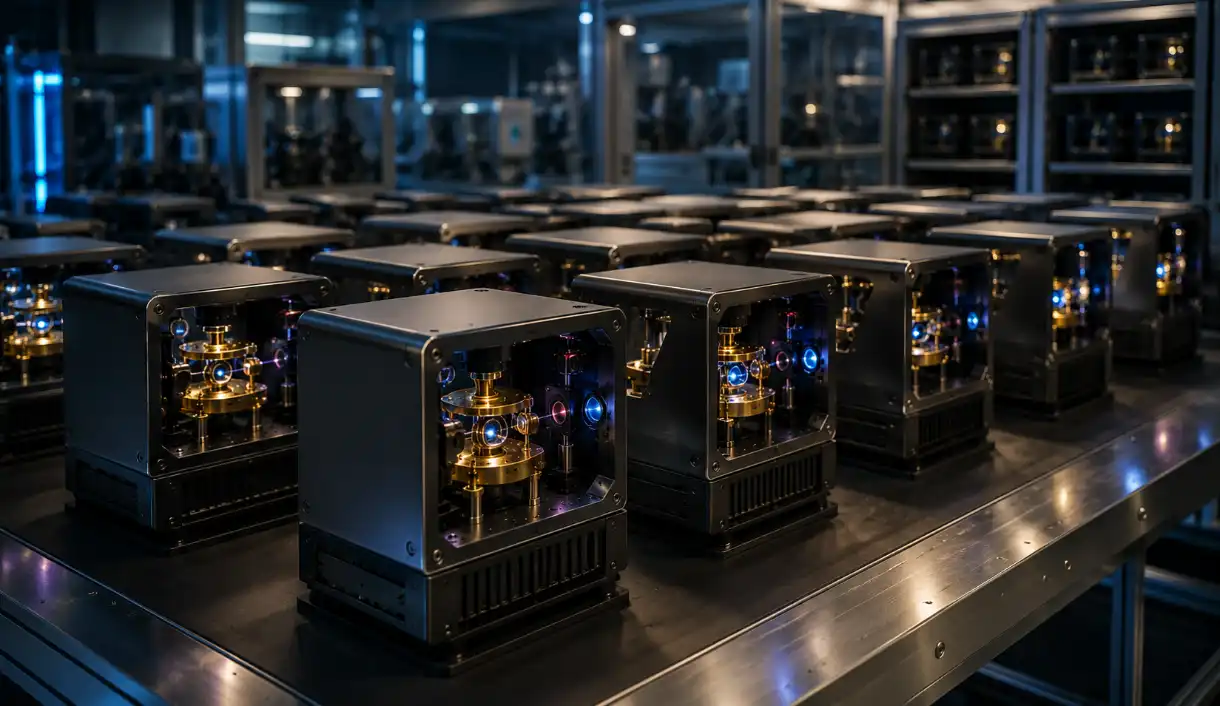
DARPA is paying IonQ $28 million to move its optical atomic clocks out of the prototype stage and into production, with an order for 125 units. The contract extension, under the same It’s About Time program that set up a clock manufacturing pipeline, covers the Evergreen-05, a shoebox-sized clock built by IonQ’s Vector Atomic division. IonQ says it will add $15 million of its own for production space and equipment.
What the clock does
According to the August 6 press release, the Evergreen-05 is a compact optical atomic clock, about five liters, that keeps time using light rather than microwaves. IonQ pitches it for radar, secure communications, and precision geolocation, the timing backbone militaries want when GPS is unavailable, the same navigation-and-timing problem the field keeps circling.
The company’s stated numbers are strong: stability of 50 femtoseconds at one second, and a projected drift of less than a second over 30 million years, in a package it says is a seventy-fifth the volume of a hydrogen maser.
The technology predates the acquisition. Vector Atomic built the clock as a DARPA-funded startup, work that began in 2019, and IonQ bought the company in October 2025 to move into quantum positioning, navigation, and timing. Marty Boyd, who co-founded Vector Atomic and runs IonQ’s timekeeping division, credited the agency’s early backing:
“DARPA has been a partner every step of the way. That initial support was critical to prove the core concepts of our clock.”
Production, at modest scale
The news here is manufacturing. The extension is about turning a proven prototype into 125 delivered units, which is why IonQ is putting up its own money for a production line rather than more research. It fits the company’s recent pattern of buying and building hardware capacity, the chip foundry SkyWater and government work with national labs among them.
Kept in proportion, this is a small run and a modest contract, early-scale production rather than mass output, and the clocks are quantum-sensing hardware rather than quantum computers. What IonQ has added is another line of government revenue and a test of whether it can build these devices at volume, part of the defense-quantum push drawing companies to Washington.