
The Quantum Cold War Runs Through a Dilution Fridge

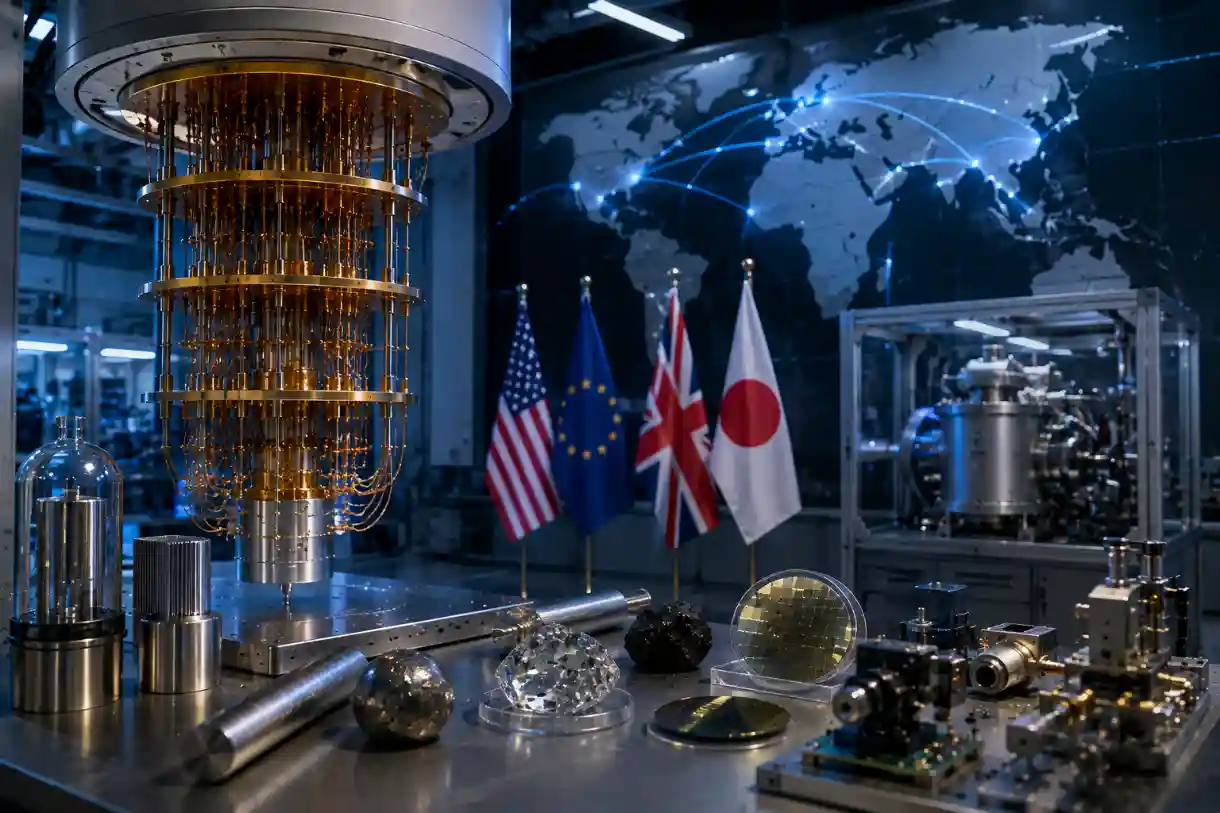
The fridge that cools a superconducting quantum computer to a whisker above absolute zero is made, at industrial scale, by just two companies of any size, Finland’s Bluefors and the UK’s Oxford Instruments. A new analysis from the International Institute for Strategic Studies (IISS) argues that this kind of bottleneck is where the West’s technology strategy now lives, more than the finished computer does. And it argues that strategy has changed shape behind the scenes.
The shift to shaping
In the report published on July 29, IISS analysts Dongyoun Cho and Maria Shagina describe a move from classic export control toward what they call “anticipatory containment.” Instead of waiting for quantum computing to mature and then restricting finished products, Western governments are regulating almost the entire technology stack now, years ahead of commercialization, and pouring billions into their own industrial base at the same time. The aim is to slow rivals early and shape how the industry forms, without cutting off the international science that feeds it.
The report puts the pivot in a single sentence:
“The decisive question is no longer which technologies to deny an adversary, but which nodes of one’s own ecosystem to sustain.”
This framing treats the supply chain as the battlefield. The US led with September 2024 rules from its Bureau of Industry and Security, setting performance thresholds on qubit counts and error rates rather than banning quantum outright, and it built in licensing exceptions for allies running similar controls.
The EU followed with union-wide “500-series” rules in late 2025, after members like France and Germany moved on their own first. The UK and Japan aligned on comparable regimes. All of it sits under a wider American push anchored by Executive Order 14413 and a 13-country coordination group.
The choke points, and why they leak
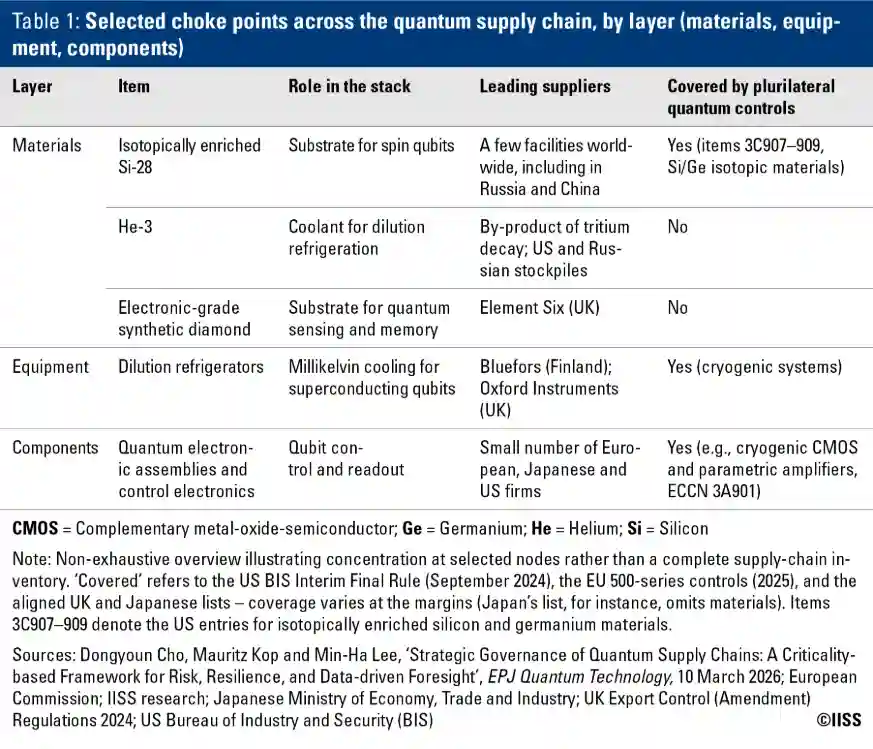
The report does its best work mapping where the leverage sits. A few inputs come from only a handful of suppliers, most of them in allied countries, among them helium-3, enriched silicon-28, electronic-grade synthetic diamond, and germanium.
Helium-3 is especially scarce, since it turns up only as a byproduct of tritium decay. Then there are the dilution fridges themselves, the Bluefors-and-Oxford duopoly, which is why so much US control effort points at cryogenics and why Washington is trying to grow domestic makers like Maybell.
The report doesn’t pretend the controls are watertight. After the UK denied an Oxford Instruments license, Beijing’s quantum institute reportedly bought dilution fridges from Bluefors before Finland’s own controls took effect. Within two years, Chinese firms including QuantumCTek and the Anhui quantum center were building their own fridges at factory scale and expanding synthetic-diamond output besides.
Some silicon-28 capacity sits in Russia and China regardless. For anything with a wider supplier base, like lasers and photonic components, the authors say the controls act as friction, raising costs and slowing acquisition without ever slamming the door. Across most of the stack, denial buys time and nudges rivals toward self-sufficiency.
Controls are the easy half
The sharper argument comes at the end. Export restrictions can’t secure leadership on their own, the authors conclude, because a choke point only holds if the company that owns it stays a going concern. Squeeze its export markets too hard, or make licensing uncertain enough that customers shop elsewhere, and the advantage erodes from underneath.
So, governments are bolting controls onto industrial policy. The report points to the US National Quantum Initiative and Washington’s May 2026 letters of intent proposing $2 billion in minority stakes across nine quantum firms, much of it aimed at domestic chip manufacturing, alongside efforts to build a home-grown supply chain.
Britain has committed £2.5 billion, the EU keeps funding its €1 billion Quantum Flagship, and Japan branded 2025 its first year of quantum industrialization. The logic lines up with a point the field keeps making, that no single lever, a better chip or a tighter control list, wins this race by itself.
It leaves Western governments somewhere odd for a security strategy. Their strongest weapons are private companies in a young market, and those weapons stay sharp only as long as the companies keep selling. The fridge maker in Finland is leverage precisely because it has customers. Cut it off from enough of them, and the leverage melts.