
IonQ Tests Quantum Generative Model on Satellite Radar Data

Recently, something counterintuitive happened: the quantum model didn’t outperform the classical baseline in every scenario, and the researchers appear completely at ease with this. In cases where the data was well-behaved, both methods performed equally. However, when the data became challenging, the quantum method gained an advantage. This complete result, though not a clean sweep, is more intriguing than it might initially seem.
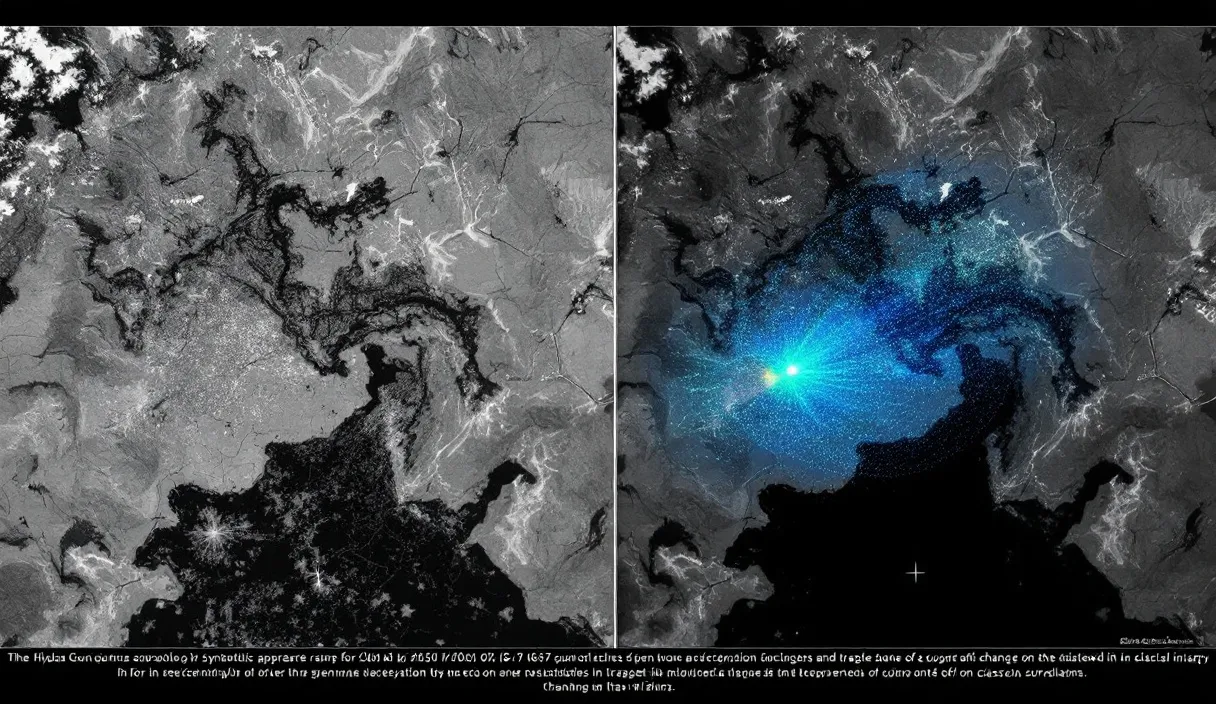
IonQ researchers utilized a quantum generative model to analyze real satellite radar imagery. Their goal was to detect changes between two images of the same location taken at different times. This work is available in an arXiv preprint. Parts of the research hapenned on an IonQ trapped-ion processor, whereas the remainder ran on a simulator and classical hardware.
What Change Detection Actually Entails
Let’s assume you have two radar images of the same air station, taken weeks apart. Something has changed: a plane moved, a building appeared, or someone repainted a runway. Your task is to precisely identify which pixels have changed, as you ignore pixels that merely appear different due to varying radar conditions. Synthetic Aperture Radar (SAR) can penetrate clouds and darkness, which is a significant advantage. However, this capability comes with a challenge: SAR data is inherently noisy and difficult to interpret. Background speckle and actual target changes often look similar until carefully separated.
The researchers’ technique involved predicting the second image. They estimated what the “after” picture should have looked like if no changes had occurred. This prediction was then compared to the actual second image. Pixels that deviated from the prediction were flagged as changes. The overall quality of this process hinges on the accuracy of that initial prediction.
The Model and Its Function
The tool employed in this study is a Quantum Circuit Born Machine (QCBM). Conceptually, it’s like a slot machine trained to generate samples from a specific probability distribution. You adjust the parameters of the quantum circuit until the samples it produces match the statistical properties of your data. In this experiment, the QCBM learned the joint distribution of “before” and “after” pixel intensities within a framework called copula space. This approach describes how two variables relate without needing to consider their individual shapes.
The researchers adapted a classical method known as the non-linear background estimator. They replaced its statistical core: instead of calculating the expected background from raw data, they used the trained QCBM to provide that estimate. Every other component in the pipeline remained unchanged. This modification of a single component represents the true scope of the experiment.
Scope: Testing and Its Scale
Two real datasets from Capella Space, the SAR company acquired by IonQ in 2025, were used. The comparison took place in three ways. Here’s the setup:
- An X-band Stripmap amplitude pair with 1.2-meter resolution, covering Marine Corps Air Station Miramar in San Diego.
- A pair of interferometric coherence maps documenting the 2026 eruptive sequence of the Piton de la Fournaise volcano on Réunion Island.
- Classical estimators, the QCBM on an ideal simulator, and the QCBM on an IonQ trapped-ion QPU were all utilized.
- Every run received score using a filtered F1 metric, which balances the detection of real changes against the occurrence of false alarms.
Notably absent from this list are logical qubit counts, fidelity figures, or any claim of quantum advantage in the strict sense. This was a measured comparison of a single, swapped component on real imagery, executed on a small scale. The QPU handled inference on actual hardware, which is a significant achievement in comparison to many quantum machine learning papers.
Where Quantum Excelled and Where It Kept Pace
The key takeaway lies in the observed pattern. For image pairs with non-Gaussian intensity distributions, which is the highly-skewed data where classical methods struggle, the QCBM achieved higher F1 scores than the baseline. In contrast, for image pairs that were approximately Gaussian, the type of data for which classical statistics are well-suited, both methods performed equally. On the volcano InSAR data, though peak F1 scores were similar, the quantum version maintained consistency across a broad range of detection thresholds.
That second finding is subtle but important. A quantum model performing on par with a mature classical baseline on data that the classical method handles well is a meaningful result. It indicates that the quantum approach isn’t at a disadvantage. It competes effectively, and when the data becomes difficult, it even performs slightly better. This suggests a competitive generative model.
Why This Aligns with a Broader Trend in Quantum-Plus-Classical Approaches
IonQ frames this as a hybrid pipeline, where the quantum component addresses the challenging subproblem, and classical infrastructure manages everything else. This same logic is evident on the deployment side of the field, where QuEra and HPE are collaborating to integrate fault-tolerant neutral-atom systems with HPE Cray supercomputers.
QuEra’s planned Libra system aims for over 256 logical qubits and a 10^-6 logical error rate, with AWS availability targeted for 2028. Though the scale and hardware differ, the underlying principle remains the same: quantum earns its place by excelling where classical methods falter and deferring the rest.
The SAR result is preliminary and small-scale, as IonQ acknowledges. Satellite data continues to accumulate faster than humans can analyze it, and this experiment highlights a specific niche where a quantum model proved beneficial when pixel data became unusual. This isn’t a revolution, but it’s a data point that performed better than anticipated, which, in this field, is a positive development in itself.