
The Quantum Advantage Argument Just Changed Currency, From Speed to Watts


For a decade the quantum advantage debate has been an argument about time. Can the machine solve a problem faster than a classical computer? A new paper from IonQ and QuantumBasel proposes a different question, and it happens at a moment when the answer matters commercially: can the machine solve that same problem using less electricity?
We could call this the energy-to-solution argument. The unit of measure becomes watt-hours to a correct answer, as opposed to ‘how fast.’
This arrives at a time when AI training and inference are straining grids and budgets, and enterprises are starting to price compute in power rather than in FLOPS. So a claim that quantum hardware could undercut classical machines on energy, even without beating them on speed, is worth examining carefully.
How the researchers measured quantum energy use
Give the methodology its due, because it’s better than most work in this area. Previous quantum energy studies typically estimated consumption by multiplying runtime by average system power. That is a rough proxy. According to the July 20 report, this team instead metered the electrical draw across major components of IonQ’s Forte Enterprise trapped-ion system as it ran the circuits.
The workload was a hybrid setup rather than a full quantum model. A conventional BERT-family sentence transformer produced the text embeddings, and only the final classification layer was replaced by a parameterized quantum circuit. The task was sentiment analysis on the Stanford Sentiment Treebank 2 benchmark. Small quantum component, large classical model, which is a realistic architecture.
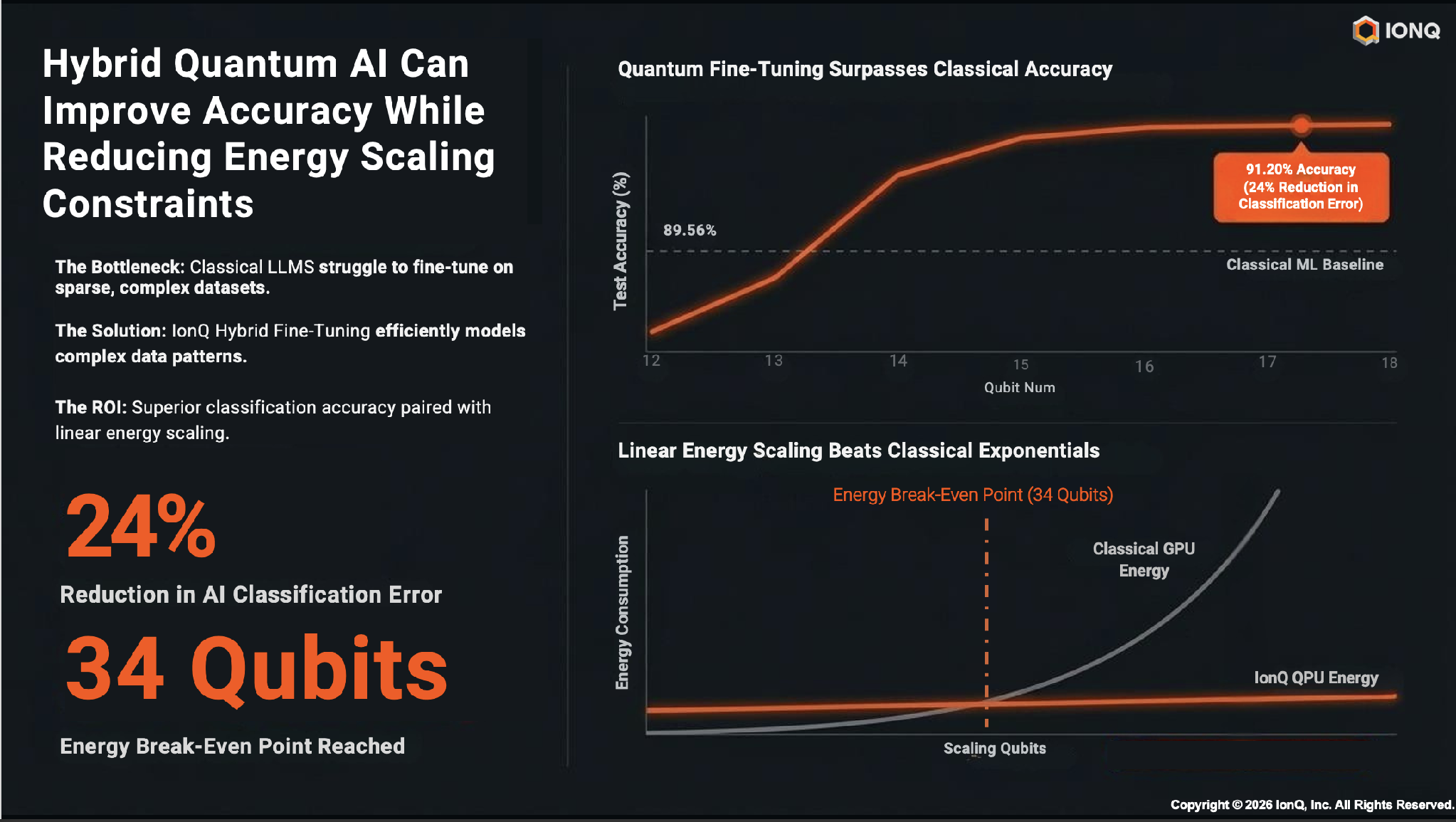
Two findings stand out. Quantum energy consumption rose almost linearly with qubit count, whereas classical state-vector simulation of the same circuits rose exponentially. And average power draw on the quantum machine stayed mostly flat regardless of circuit size, meaning energy scaled with execution time. That’s a useful, concrete result.
Where the energy advantage claim still falls short
So the framing is sound and the measurement is honest. The projections are where it gets fragile.
The widely quoted 34-qubit break-even point, where quantum would use less energy than classical simulation, was not observed. It’s an extrapolation. The energy analysis ran to 28 qubits, the accuracy testing to 18.
The accuracy numbers need similar care. The best result reached 91.2% on hardware with error mitigation, against a noiseless simulation of 92.06%. The eye-catching 24% reduction in classification error was achieved in simulation. On actual hardware, it was around 16%. Those are different claims, and only one of them describes a machine that exists. The evaluation also used 250 test samples, which the authors concede leaves wide statistical uncertainty around any single measurement.
The most consequential caveat is the choice of classical opponent. State-vector simulation scales exponentially by definition, because each added qubit doubles the state. Beating it is close to arithmetic. The authors are straightforward that matrix product states offer a much stronger classical comparison for many practical circuits, and their claim that quantum could eventually beat MPS on certain logarithmic-depth circuits is theoretical and was not tested.
Then there are the structural facts. Only inference ran on quantum hardware; training stayed classical. The whole result rests on one sentiment-analysis benchmark tested on a single hybrid architecture, and the machine doing the measuring belonged to IonQ. The paper is an arXiv preprint, not peer-reviewed.
What to take from it
Separate the paper from the promotion. The paper is measured and lists its own limits. IonQ’s blog is not, telling enterprises they can “milk even today’s quantum hardware for compute efficiencies” ahead of a data center energy crisis that will supposedly stall classical competitors by 2027. That might read as a sales pitch wearing a research result’s clothes.
The durable contribution is the metric, not the number. Arguing that quantum systems should be judged on energy-to-solution rather than raw speed is a reasonable proposal, and directly metering hardware to test it sets a better standard than the estimates the field has been using. At the very least, the next company claiming an energy advantage now has a measurement bar to clear. Whether 34 qubits is where the lines actually cross is a question the hardware hasn’t yet answered.