
ORNL’s LuGo Cuts Quantum Gate Count by Over 95%

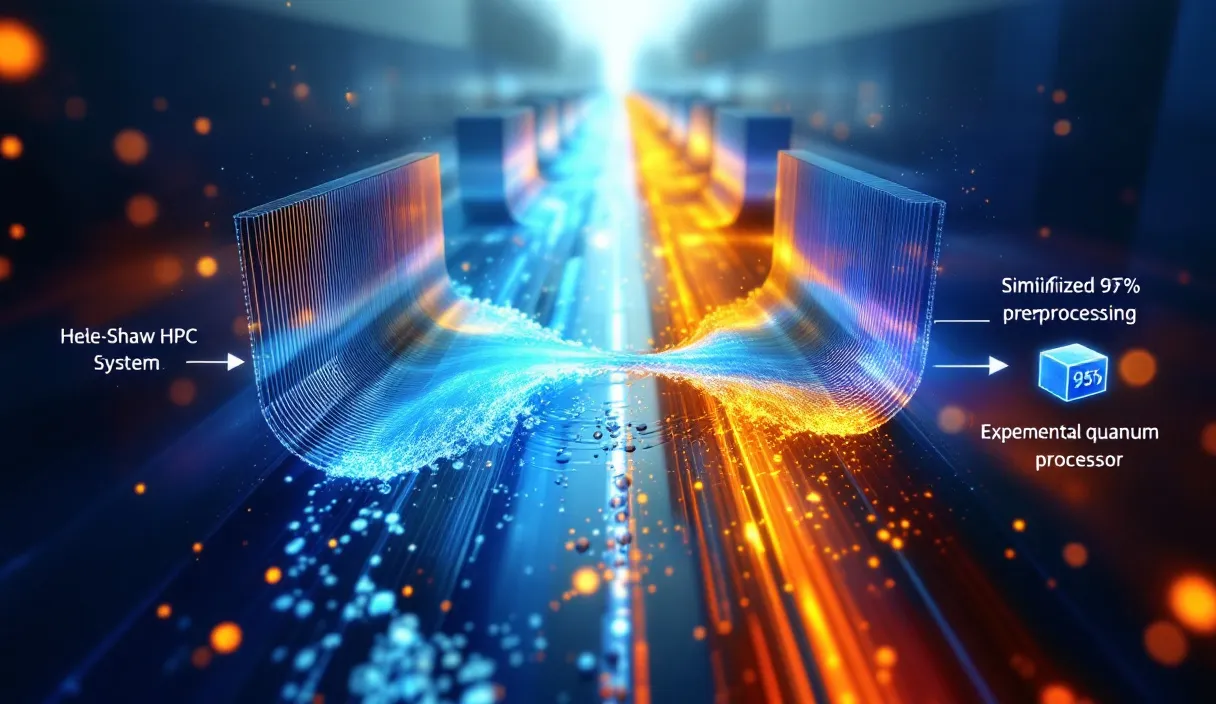
In a counterintuitive move, a team developing a quantum algorithm for fluid dynamics improved its performance by offloading more tasks to classical computers. This strategy reduced the quantum component, leading to a stronger overall result.
The algorithm, named LuGo, originates from Oak Ridge National Laboratory. A key achievement is the reduction in quantum gate count from 2 million to 91,000 for a fluid-flow modeling problem, representing a decrease of over 95%. The work has undergone peer review and is published in Future Generation Computer Systems (DOI 10.1016/j.future.2025.108270), with an earlier version presented at the 2025 IEEE International Conference on Quantum Computing and Engineering.
What Was Actually Shown, and Its Magnitude
It’s crucial to clarify the scope of this achievement, as it forms the core of the story. LuGo’s validation was conducted through classical simulations of its quantum circuits. This means the reported gate-count reduction stems from simulating these circuits on conventional supercomputers, not from a complete execution on a quantum chip. The team performed these simulations on Frontier, ORNL’s 1.4-exaflop machine, and NERSC’s Perlmutter. Notably, the 91,000-gate circuit required only one of Frontier’s nearly 10,000 nodes.
Additionally, the team tested the algorithm on actual quantum hardware to assess its quantum behavior. This included:
- Quantinuum’s H-1, a trapped-ion machine
- IBM’s Marrakesh and Sherbrooke, both superconducting
- IQM’s Garnet and Sirius, also superconducting
Therefore, two distinct aspects are at play: the significant gate-count number is simulated, while the hardware runs were evaluations of the algorithm’s quantum capabilities, not a demonstration of end-to-end speedup over a classical fluid solver. Maintaining this distinction ensures an accurate understanding of the claim.
The Unspoken Chokepoint
The problem addressed is Hele-Shaw flow, which describes liquids or gases compressed between two very closely spaced flat plates. To model this using a quantum computer, one might typically employ an algorithm like Harrow-Hassidim-Lloyd (HHL), designed to solve systems of linear equations. Fluid flow, at a mathematical level, involves a vast number of linear equations.
However, a significant hurdle arises when converting these equations into a quantum format. This conversion involves a step called quantum phase estimation (QPE), which consumed over 90% of the computational effort. The primary issue was the high number of logic gates required for this step.
Why is this problematic?
Gates are a source of noise. Qubits are inherently fragile, and each gate introduces another opportunity for errors to accumulate, potentially corrupting the final result before the calculation is complete.
The Traffic-Jam Problem
Co-author Murali Gopalakrishnan Meena likened this to a highway, where gates represent intersections. More intersections lead to more traffic, and in a quantum circuit, this traffic translates to error. Two million intersections on a road built from qubits that struggle to maintain their coherence? That’s not a commute; that’s gridlock with an engine on fire.
LuGo alleviates this by shifting the setup work entirely off the quantum highway. It postpones the quantum conversion and performs more preprocessing on the classical side first, encoding the data into quantum circuits only after much of the heavy lifting is complete. This significantly reduces the number of intersections that reach the quantum stage, minimizing the chances of errors.
This design philosophy, hidden within a fluid-dynamics paper, suggests performing routine, reliable arithmetic where it’s inexpensive and stable. Fragile quantum hardware is then reserved for the specific tasks where classical machines genuinely struggle.
The Supporting Numbers
The core of this result rests on the following:
- Gate count reduced from 2 million to 91,000, exceeding a 95% reduction (simulated)
- The 91,000-gate circuit was run on one of Frontier’s nearly 10,000 nodes
- QPE previously accounted for over 90% of the computational effort
- Frontier operates at 1.4 exaflops, Perlmutter at 113 petaflops
- Hardware evaluations were conducted on five processors from three companies, utilizing two qubit technologies
What is not explicitly detailed in the public write-up are the qubit count for the demonstration, the fidelity or error rate from the hardware runs, or any head-to-head timing comparisons against a classical fluid solver. While the innovation did receive a 2026 R&D 100 Award, a commendable credential, it doesn’t provide insight into the underlying physics.
Why This Type of Result is Common
LuGo exemplifies a hybrid workload, where classical supercomputers and quantum processors collaborate on a single task. This architecture is increasingly being adopted across the field, from QuEra and HPE integrating fault-tolerant quantum hardware into on-premises HPC environments to roadmaps like QuEra’s Libra aiming for 256 logical qubits on AWS by 2028. Given the current state of noisy and limited quantum machines, offloading as much as possible is essential. For a more detailed explanation of qubit sensitivity, TQI’s “maple-syrup explainer” offers an accessible overview of the tuning challenge.
Co-author Kalyan Gottiparthi presented LuGo as an extension of HHL, enabling new levels of detail in less time. This represents a significant benefit for scientists working with microfluidics, groundwater flow, and porous media flow.
It’s important to acknowledge that the reported 95% improvement is a circuit-size result derived from simulation, not a measured speedup on a functional quantum computer solving real turbulence. While that day will come, this paper focuses on making the initial steps more efficient.