
The Navy’s Quantum Lab Focuses on Sensing and Algorithms

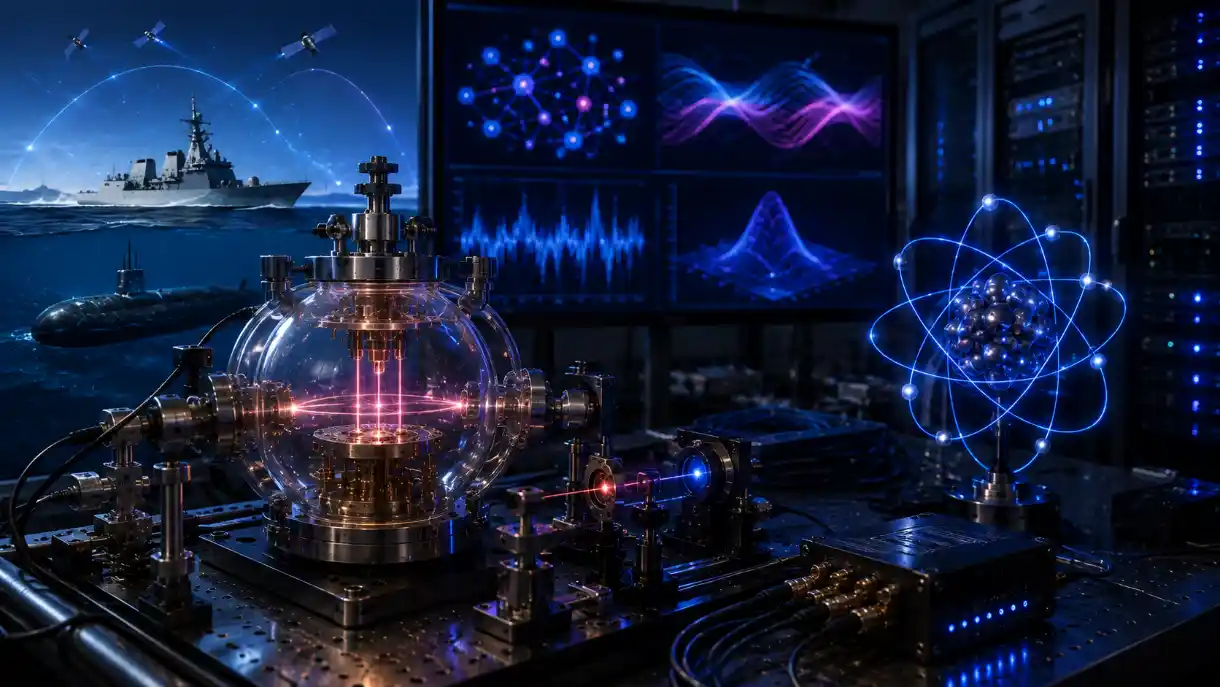
The U.S. Naval Research Laboratory (NRL) has spelled out what its year-old Quantum Science Institute works on, and the list stops short of building quantum computers. The Navy lab develops the sensors and algorithms that would let the fleet use quantum technology once it arrives from elsewhere.
What NRL works on
According to the July 24 report, the institute, formally existing since June 2025, pulls together quantum work that’s been scattered across the century-old lab for decades, organized now into four areas that cover sensing and navigation, computing, networking, and foundational science. Indeed, Director Adam Black drew the boundary on the computing side clearly:
“We don’t build quantum computers here. What we do is develop the algorithms and applications that allow the Navy to take advantage of those computers as they continue to mature.”
The most concrete work is in sensing. NRL is developing cold-rubidium atom sensors, accelerometers and gyroscopes cooled to near absolute zero, which aim to keep ships and submarines on an accurate course in cases of jammed or unavailable GPS, and it’s working toward shipboard demonstrations. Atomic clocks, the most mature piece, handle precise timing.
In terms of networking, NRL belongs to DC-QNet, a consortium linking federal labs over optical fiber to test quantum communications. Its algorithm teams partner with private hardware makers to find Navy uses, in logistics and materials among others, for machines someone else builds.
A defense bet, pegged to an order
The release relates to Executive Order 14413 from June, and the loftier lines, the “cusp of a quantum revolution” and “transformational capabilities,” are quotes from that order rather than NRL findings, so they belong to the White House rather than the lab. What’s real underneath is a clear military driver. Navigation that survives GPS jamming and communications an adversary can’t quietly read are capabilities the Navy actually wants, and quantum is one route to them.
That puts NRL inside a fast-growing defense push on quantum, alongside the Pentagon’s $200 million quantum-sensing program and allied work on navigation that resists jamming. Its networking effort maps to the same problems a recent quantum-networking roadmap says are mostly unsolved, and the whole thing sits under the national quantum strategy the June order set out, which pushes agencies to treat quantum as one connected effort. Quantum, in the Navy’s telling, is a strategic capability worth building people and programs around, even if the useful hardware is still someone else’s to deliver.