
In These Flat Crystals, Light and Magnetism Finally Talk to Each Other

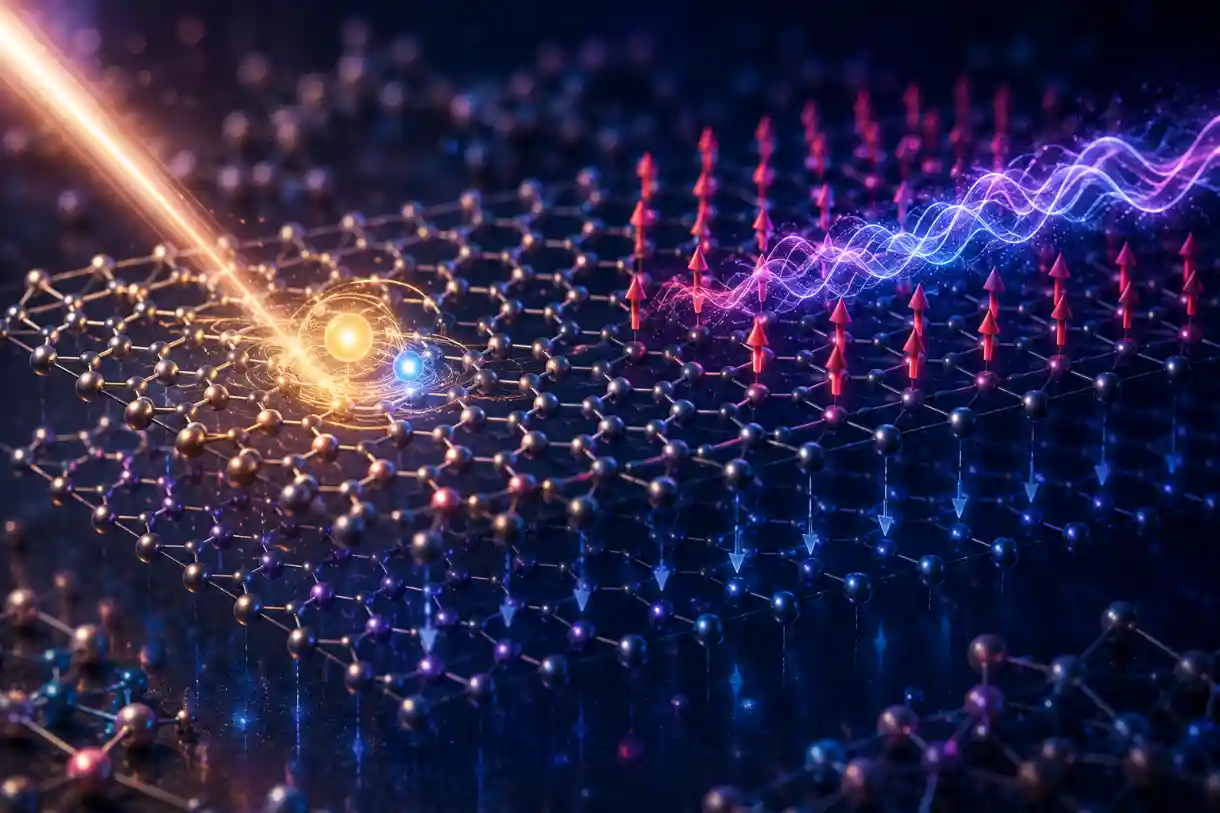
Say two coworkers share an office for years and never once speak. Light does its job, magnetism does its job, and in almost every material you have ever touched, that is exactly how they operate. Separate desks, separate emails. A new review in Nature Materials, led by Vinod Menon’s group at City College of New York, is about a rare class of materials where those two finally start collaborating, and it maps where that collaboration could go.
Quick reminder: shine light on a semiconductor and you can knock an electron loose, leaving behind a positively charged empty spot called a hole. The electron and the hole stay bound to each other like a tiny couple, and that pair is an exciton: electrically neutral, but very much made of light. Now the magnetism. In a magnetic material the atomic spins line up, and when that alignment ripples, the ripple travels as its own wave, called a magnon. Excitons carry light. Magnons carry magnetism.
The trick is that they share a bloodline
For decades, getting these two to interact meant forcing it. You sprinkle magnetic atoms into a semiconductor, or you stack an atomically thin semiconductor on top of a magnet and hope they whisper through the interface. It works, sort of, but it always feels bolted together.
Van der Waals magnetic semiconductors do something cleaner. In these layered crystals, the excitons and the magnetism grow out of the same electronic orbitals. Same source, same bloodline. That shared origin lets an exciton feel the magnetic order directly, and, as lead author Pratap Chandra Adak puts it, under the right conditions even help push that magnetism around.
What that buys you
Why does anyone care that a particle of light can feel a magnet?
Because it turns light into a readout tool and, maybe, a control knob. In materials like chromium triiodide and chromium sulfur bromide, excitons crank up magneto-optical effects, which means you can read a material’s magnetic state just by watching how it twists the polarization of light. Run it the other way and the magnetism tunes the excitons back, shifting their energy and where they sit. And when excitons couple to magnons, you get an optical signal wired straight to magnetic wiggles happening at gigahertz speeds.
That last one is the tantalizing bit. A device that translates between fast magnetic dynamics and optical signals is exactly what a future quantum network needs to move information between microwave and optical frequencies.
Now the part where I manage expectations
Menon and his co-authors, spread across CCNY, TU Munich, the University of Washington and a few other institutions, wrote this review to pull a fast-moving field into one coherent picture and point at the open questions. There are plenty. Most of these materials are barely explored. The theory needed to describe excitons, spins, atomic vibrations and photons all interacting at once does not fully exist yet. The magneto-photonic memory and optical logic chips people keep invoking are still on the “wouldn’t this be cool” side of the ledger, not the shelf.
Still, there is something quietly great about a material where light and magnetism stopped ignoring each other. Nobody has built the useful device yet. For now the two coworkers are just, at last, on speaking terms.