
Quantum Key Distribution Field Guide
QKD Hardware, Explained: What’s Inside the Box

- THE LINK
- Laser → fiber → detector
- plus a key-processing layer
- WHY COSTLY
- Precision optics
- no amplifier, sometimes cryogenic detectors
- THE DESIGN
- DV prepare-and-measure
- the common fiber type
- FOR YOUR WALLET
- Doesn’t sign it
- makes key material, not signatures
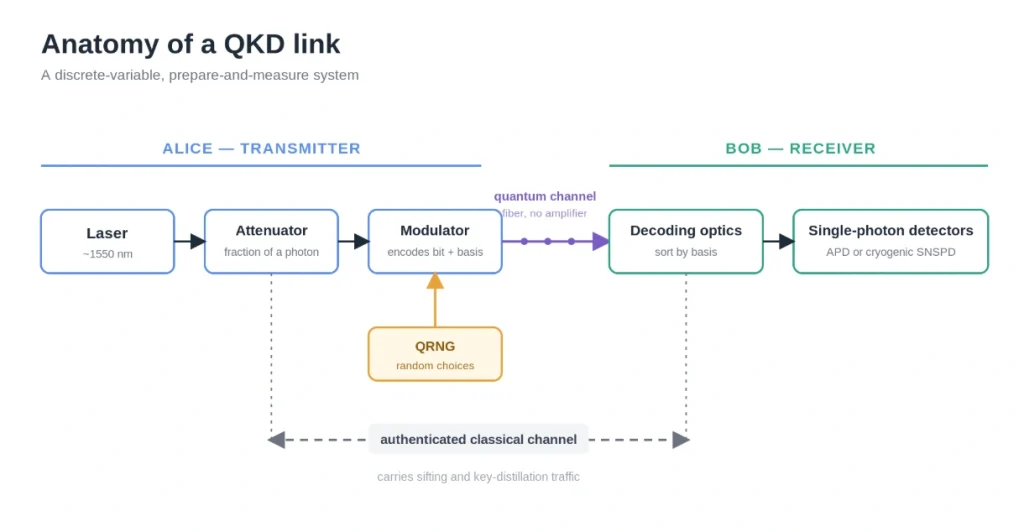
A QKD link’s reputation as costly and point-to-point comes straight from what’s inside the box. The common fiber design (discrete-variable, prepare-and-measure) has four parts: a transmitter that dims a telecom laser to a fraction of a photon and stamps each pulse with a random bit and basis, an optical channel you can’t amplify, a receiver of delicate single-photon detectors, and a classical layer that sifts and cleans the detections into a usable key. The physics is simple; the equipment is fussy and expensive, which is why QKD doesn’t scale like a software upgrade. And none of it signs your transactions.
Part of the Quantum Key Distribution guide seriesThe transmitter: making faint, random light
This box establishes key material for a link between two machines. It doesn’t sign your transactions, and no exotic optics change that. What protects your coins is post-quantum cryptography. See Post-Quantum Cryptography, in Plain English.
By the usual convention, the two ends of a QKD link are Alice, the sender, and Bob, the receiver. Alice’s end starts with a telecom laser, the kind that carries internet traffic around 1550 nanometers, where fiber loss is low. A variable attenuator dims each pulse to a fraction of a photon on average, so the multi-photon pulses an eavesdropper could exploit stay relatively rare.
That fraction is deliberate: the pulse isn’t a clean single photon but a faint one whose photon count varies, which is why these systems lean on decoy states to stay safe. A modulator then stamps each pulse with the bit and basis Alice picked.
Those choices have to be unpredictable. If an attacker could guess Alice’s settings, the security can be compromised, so implementations feed the modulator from a strong entropy source. That’s often a quantum random-number generator, sometimes a smaller generator whose output is stretched to the rate the protocol needs. QRNGs have also escaped the QKD box and reached consumer devices on their own, in a specialist line of security phones and hardware modules.
The pulse isn’t a clean single photon but a faint one whose photon count varies, which is why these systems lean on decoy states. The bit and basis choices must be unpredictable, so the modulator is fed from a strong entropy source, often a quantum random-number generator.
- Laser
- telecom, ~1550 nm (low fiber loss)
- Attenuator
- dims each pulse to a fraction of a photon
- Modulator
- stamps each pulse with the chosen bit and basis
The channel: one path you can’t amplify
Between Alice and Bob runs the quantum channel, most often an optical fiber and sometimes a free-space or satellite link. It’s frequently provisioned apart from ordinary traffic, though the quantum signal can also share a fiber with classical data on separate wavelengths. The hard limit comes from the rule that makes QKD secure: you can’t copy an unknown quantum state, so you can’t drop in an amplifier to boost the signal the way telecom networks do.
Loss builds up and the usable key rate falls steeply with distance. Conventional long-distance fiber networks commonly relay through trusted nodes to reach across a country, though experimental methods like twin-field QKD have demonstrated secure key distribution over more than 1,000 kilometers of fiber, at a tiny key rate.
The same no-cloning rule that makes QKD secure means you can’t drop in an amplifier to boost the signal. Loss builds up and the usable key rate falls steeply with distance, so long-distance fiber networks relay through trusted nodes, though twin-field QKD has carried keys over 1,000+ km of fiber at a tiny rate.
The receiver: catching one photon at a time
Bob’s end contains some of the trickiest hardware, at least in this discrete-variable design. First come decoding optics that sort each incoming photon by basis, using beam splitters and polarization parts in some systems and interferometers in others. Then come the single-photon detectors, and here builders usually pick between two families.
| Detector | Cost and cooling | Trade-off |
|---|---|---|
| Avalanche photodiodes | cheaper, modest cooling | twitchy, afterpulse-prone; the detector-blinding attack targets |
| Superconducting nanowire | high-end, cryogenic (~few kelvin) | excellent efficiency, very low noise; needs a cryocooler |
| CV-QKD (for contrast) | balanced photodetectors, like ordinary receivers | skips single-photon detection altogether |
Avalanche photodiodes are the cheaper option, cooled only modestly, but they’re twitchy and afterpulse-prone, and they were the targets of the landmark detector-blinding attacks against commercial QKD systems. Superconducting nanowire detectors are the high-end choice, with excellent efficiency and very low noise, though they need cryogenic cooling down near a few kelvin, which means a cryocooler humming next to the rack. Continuous-variable QKD skips single-photon detection altogether and uses balanced photodetectors closer to those in ordinary optical receivers.
The layer that turns photons into keys
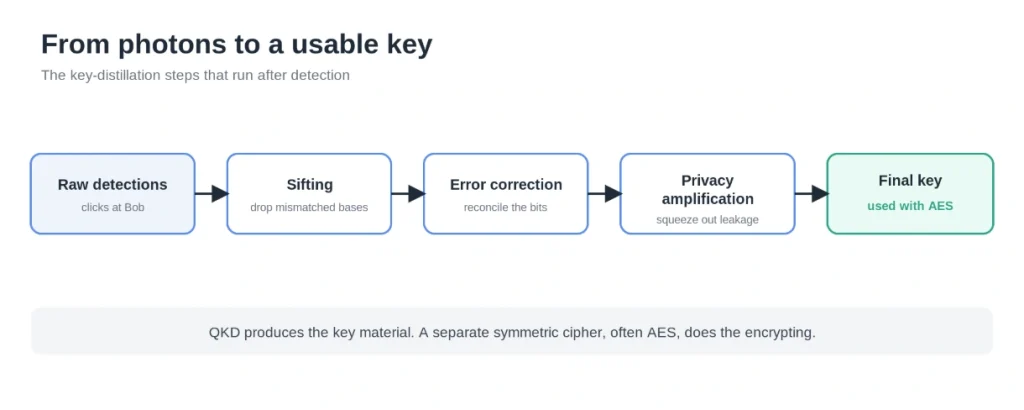
Raw detections aren’t a usable key yet, and the steps that finish the job rely on a classical channel between Alice and Bob. That channel has to be authenticated. QKD doesn’t prove who’s on each end by itself, so without authentication an attacker could pose as Alice to Bob and as Bob to Alice, and the whole exchange falls to a middleman. Implementations handle this with a pre-shared key or a signature scheme, post-quantum ones included.
From photons to a key
Authenticate the classical channel
QKD doesn’t prove who is on each end, so without this a middleman can pose as Alice to Bob and Bob to Alice. Use a pre-shared key or a signature, post-quantum ones included.
Sift
Compare bases and drop the mismatches. Textbook BB84 throws away about half; biased modern variants waste far less.
Error correction
Reconcile the surviving bits between Alice and Bob.
Privacy amplification
Shrink the result to squeeze out anything an eavesdropper might have learned.
Store and use
A key-management system hands the finished keys to an ordinary cipher, often AES, which does the actual encrypting. QKD makes the key; AES protects with it.
With that in place, Alice and Bob compare bases and drop the mismatches. In textbook BB84 that throws away about half the detections, though efficient modern variants bias the basis choice and waste far fewer. They then run error correction to reconcile the surviving bits, followed by privacy amplification, which shrinks the result to squeeze out anything an eavesdropper might have learned. A key-management system stores the finished keys and hands them to ordinary encryptors. QKD produces key material. Standard symmetric encryption, often AES, does the protecting with it.
Why the box keeps QKD niche
Against post-quantum cryptography, which for many users arrives as a software or firmware update on hardware they already own, that is a set of specialized equipment at each end. Costly, short-range, and the key rate falls off steeply with distance, which is the concrete reason several Western agencies file QKD under niche and send most buyers toward PQC.
- Precision optics
- stabilization at each end
- Entropy
- a strong source
- Channel
- can’t be amplified, short range
- Detectors
- cryogenic in high-performance builds
What it means for you
The box establishes key material for a link between two machines. It doesn’t sign your transactions, and no amount of exotic optics changes that. There’s one component worth pulling out, though.
The quantum random-number generator inside some transmitters has escaped the QKD box into consumer devices, and strong randomness is exactly what your wallet needs when it makes a key or seed phrase. It doesn’t have to be quantum: a properly built classical secure RNG has done the job for years. The reason it matters is the failure case, since weak randomness has drained wallets before, most famously a 2013 Android RNG flaw.
The box makes key material for a link between two machines. It doesn’t sign your transactions, and no exotic optics change that.
This article is educational and does not constitute security or investment advice.
// FAQ
What's inside a QKD box?
In the common fiber design, a transmitter (a dimmed telecom laser, an attenuator, a modulator and a strong entropy source), an optical channel you can’t amplify, a receiver with single-photon detectors, and a classical layer that sifts and cleans the detections into a key.
Why is QKD hardware so expensive?
It needs precision optics and stabilization, a strong entropy source, an optical path that can’t be amplified, and, in high-performance builds, cryogenic single-photon detectors. That specialized gear at each end is why QKD doesn’t scale like a software update.
What are the single-photon detectors?
Two families. Avalanche photodiodes are cheaper and only modestly cooled but noisy and the target of detector-blinding attacks; superconducting nanowire detectors are high-end, with excellent efficiency and very low noise, but need cryogenic cooling.
Does QKD encrypt my data directly?
No. QKD produces key material. A standard symmetric cipher, usually AES, does the actual encrypting with that key.
Does anything in the box protect my crypto?
Not directly. QKD makes keys for a link, not signatures for a transaction. The one spin-off worth knowing is the quantum random-number generator, since strong randomness matters when a wallet makes a key, though a good classical RNG does that job too. Protecting coins from a quantum computer needs post-quantum signatures.
// Sources
- QNews, What Is Quantum Key Distribution (QKD)? The No-Math Version https://qnews.io/guides/quantum-key-distribution/what-is-quantum-key-distribution-the-no-math-version/
- QNews, Why "Unbreakable" QKD Still Gets Hacked https://qnews.io/guides/quantum-key-distribution/why-unbreakable-qkd-still-gets-hacked/
- QNews, QRNG vs QKD https://qnews.io/guides/quantum-key-distribution/qrng-vs-qkd-the-quantum-security-tool-you-might-already-own/
- QNews, Post-Quantum Cryptography: The Quantum Computing Threat, in Plain English https://qnews.io/guides/post-quantum-cryptography/post-quantum-cryptography-a-plain-english-guide-for-crypto-holders/
- NSA, Quantum Key Distribution (QKD) and Quantum Cryptography (QC) guidance https://www.nsa.gov/Cybersecurity/Quantum-Key-Distribution-QKD-and-Quantum-Cryptography-QC/