
Imec and Diraq Build an Eight-Qubit Silicon Array on a Standard Chip Line

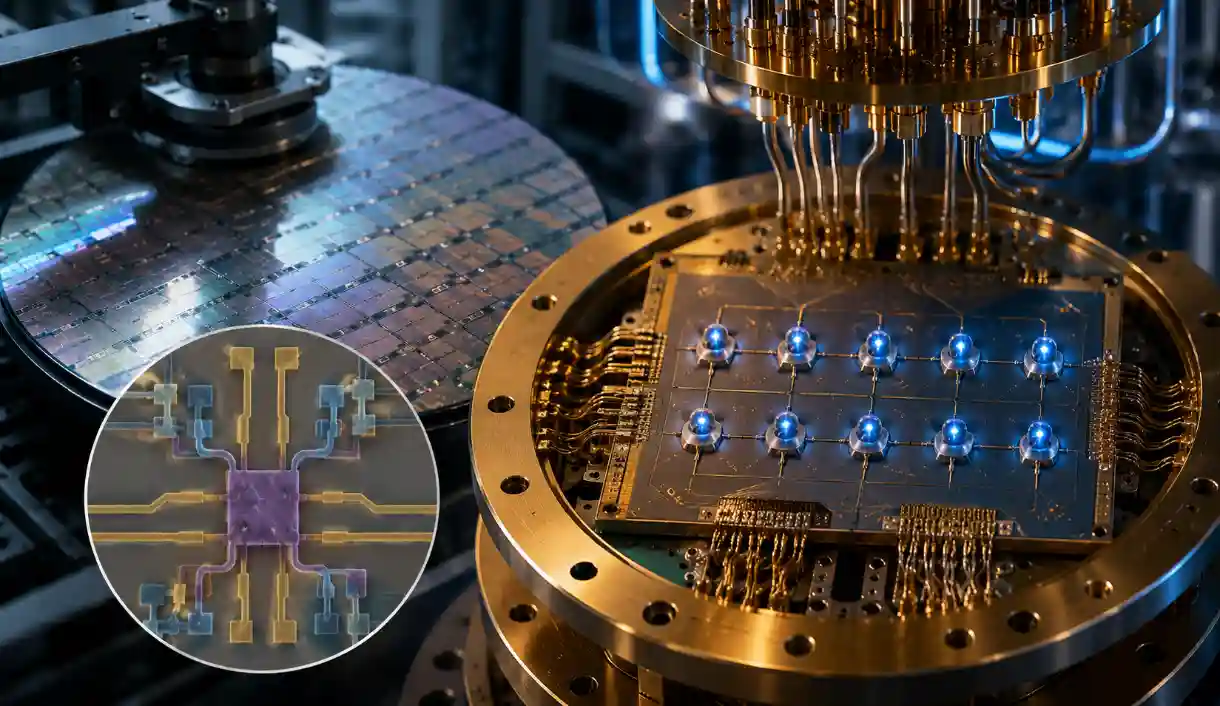
Nanoelectronics R&D hub Imec and quantum computing company Diraq have run an eight-qubit silicon spin array made on a standard 300mm CMOS manufacturing line, the same kind used to produce advanced commercial chips. The two ran and read out the array while keeping the qubits coherent, and published the work in Nature Communications.
Why silicon spin qubits
Silicon spin qubits are one of the more promising routes to large-scale quantum computing for a practical reason. They can be made with the factories, supply chains, and process knowledge the semiconductor industry has already spent decades building, rather than with specialized one-off fabrication. That means a path to producing quantum processors with the yield and repeatability of ordinary chips.
Per the July 13 press release, the team built the devices on imec’s 300mm spin-qubit platform, developed over nearly ten years of process work. It builds on a 2025 Nature paper in which the two companies showed that industrially made silicon qubits could hit the fidelity needed for error correction. That earlier result covered single and two-qubit building blocks. This one shows the same process scaling to a larger array without losing coherence.
The important bit for scaling
The more useful finding is in the readout. Moving from a couple of qubits to eight did not require a large jump in sensor count, wiring density, or heat load. That favorable ratio matters because wiring and cooling are among the hardest problems in growing a quantum processor, and a design that stays compact as it adds qubits is what large machines will need.
Eight qubits is still small, and nobody is claiming otherwise. Diraq CEO Andrew Dzurak framed the result as a question of cadence, since it showed reliable fabrication nine months ago and now a working larger array on the same process, which he said is the pace for reaching useful scale. Whether that pace holds is what the next devices will show.