
A Berkeley Quantum Chip Just Got a 250-Year Assignment: Stay Buried

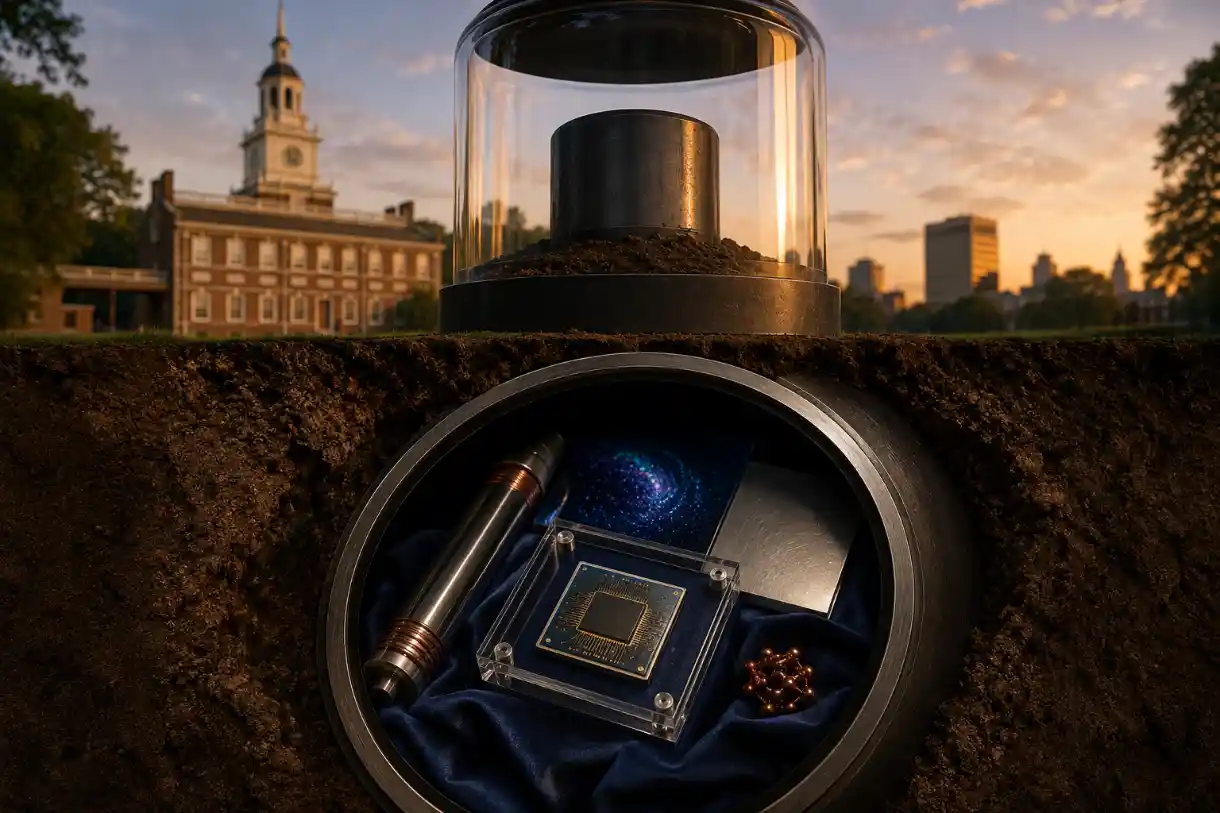
Somewhere under Independence National Historical Park in Philadelphia, sealed since June and not to be reopened until 2276, there is now a quantum computing chip. Ten millimeters square, eight qubits, niobium, and aluminum on silicon. California picked it as one of seven contributions to the America250 time capsule, the one that gets dug up on the country’s 500th birthday, when everyone currently reading this is comprehensively dead.
It’s a strange honor for a piece of hardware, and a fitting one. This wasn’t a prototype that never left the bench. Berkeley’s eight-qubit chip is the first widely-distributed QPU, a quantum processing unit that research groups around the world used through Berkeley Lab’s Advanced Quantum Testbed. People ran it to simulate neutrino interactions and the innards of atomic nuclei. It did real work for four years.
According to the July 14 press release, Governor Gavin Newsom chose it, alongside a conductor built in San Diego for an experimental fusion reactor, to stand in for California’s innovation streak. (Also in the capsule: a letter to future Californians, and a prediction of the state’s future written by Anthropic’s AI, Claude, which is a very 2026 thing to bury for two and a half centuries.)
Why this eight-qubit chip was so important
Here is the part I find quietly funny. The chip only works at a few thousandths of a degree above absolute zero, colder than deep space, where its circuits turn superconducting and stop drowning in thermal noise. So the object chosen to symbolize the quantum future is one that, sitting in a box of Philadelphia dirt, cannot do a single quantum thing. It’s a photograph of the technology mid-stride, frozen and switched off.
A time capsule for the quantum age
Which is sort of the point of a time capsule. It carries a bookmark forward, a note that says this existed and was important here. “There’s a lot of quantum industry already in California,” said Kan-Heng Lee, the Berkeley Lab scientist who oversaw the chip’s production, naming Google and Amazon, “but I want us to be in the time capsule as a symbol of one of the important places where it began.”
Whether quantum computing amounts to much by 2276 is anyone’s guess. Maybe the people who open the box will recognize this chip as the start of something. Maybe they’ll regard eight qubits the way we regard a vacuum tube. Either way, it will be down there waiting, cold and quiet and off, for someone to notice.