
Photon Queue Raises $4 Million to Build Quantum Memory That Runs Warm

Photon Queue has closed a $4 million seed round led by Playground Global to scale its quantum memory hardware. The company already has paying customers, with devices deployed at Sandia National Laboratories and the University of Maryland. That deployment record is what distinguishes this from most seed-stage quantum funding.
How Photon Queue stores photons without cryogenics
Scaling quantum computers will mean linking many smaller processors together, and that only works if single photons show up in the right place at the right moment. Getting that timing right across a complex system is a genuine issue. Quantum memory fixes it by holding a photon until it’s needed.
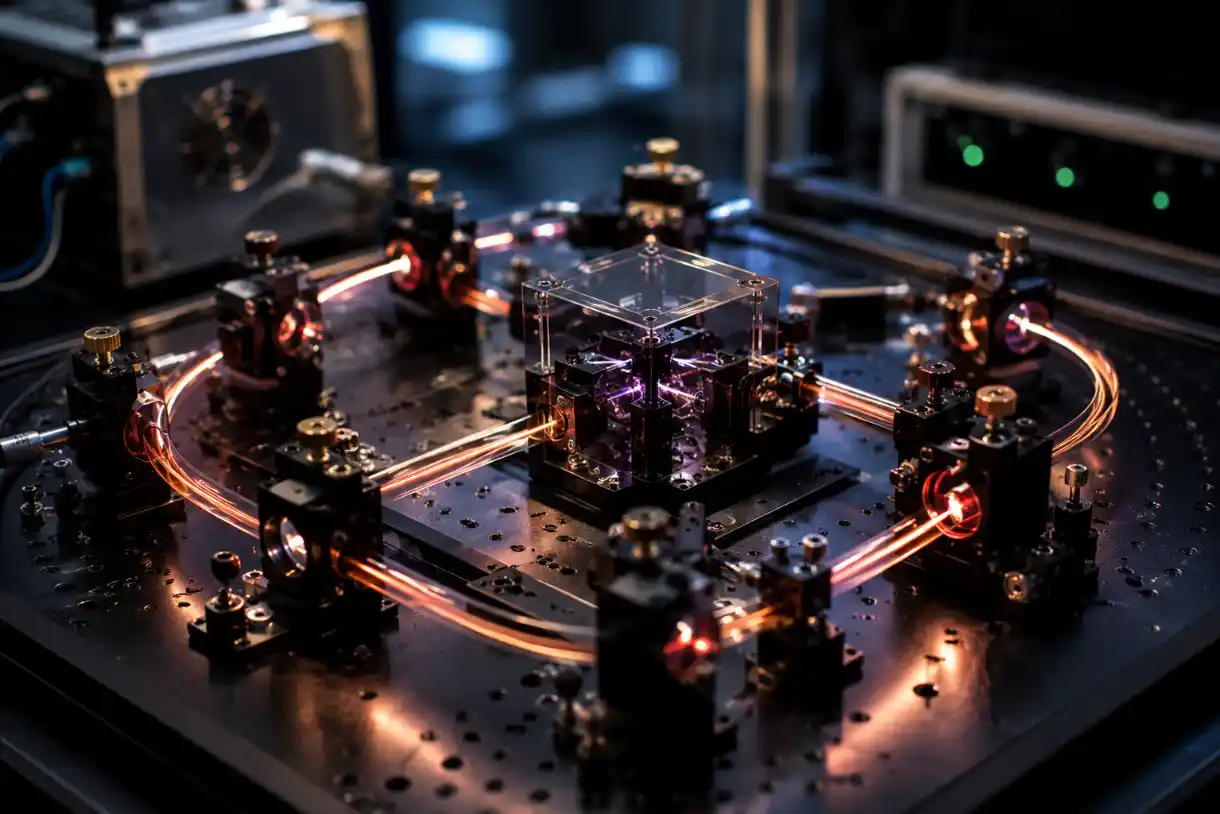
According to a July 21 press release, Photon Queue’s version keeps photons circulating in free-space optical loops, bouncing between high-reflectivity mirrors and routed by optical switches. The light is stored as light, rather than converted into another form. That avoids cryogenic cooling, vacuum chambers, and the conversion steps other approaches require, so the devices run at room temperature on standard power. The company says they work across effectively any wavelength, which would suit photonic, trapped-ion, and neutral-atom systems alike.
Claims of ultra-high efficiency and world-leading bandwidth are the company’s own.
Why investors are backing Photon Queue
Playground Global, whose portfolio includes PsiQuantum, led the round. Saikat Guha of the University of Maryland, who directs the NSF Center for Quantum Networks, called the room-temperature free-space approach compelling for avoiding cryogenics and transduction.
The seed money sits alongside a separately announced $500,000 from New Mexico’s Economic Development Department and Roadrunner Venture Studios. Playground also runs a $50 million fund backed by New Mexico’s State Investment Council that requires portfolio companies to hold material business relationships in the state, which helps explain why an Illinois spinout founded in 2024 keeps turning up in New Mexico announcements.