
QRNG vs QKD: The Quantum Security Tool You Might Already Own

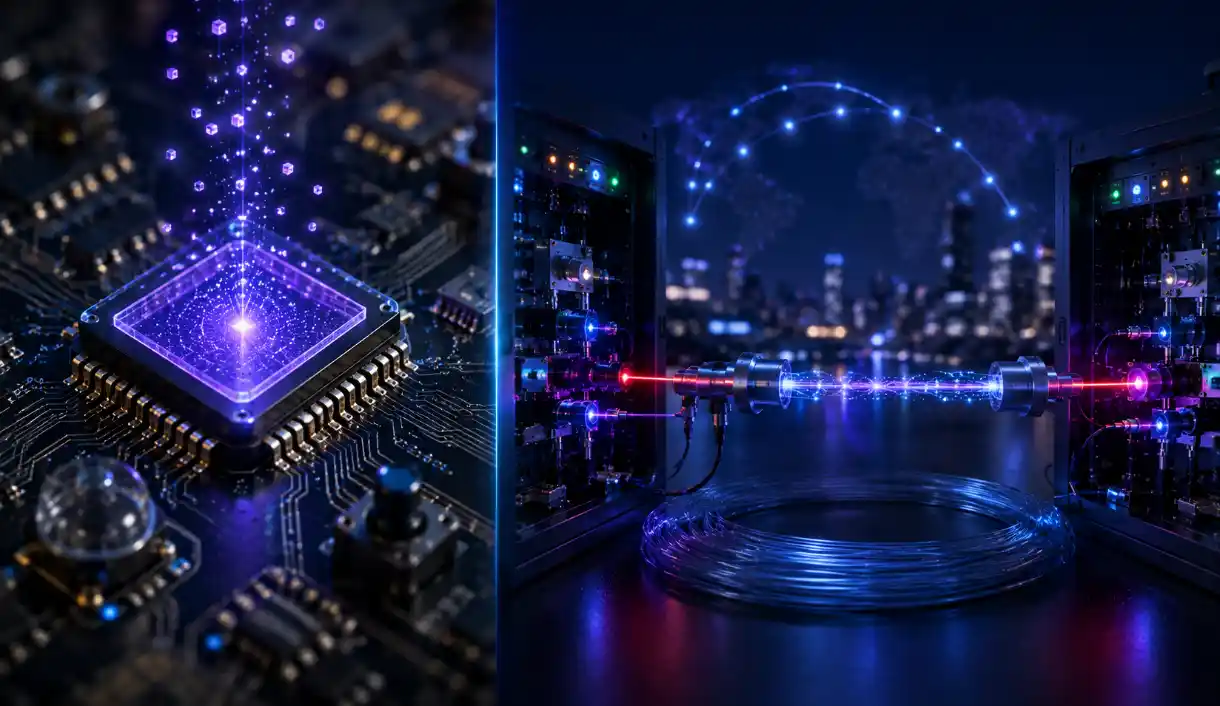
Quantum security gets sold as one thing, but two different technologies hide behind the label, and people mix them up all the time. Quantum key distribution (QKD) establishes shared secret key material between two endpoints using specialized communications hardware, and it’s niche and costly, and probably nowhere near you.
A quantum random-number generator, or QRNG, does something smaller and more widely deployable. It produces unpredictable random numbers from a quantum process, and it can fit on a single chip. QRNGs are already shipping in phones and security hardware. One is a link. The other can be a chip. Telling them apart is a good skill to have for anyone holding crypto, because randomness is one of the foundations underlying your wallet.
Two different jobs
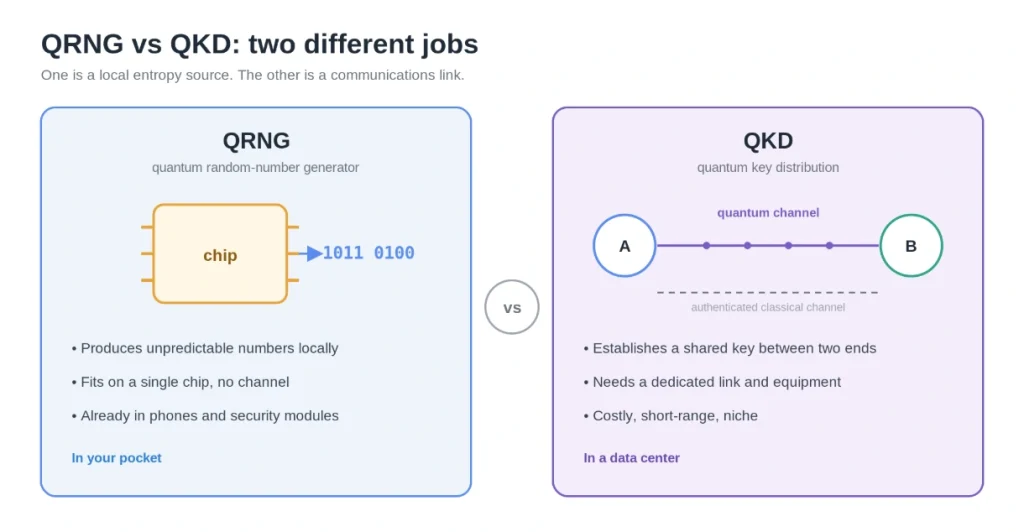
The two get lumped together because both use quantum physics for security, but they solve different problems. QKD answers a communications question: how do two endpoints with the right equipment establish shared secret key material even when the quantum channel might be monitored, using authenticated classical communication so nobody can pose as either side. A QRNG answers a local question: how do you produce fresh entropy whose outcome wasn’t fixed in advance and can’t be predicted by an adversary.
You need unpredictable numbers all over cryptography, to pick keys and to seed the generators that make them, so a QRNG is a building block you can drop into almost anything. A QKD link is a whole system connecting two endpoints. QKD systems themselves need private randomness, and many implementations use a QRNG to supply Alice’s choices. The QRNG can be one component; QKD is the communications system built around components like it.
What a QRNG does
A QRNG turns a quantum process into random bits. Different designs tap different sources, like the shot noise of light hitting an image sensor or the arrival times of single photons. The distinction is where the unpredictability comes from. A pseudo-random generator expands a secret internal state deterministically: learn that state and its future output becomes predictable.
At the same time, a QRNG draws fresh entropy from measurements of a quantum process, though practical devices still need careful characterization and post-processing before those raw measurements become cryptographic random bits.
Why this one reached your pocket
QKD needs specialized optical hardware at both ends, plus tightly controlled links and network integration, so it stays infrastructure rather than consumer electronics. A QRNG can shrink onto a semiconductor chip, which makes it far easier to put inside ordinary devices. ID Quantique put a QRNG chip in a Samsung phone sold by SK Telecom back in 2020, the first of a continuing line of quantum-security handsets.
QRNGs also appear in hardware security modules and other embedded security systems. Several QRNG implementations have received NIST Entropy Source Validation under SP 800-90B, the same framework used for classical physical entropy sources. That puts them inside production and FIPS-oriented assurance processes rather than leaving them as lab demonstrations.
What it means for your wallet
Here’s where randomness gets personal. One of the foundations of a crypto wallet’s security is the randomness it uses to generate your seed phrase. If those numbers are predictable, the seed is guessable, and a guessable seed means someone can rebuild your keys and take everything. This isn’t hypothetical.
A 2013 flaw in Android’s random-number generation left Bitcoin wallets open to theft. And in 2026, a years-old Coldcard firmware bug sent seed generation down a weak software-randomness path instead of the intended hardware RNG. One early sweep alone drained around 594 Bitcoin from about 500 wallets, and later attacks pushed the tracked losses much higher.
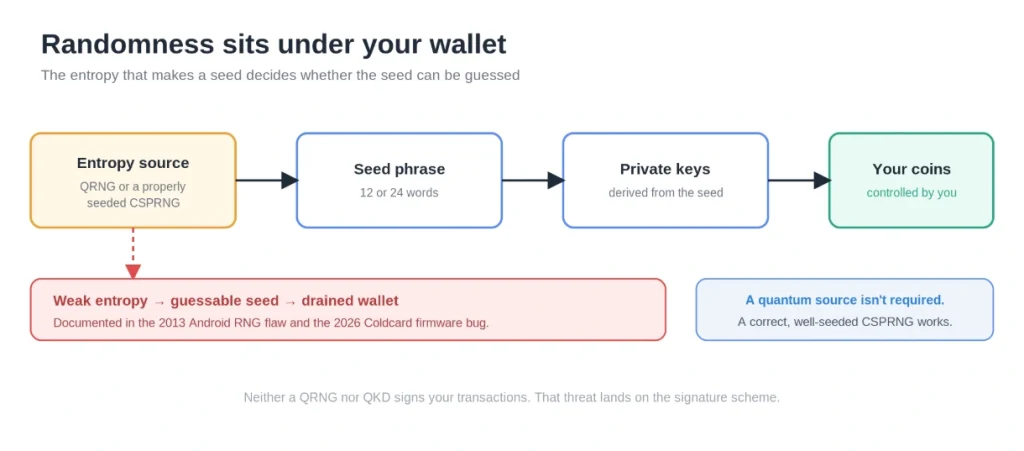
So strong randomness is something to care about, and a QRNG is one way to get it. It’s worth being clear, though: your wallet doesn’t need a quantum one. A correctly built cryptographic generator, properly seeded from a strong entropy source, has met the security bar for years, and secure wallets can rely on exactly that.
A QRNG can add an independently characterized source of entropy, but the word “quantum” doesn’t by itself make a generator safer. Assurance comes from the full design and its validation, entropy model included. It isn’t a requirement for a secure wallet.
Bottom line
Two technologies wear one label, and the difference is worth keeping straight. A quantum random-number generator is an entropy source small enough to fit on a chip, it’s already in phones and security modules, and it can strengthen the randomness behind a key or a seed. Quantum key distribution refers to specialized communications infrastructure for establishing shared keys between endpoints, and you likely won’t touch it.
Neither one signs a blockchain transaction, and neither addresses the main quantum threat to your coins. That threat lands on the signature scheme, and the fix there is post-quantum cryptography. If a quantum-security product ever ends up in your hand, odds are it’s a QRNG, quietly supplying fresh entropy.