
Rice University Adds a Temperature Dial to Quantum Simulator

When something warms up, its electrons behave differently. This is obvious in a chemistry lab but much harder to replicate inside a machine built from a handful of atoms held perfectly still in a vacuum. A team at Rice University recently added a temperature dial to their trapped-ion quantum simulator. When they increased the temperature, electron transfer became more efficient and activated pathways that remained inactive in the cold.
This finding comes from a peer-reviewed paper published in Physical Review Letters, led by Rice physicist Guido Pagano, with doctoral graduate Visal So as the first author.
The purpose of a trapped-ion simulator
Let’s start with the machine itself. A trapped-ion quantum simulator holds a small crystal of charged atoms in place using electromagnetic fields within a vacuum chamber. It then uses lasers to nudge these ions, mimicking the physics of another system you want to study. In this case, the target is molecular electron transfer, the process where an electron jumps from one molecule to another. This process is fundamental to photosynthesis and many biochemical reactions.
Directly simulating this electron hop on a classical computer quickly becomes complex because the electron and the molecule’s vibrations are intertwined. So, Pagano’s group built an analog. The ion’s own vibrations represent the molecule’s vibrations, and the electron’s jump from a donor site to an acceptor site is mapped onto the ion’s states. This allows them to observe the entire process in slow motion.
The challenge was temperature. Real molecules exist in warm, chaotic environments. Earlier versions of this simulator could only do one of two things with vibrations: cool them to a near-frozen ground state or heat the system without precise control. There was no in-between, and no way to maintain a chosen temperature steadily.
Two deliberately opposing knobs
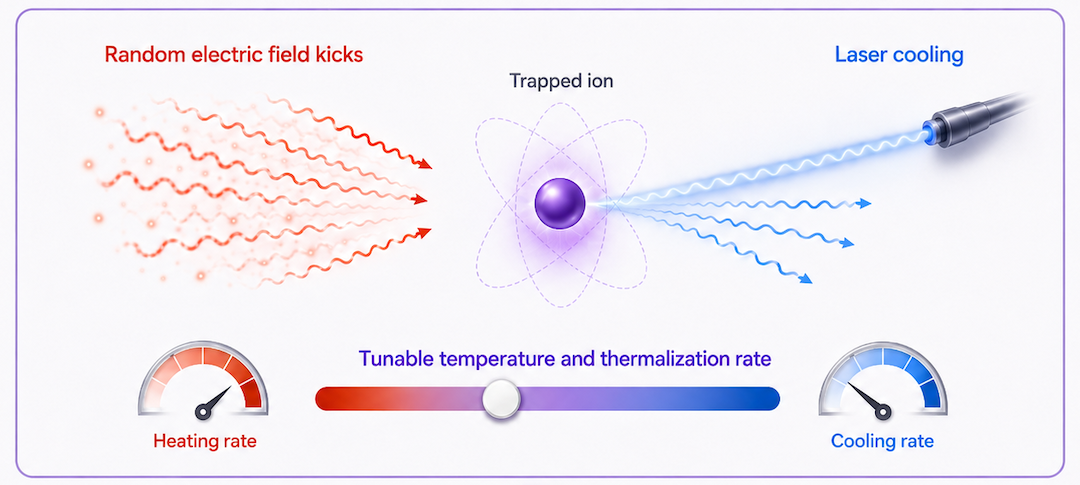
The new work introduces independent control over both temperature and dissipation, which is the rate at which the system sheds energy into its environment. These are two separate controls.
The first control heats. The team fires random electric-field signals at the ions, providing small, unpredictable nudges that dump vibrational energy into the crystal. The second control cools, using a laser that drains vibrational energy away. Because these two processes run independently, they can be set to counteract each other. The balance point determines the final temperature the ion maintains.
Here’s an analogy: Imagine a bathtub with the tap running and the drain open simultaneously. By adjusting the tap and the drain separately, you can maintain the water at any desired level and also control how quickly the water churns to reach that level. The electric kicks are the tap, the cooling laser is the drain, and the water level represents the temperature.
So, the first author, described the heating mechanism this way:
“You can think of it as random kicks to the crystal. Each kick provides vibrational energy, which essentially creates a heating effect on the ions in the study. By controlling these kicks, we can tune the rate at which we heat up the system.”
Pagano explained the benefit in a different way. The controls allow the team to place an ion into a specific thermal state or to investigate an ion whose state is not yet known.
Warmth activated chemistry that cold couldn’t reach
Once the temperature dial was available, the physics became clear. Increasing the temperature changed the transfer efficiency of the electron’s hop from donor to acceptor. Warmer conditions also activated processes that never appeared when the vibrations were frozen at their ground state.
This aligns with how chemistry operates in nature. Many reactions require a thermal push to overcome an energy barrier, and a simulator stuck at the coldest possible setting cannot reveal these processes. Giving the machine a range of temperatures broadens the questions that can be asked, which is the entire point of building a simulator instead of just experimenting with the real molecule.
What this is, and what it isn’t
This represents a capability upgrade to one research instrument, demonstrated in a lab, and confirmed by observing electron-transfer behavior shift with temperature.
What it isn’t is a designed catalyst or a photosynthesis breakthrough. The molecular electron transfer here is an engineered stand-in within a small ion crystal, not a specific molecule anyone wants to manufacture. No one has cured or treated anything with it, and the researchers don’t claim otherwise. Its value lies upstream, providing physicists with a clearer way to study how heat influences electron movement, which may someday inform how chemists approach reactions that depend on it.
Today, we have a trapped-ion simulator that can be heated, cooled, and held at a chosen temperature. Aspirationally, this warmth may eventually teach us about the molecules that rely on it.