
A New Material Sorts Light by Something Weirder Than Color

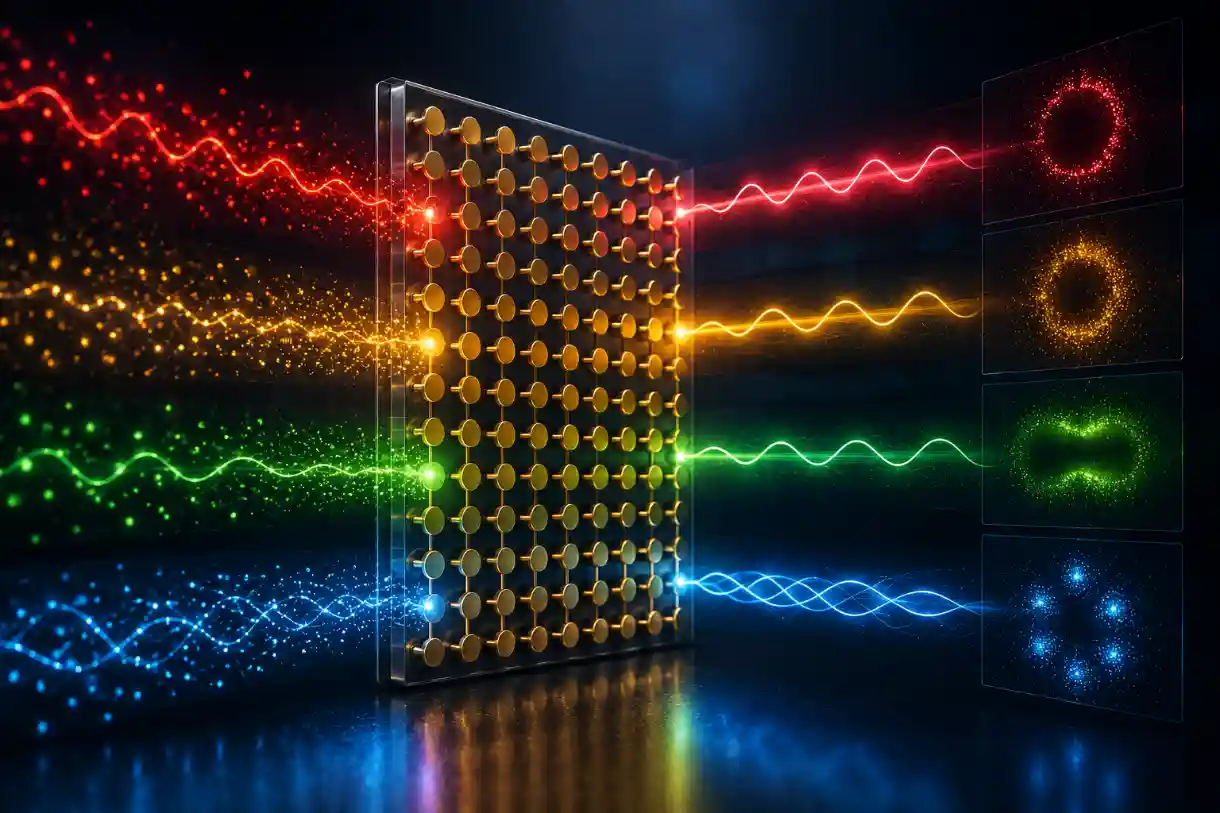
Every light filter you’ve ever met sorts by the obvious stuff. Sunglasses cut glare by polarization. A red gel on a stage light blocks everything but red. Useful, intuitive, boring. A team at Louisiana State University just built something that ignores all of that and sorts light by its quantum statistics instead, a property most people have never once had a reason to think about.
Here’s the property. A beam of light is more than a color and a brightness. Zoom in and the photons inside it are arranged in a particular pattern, and that pattern changes depending on where the light came from. Indeed, laser light, the thermal glow of a bulb, and stranger quantum light sources each carry their own statistical fingerprint, describing how the photons clump, spread, or arrive in step. The LSU material, published in Nature, is the first thing to clearly react to that fingerprint directly, at room temperature, with no cryogenics involved.
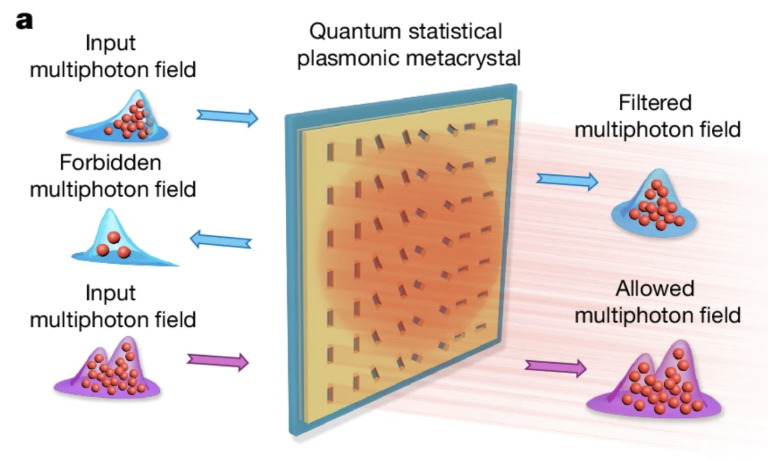
A material that recognizes light’s quantum fingerprint
The way the team pulled it off borrows a page from the semiconductor playbook. Specifically, in a chip, a band structure decides which electron energies are “allowed” to move through the material and which are “forbidden.” Using an array of a hundred tiny gold antennas acting like artificial atoms, the team engineered that same idea for the statistics of light. Light whose fingerprint lands in an allowed band sails through unchanged. Light in a forbidden band receives nudges until its statistics shift to the nearest allowed state.
Why build a band structure for something as abstract as photon statistics?
Because those statistics are exactly the parts building fragile quantum states, and keeping them intact is one of the hardest parts of doing anything quantum with light. A material that can usher particular multiphoton states through itself without scrambling them is, in principle, a useful new building block.
Why sorting light this way could matter
In principle. That’s the honest caveat. After all, this is fundamental physics, not a device. The researchers say plainly that it is an early demonstration, run under careful lab conditions, and that it makes no quantum computer faster today. The uses they float, photonic quantum computing, better solar cells, sit way out on the maybe horizon.
Still, it’s a genuinely new knob. For decades we have sorted light by color, direction, and polarization. Now there is a fourth option, and it answers to the one quality of light you can’t see.