
Physicists Turned Quantum Computing’s Worst Enemy Into a Way to Make Entanglement

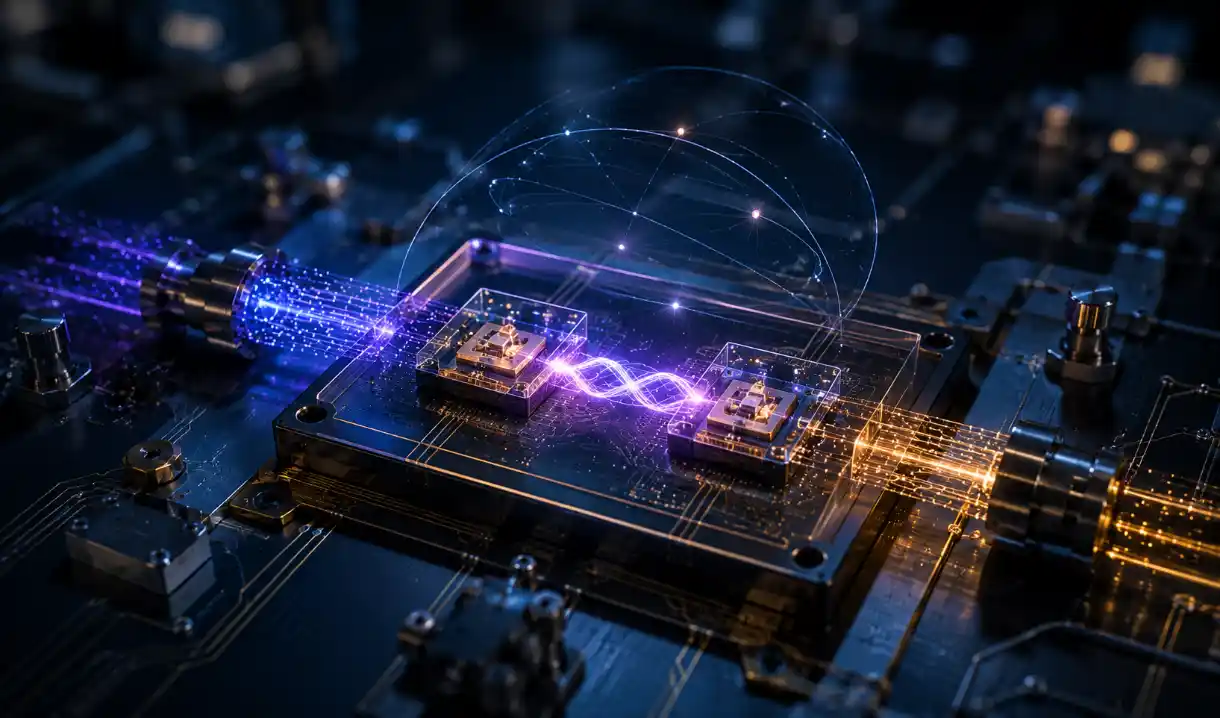
Ask anyone building a quantum machine what they fear most and the answer is dissipation: the slow leak of energy and information from a quantum system into everything around it. Dissipation is what causes decoherence, the process that erases delicate quantum states and fills quantum computers with errors. A team from the University of Illinois Urbana-Champaign and the University of Chicago has now done something genius with it. They engineered dissipation to build entanglement instead of destroying it, and to hold that entanglement in a steady state. The result is peer-reviewed in Physical Review X and featured as a Viewpoint in Physics.
Why sharing entanglement is so hard
Entanglement is the resource that quantum technologies run on, the strange correlation between distant particles that lets them do things classical systems can’t, and the thing a quantum internet would need to distribute. The catch is getting it from one place to another.
The usual recipe is to entangle objects in a single spot and then carry them apart, and it’s the carrying that hurts. In transit, noise creeps in and the correlations erode, the decoherence that plagues every attempt to move quantum states through the world. According to the July 15 report, Wolfgang Pfaff, who led the Illinois side, poses the obvious question: could you skip the trip entirely?
Entanglement as the resting point
His collaborators had a route in mind, drawn from a theory of “cascaded” quantum systems. Picture a set of superconducting qubits that constantly absorb and emit light, with some of that light bleeding into the environment. Feed in outside light that exactly balances what leaks away, and the system settles into a steady state. Tune that state carefully, and the qubits come to rest entangled, without ever moving. Aashish Clerk, who led the Chicago side, reached for a homely analogy.
“It’s almost like having a ‘refrigerator’ that pumps out external influences to maintain entanglement instead of pumping out heat to maintain coldness.”
That is the strange part. Instead of preparing entanglement in an instant and watching it decay, the system relaxes toward entanglement as its natural resting point, and can in principle stay there. The particles never travel. They only need to talk to each other.
The trick that makes it usable
Cascaded systems weren’t new, but they had a reputation for producing weak entanglement, because physical hardware is noisy and the theory that promised clean results assumed an idealized world. The advance here is a framework Clerk’s group calls synthetic squeezing, which folds those imperfections into the design and tunes the system so they cancel out.
It reduces the whole problem, in Pfaff’s words, to careful fine-tuning in the lab, and it’s what let the team reach high-quality steady-state entanglement where earlier cascaded experiments fell short. This is the true result. Theorists had long suspected dissipation could produce entanglement; the achievement is producing it cleanly enough to be useful.
What it is, and what it isn’t yet
The promise gets big fast, so it’s worth holding steady. The paper’s headline appeal is that a steady state could, in principle, be maintained indefinitely across arbitrarily large distances. That’s the theory talking. What the team actually built is two superconducting qubits coupled through a waveguide on a chip, well short of a link spanning any meaningful distance.
The entanglement is good but, as Clerk notes, still below the theoretical limit, which is why the group is eyeing distillation, a way to combine many weakly entangled qubits into a few strongly entangled ones, before the system could run actual computations. Extending past two qubits is also still ahead, and the distributed quantum computing this points toward remains mostly aspirational today.
Even Pfaff frames the next phase as an open question, saying the work is to figure out “what, if any, advantage is to be gained.” Still, the direction is appealing. If it scales, you could link quantum machines by letting them communicate rather than shipping fragile states down channels that break them. That is a long way off. But turning the field’s oldest enemy into a resource is the kind of inversion that tends to change how people build.