
Satellite QKD, Explained: Sending Quantum Keys From Space

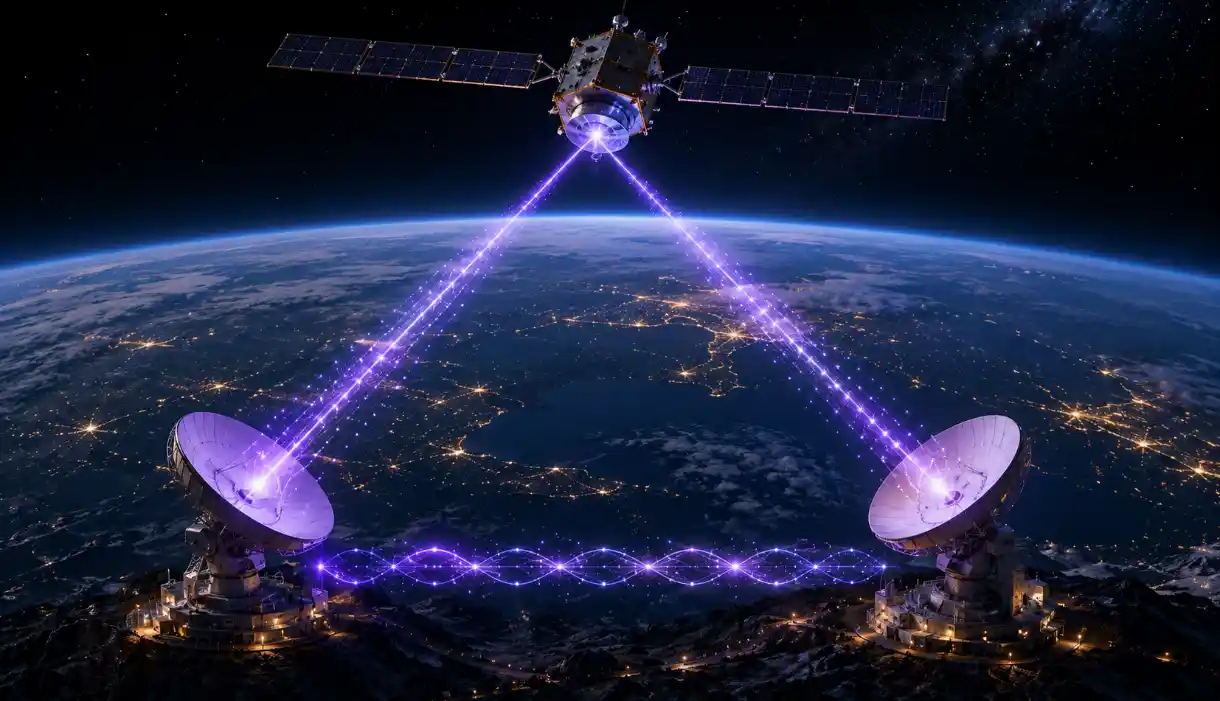
Conventional point-to-point fiber QKD becomes impractical beyond a few hundred kilometers, because optical loss drives the usable key rate toward zero. Experimental twin-field systems have crossed 1,000 kilometers of laboratory fiber, at exceptionally low rates. Satellites are the way around the wall, and the reason is a quirk of physics: most of a satellite’s path to the ground is empty space, where a photon barely fades.
That’s how China’s Micius satellite ran quantum keys down to the ground over link distances up to 1,200 kilometers, and later distributed entanglement between two ground stations more than 1,100 kilometers apart. One catch shows up in the version that spans continents: there the satellite acts as a trusted relay, so it has to be trusted. And whichever way it’s done, none of it signs your transactions.
Why fiber hits a wall
Start with the problem satellites solve. A QKD photon travels down an optical fiber, and the fiber absorbs and scatters a fixed fraction of the light per kilometer. That makes the loss exponential: every kilometer multiplies what has already gone, so across a thousand kilometers of ordinary fiber almost nothing arrives. Ordinary optical amplifiers can’t rescue it.
They can’t noiselessly reproduce an unknown quantum state, because the no-cloning theorem rules out perfect copying and practical amplification adds noise that wrecks the quantum information. In conventional direct fiber systems, the key rate becomes impractically low after a few hundred kilometers.
Why space is easier than a long cable
A satellite link plays by different rules. Once a photon leaves the dense lower atmosphere, it’s traveling through near-vacuum, where there’s almost nothing to absorb or scatter it. The main loss isn’t the distance eating the signal. It’s the beam spreading out, so only a fraction of it lands on the receiver. That received signal still falls sharply with distance, but the scaling is geometric rather than the exponential attenuation fiber imposes.
The numbers are dramatic. At 1,200 kilometers, the Micius team estimated its satellite-to-ground link at up to 20 orders of magnitude more efficient than a fiber link of the same length with a loss of 0.2 decibels per kilometer. A photon from orbit crosses the dense air near the ground and spends most of its journey in near-vacuum. A photon in a cable fights every step.
What Micius pulled off
China launched Micius in 2016 as the first satellite built for quantum communication. In 2017 it beamed quantum keys down to ground stations over link distances up to 1,200 kilometers, running a decoy-state version of the standard BB84 protocol from orbit.
The same year, it did something stranger: it sent one half of an entangled pair of photons to each of two observatories more than 1,100 kilometers apart, and the pairs stayed entangled across that gap, confirmed by a Bell test. In 2018 it acted as a relay to help create a shared key between sites in China and Austria, 7,600 kilometers apart.
Then in 2020 the team removed the relay’s weak spot. They used Micius to distribute entangled pairs and established a key directly between two ground stations 1,120 kilometers apart, with the satellite never learning the key. The rate was tiny, about 0.12 bits per second, but it showed satellite QKD without a trusted node in orbit.
The catch: the relay is a trusted node
The intercontinental key came with the same compromise that dogs QKD on the ground. To link China and Austria, Micius established one key with the Chinese station and another with the Austrian station. It then took the bitwise XOR of the two and relayed that, so the stations could derive a common key. Because the satellite held both original keys, it had to be trusted not to keep or reveal them. This is the relay architecture, and it’s what spans continents today. The entanglement route from 2020 sidesteps it, since the satellite distributes quantum correlations without learning the final key the ground stations end up with. That route runs far slower, so a satellite adds range and, in relay mode, adds an intermediary that has to be trusted in a system built to catch interception on the channel.
Why it’s still difficult
Satellite QKD isn’t a switch you flip. A low-orbit satellite is only overhead for a few minutes per pass, so a ground station collects key in short bursts instead of a steady stream. Daylight raises the background noise: stray light swamps the faint single photons, so early links ran at night, and daytime operation is its own research effort.
Clouds block the beam, and the satellite and station have to point at each other with extreme precision across hundreds of kilometers as both keep moving. The current push is toward smaller and cheaper satellites and links that work in daylight. Constellations come after that. Europe’s EAGLE-1 demonstrator is scheduled for 2027, after earlier plans targeted 2024 and then 2026.
The takeaway for wallet holders
Satellites are how QKD could go global, and it helps to see the shape of that clearly. It still revolves around specialized key delivery between equipped optical ground stations, and the version that crosses continents still trusts a relay in orbit. Impressive, and narrow.
Satellite QKD supplies shared secret key material for a link between equipped stations. It doesn’t create the signature that authorizes a cryptocurrency transaction or proves you own a wallet key. When a quantum computer threatens that signature, the fix stays the same: a post-quantum signature scheme the blockchain adopts. The satellite is a stunning piece of engineering aimed at a different problem than the one your wallet has.