
Quantum Key Distribution Field Guide
QRNG vs QKD: The Quantum Security Tool You Might Already Own

- QRNG
- A chip
- local entropy, already in phones
- QKD
- A link
- shared key between two endpoints
- THE OVERLAP
- Both use physics
- but solve different problems
- FOR YOUR WALLET
- Randomness matters
- but it needn’t be quantum
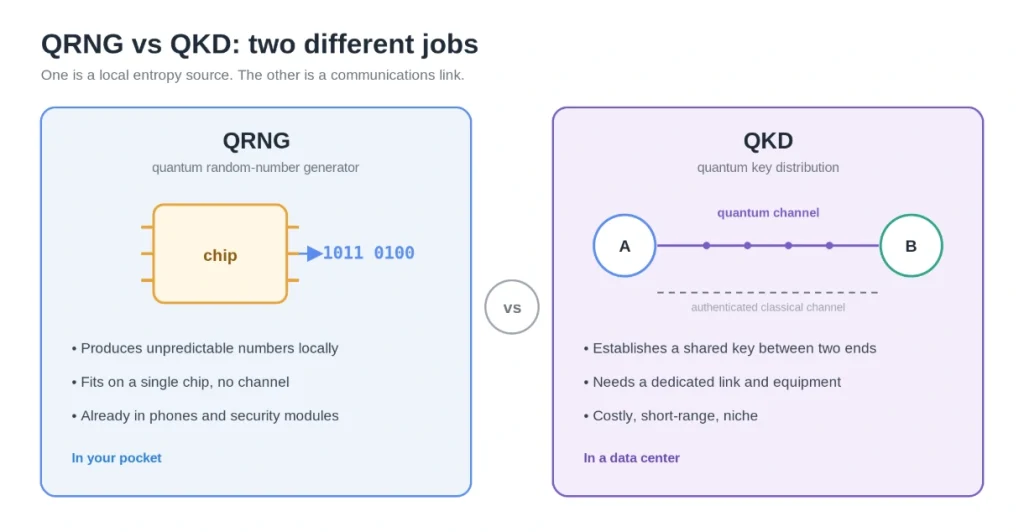
“Quantum security” hides two different technologies that people constantly mix up. A quantum random-number generator (QRNG) produces unpredictable numbers from a quantum process and fits on a single chip, so it already ships in phones and security hardware. Quantum key distribution (QKD) is a costly communications link that establishes a shared key between two endpoints, and you probably won’t touch it. One is a chip; the other is a link. For a crypto holder the QRNG is the relevant one, because strong randomness is a foundation of your wallet, though it does not have to be quantum: a properly seeded classical generator meets the bar too.
Part of the Quantum Key Distribution guide seriesTwo different jobs
A QRNG and QKD both use quantum physics, but a QRNG is a chip that makes local randomness and a QKD link establishes a shared key between two endpoints. Neither signs a blockchain transaction; the quantum threat to your coins lands on the signature scheme, and the fix there is post-quantum cryptography. See Post-Quantum Cryptography, in Plain English.
| QRNG | QKD | |
|---|---|---|
| What it is | a local entropy source | a two-endpoint communications link |
| Form factor | fits on a chip | specialized optical hardware at both ends |
| Job | produce unpredictable random numbers | establish shared secret key material |
| Where you meet it | phones, security modules | infrastructure; probably not near you |
QKD systems themselves need private randomness, and many implementations use a QRNG to supply Alice’s choices. The QRNG can be one component; QKD is the communications system built around components like it.
What a QRNG does
A QRNG turns a quantum process into random bits. Different designs tap different sources, like the shot noise of light hitting an image sensor or the arrival times of single photons. The distinction is where the unpredictability comes from. A pseudo-random generator expands a secret internal state deterministically: learn that state and its future output becomes predictable.
At the same time, a QRNG draws fresh entropy from measurements of a quantum process, though practical devices still need careful characterization and post-processing before those raw measurements become cryptographic random bits.
Designs tap different sources, like the shot noise of light hitting an image sensor or the arrival times of single photons. The distinction is where the unpredictability comes from.
- Pseudo-random (PRNG)
- expands a secret internal state deterministically; learn the state, predict the output
- QRNG
- draws fresh entropy from a quantum measurement
- Still needs
- careful characterization and post-processing before raw measurements are cryptographic bits
Why this one reached your pocket
QKD needs specialized optical hardware at both ends, plus tightly controlled links and network integration, so it stays infrastructure rather than consumer electronics. A QRNG can shrink onto a semiconductor chip, which makes it far easier to put inside ordinary devices. ID Quantique put a QRNG chip in a Samsung phone sold by SK Telecom back in 2020, the first of a continuing line of quantum-security handsets.
QRNGs also appear in hardware security modules and other embedded security systems. Several QRNG implementations have received NIST Entropy Source Validation under SP 800-90B, the same framework used for classical physical entropy sources. That puts them inside production and FIPS-oriented assurance processes rather than leaving them as lab demonstrations.
That puts QRNGs inside production and FIPS-oriented assurance processes rather than leaving them as lab demonstrations.
- QKD
- needs optics at both ends and controlled links, so it stays infrastructure
- QRNG
- shrinks onto a chip, so it fits ordinary devices
- In the field
- ID Quantique’s QRNG chip in a Samsung phone (SK Telecom, 2020)
- Assurance
- several QRNGs have NIST SP 800-90B entropy-source validation
What it means for your wallet
Here’s where randomness gets personal.
One of the foundations of a wallet’s security is the randomness behind your seed phrase. If those numbers are predictable, the seed is guessable, and a guessable seed means someone can rebuild your keys and take everything. This isn’t hypothetical.
- 2013
- an Android RNG flaw left Bitcoin wallets open to theft
- 2026
- a Coldcard firmware bug sent seed generation down a weak software-randomness path
- One sweep
- ~594 BTC from about 500 wallets, with later losses higher
A 2013 flaw in Android’s random-number generation left Bitcoin wallets open to theft. And in 2026, a years-old Coldcard firmware bug sent seed generation down a weak software-randomness path instead of the intended hardware RNG. One early sweep alone drained around 594 Bitcoin from about 500 wallets, and later attacks pushed the tracked losses much higher.
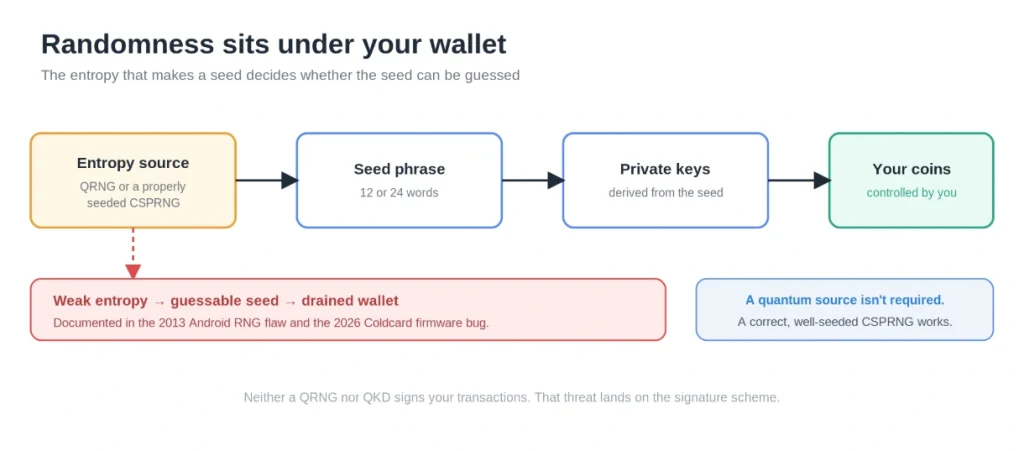
So strong randomness is something to care about, and a QRNG is one way to get it. It’s worth being clear, though: your wallet doesn’t need a quantum one.
A correctly built cryptographic generator, properly seeded from a strong entropy source, has met the security bar for years, and secure wallets rely on exactly that. A QRNG can add an independently characterized source of entropy, but the word “quantum” doesn’t by itself make a generator safer. Assurance comes from the full design and its validation, entropy model included.
Bottom line
Two technologies wear one label, and the difference is worth keeping straight. A quantum random-number generator is an entropy source small enough to fit on a chip, it’s already in phones and security modules, and it can strengthen the randomness behind a key or a seed. Quantum key distribution refers to specialized communications infrastructure for establishing shared keys between endpoints, and you likely won’t touch it.
Neither one signs a blockchain transaction, and neither addresses the main quantum threat to your coins. That threat lands on the signature scheme, and the fix there is post-quantum cryptography.
If a quantum-security product ever ends up in your hand, odds are it’s a QRNG, quietly supplying fresh entropy. Neither QRNG nor QKD signs a blockchain transaction.
This article is educational and does not constitute security or investment advice.
// FAQ
What's the difference between a QRNG and QKD?
A QRNG is a chip-sized source of random numbers from a quantum process. QKD is a two-endpoint communications link that establishes a shared secret key. One produces local entropy; the other distributes a key between two machines.
Which one might I actually own?
A QRNG. They already ship in some phones and hardware security modules. QKD needs specialized optics and controlled links, so it stays infrastructure you likely won’t touch.
How is a QRNG different from a normal random-number generator?
A pseudo-random generator expands a secret internal state deterministically, so learning the state makes future output predictable. A QRNG draws fresh entropy from a quantum measurement, though it still needs careful characterization and post-processing to produce cryptographic bits.
Does my crypto wallet need a quantum RNG?
No. A correctly built cryptographic generator, properly seeded from a strong entropy source, meets the security bar and has for years. A QRNG can add an independently validated entropy source, but “quantum” alone doesn’t make a generator safer.
Why does randomness matter so much for a wallet?
Your seed phrase is generated from randomness. If it’s predictable, the seed is guessable and your keys can be rebuilt. Weak randomness has drained real wallets, including a 2013 Android flaw and a 2026 Coldcard firmware bug.
// Sources
- QNews, QKD Hardware, Explained: What's Inside the Box https://qnews.io/guides/quantum-key-distribution/qkd-hardware-explained-whats-inside-the-box/
- QNews, Seed Phrases vs PQC: What Changes for Self-Custody https://qnews.io/guides/post-quantum-cryptography/seed-phrases-vs-pqc-what-changes-for-self-custody/
- NIST, SP 800-90B (Entropy Source Validation) https://csrc.nist.gov/pubs/sp/800/90/b/final
- QNews, Post-Quantum Cryptography: The Quantum Computing Threat, in Plain English https://qnews.io/guides/post-quantum-cryptography/post-quantum-cryptography-a-plain-english-guide-for-crypto-holders/
- QNews, What Is Quantum Key Distribution (QKD)? The No-Math Version https://qnews.io/guides/quantum-key-distribution/what-is-quantum-key-distribution-the-no-math-version/