
QoreChain Claims First Fully Post-Quantum Blockchain Transaction

Blockchain company QoreChain says it has completed the first blockchain transaction protected from end to end by all three of the post-quantum cryptography (PQC) algorithms standardized by the U.S. National Institute of Standards and Technology (NIST). The transfer moved 1,000 QOR tokens on the company’s live public mainnet on July 2, 2026, and landed in a wallet made with Keplr, a self-custody app. QoreChain says the transaction is viewable by anyone on its public block explorer.
What QoreChain did
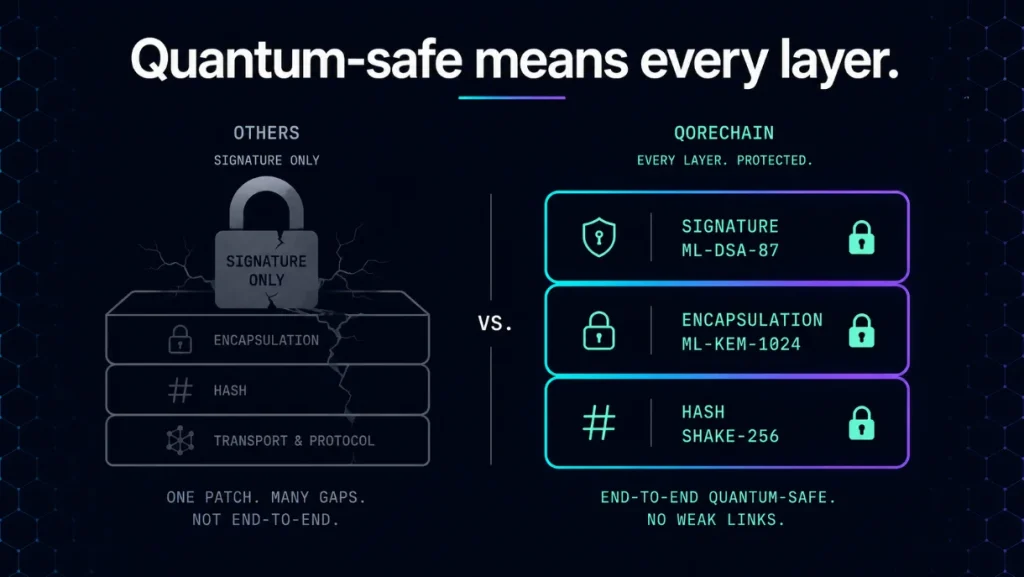
Specifically, the claim rests on the word “complete.” Plenty of projects call themselves quantum-safe after swapping out a single piece of the protocol, usually the transaction signature, as the rest of the system keeps running on classical cryptography that a strong enough quantum computer could break. QoreChain says its transaction applies post-quantum cryptography across the whole cryptographic path. The signature uses ML-DSA-87, the NIST standard also known as FIPS 204 and Dilithium-5. Key encapsulation uses ML-KEM-1024, or FIPS 203, based on Kyber. Hashing uses SHAKE-256. All three carry NIST standardization.
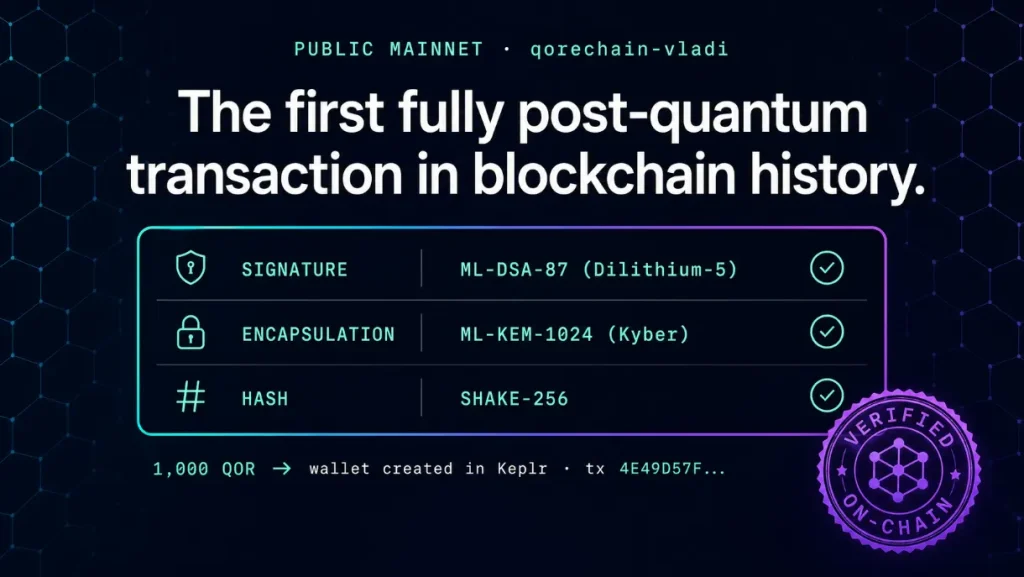
QoreChain describes itself as a quantum-safe, AI-native Layer 1 blockchain, and it framed the demonstration as something built with off-the-shelf tools rather than a lab rig. The receiving wallet was created in Keplr, a mainstream wallet, which the company offers as proof that post-quantum security doesn’t require people to give up the software they already use.
Founder and CTO Liviu Epure said the point was to move the idea out of theory. “For years, the response to our thesis was that it was too early,” he said.
“Today that argument stops being theoretical. This isn’t a signature that its creators have swapped at the edge and marketed as quantum-safe. Every layer of this transaction, how it is signed, how keys are exchanged, and how it is hashed, is post-quantum, and the receiving wallet is one an ordinary person can install today.”
He encouraged cryptographers and engineers to open the transaction and inspect it, and said it was public for that reason.
Why full-stack post-quantum is important for a ledger
The urgency ties to a strategy security researchers have tracked for years called ‘harvest now, decrypt later’. An attacker collects encrypted data today and stores it, waiting for the day a capable quantum computer can crack it open. Blockchains make that problem sharper because they keep their history permanently and in public. A ledger without the post-quantum cryptography security from the beginning risks the exposure of its entire recorded history after the fact. Upgrading later only shields what gets signed after the switch, as opposed to what’s already sitting on the chain.
That framing is where QoreChain’s executives drew the line between novelty and readiness. “Being first is not the point. Being ready is,” said President and CEO Tilak Patel. He argued that the organizations with the most exposure in a quantum transition, across finance and other sectors, cannot run on infrastructure that is experimental or nonstandard. The demonstration shows, in his words, standardized, live, and independently verifiable post-quantum security.
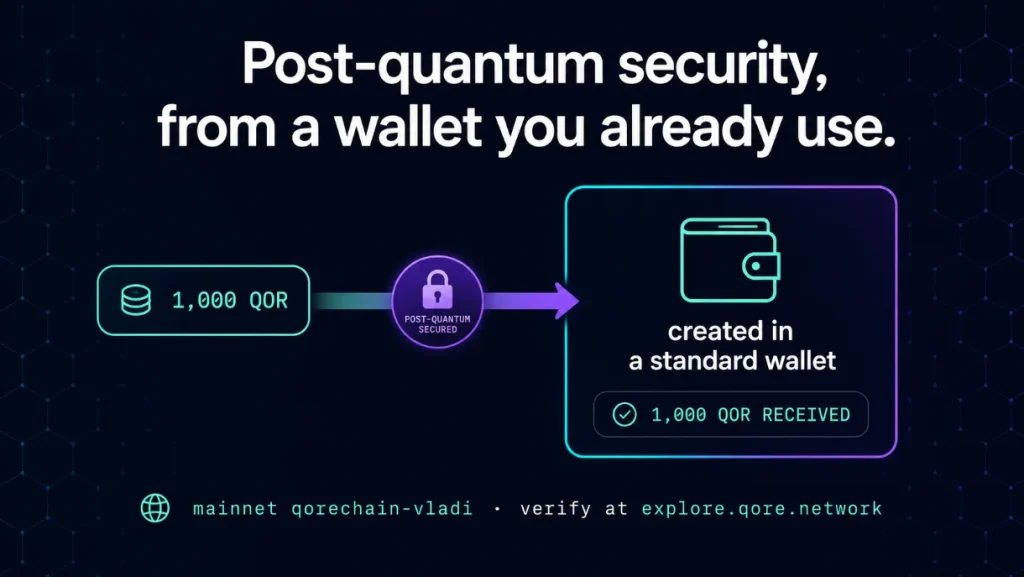
Meanwhile, the strongest part of the announcement is that you can check it. QoreChain’s mainnet is running, its block explorer is open at explore.qore.network, and its developer documentation is available in ten languages. The company is inviting outside review rather than asking anyone to take the claim on faith, which is the reasonable test for a first of this kind. Whether independent cryptographers confirm the end-to-end claim, and whether other chains follow, will decide how much the milestone ends up meaning.