
Eaton Wins $7M to Aim Quantum Computing at Grid Security

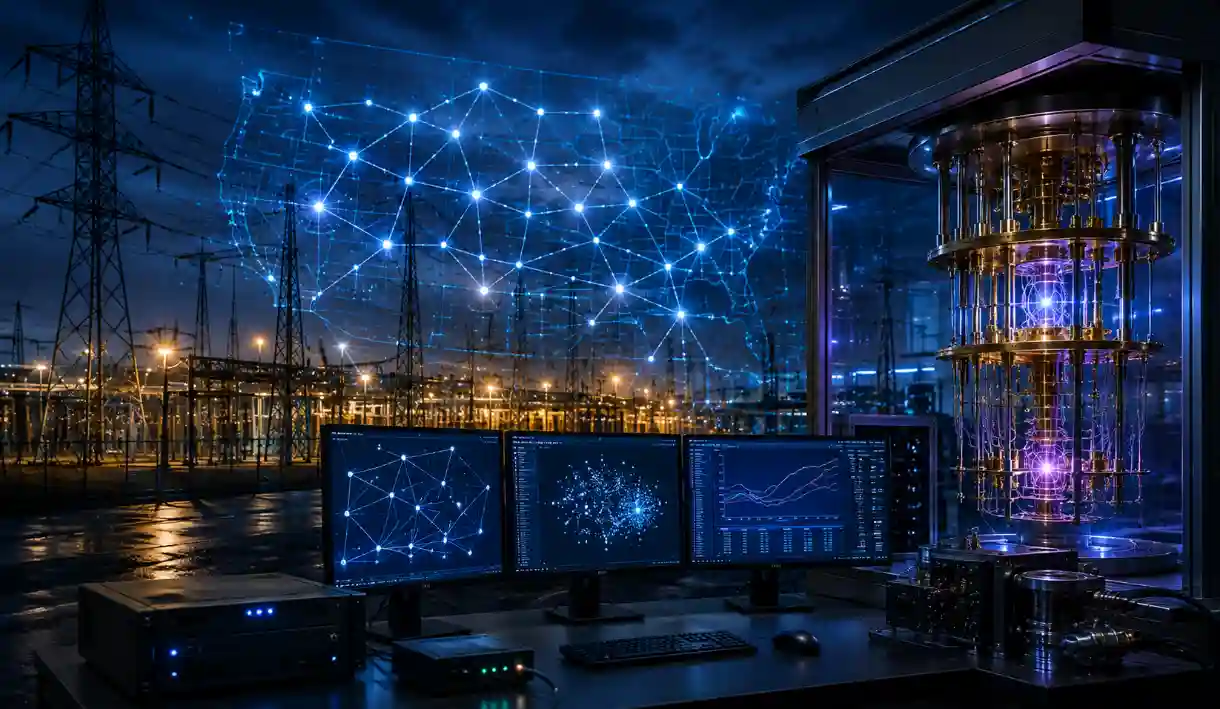
Eaton has won a $7 million, two-year Air Force Research Laboratory contract to test whether quantum computing can make the electric grid harder to knock out. Working with the quantum firm Infleqtion and Penn State, the power-management company will build quantum and machine-learning methods for the “contingency problem,” the job of checking a vast number of ways a grid could fail. The deliverable is a proof-of-concept demonstration rather than a system running on the grid.
The contingency problem
Grid operators have to plan for equipment failing. Today’s reliability rules require the North American grid to survive two sequential failures, and Eaton’s project aims higher, at many concurrent and unpredictable threats at once, the kind stacked up by extreme weather and deliberate attack.
Checking every combination means evaluating an enormous number of grid configurations, a combinatorial optimization problem, and that shape is the classic pitch for quantum computing, the same logic behind quantum optimization of a phone network. In an August 6 report, Sid Suryanarayanan, a senior chief engineer at Eaton, framed the need:
“We’re facing unprecedented risks to electric reliability and security from extreme weather, wildfires, physical and cyber threats and need tools that consider many failures at once.”
Whether quantum truly helps
That said, Eaton plans to run this on “current quantum hardware,” and near-term quantum machines have yet to beat good classical methods on real optimization problems of this kind. The release’s own language, hybrid quantum-classical methods and error mitigation, signals a team that knows today’s hardware is noisy and limited.
This is a research contract to explore the question, in the same territory as early quantum proofs-of-concept like D-Wave’s financial-crime pilot, and whether the payoff arrives is exactly what the industry is still trying to measure.
Infleqtion supplies the quantum side, neutral-atom hardware from a company that also anchors Albuquerque’s open quantum network, with Penn State on algorithms and machine learning. The problem is genuine and the money is committed. The promised demo aims to solve the open question of whether current quantum hardware helps solve it.