
PsiQuantum Is Betting on the Finish Line While Everyone Else Counts Mile Markers

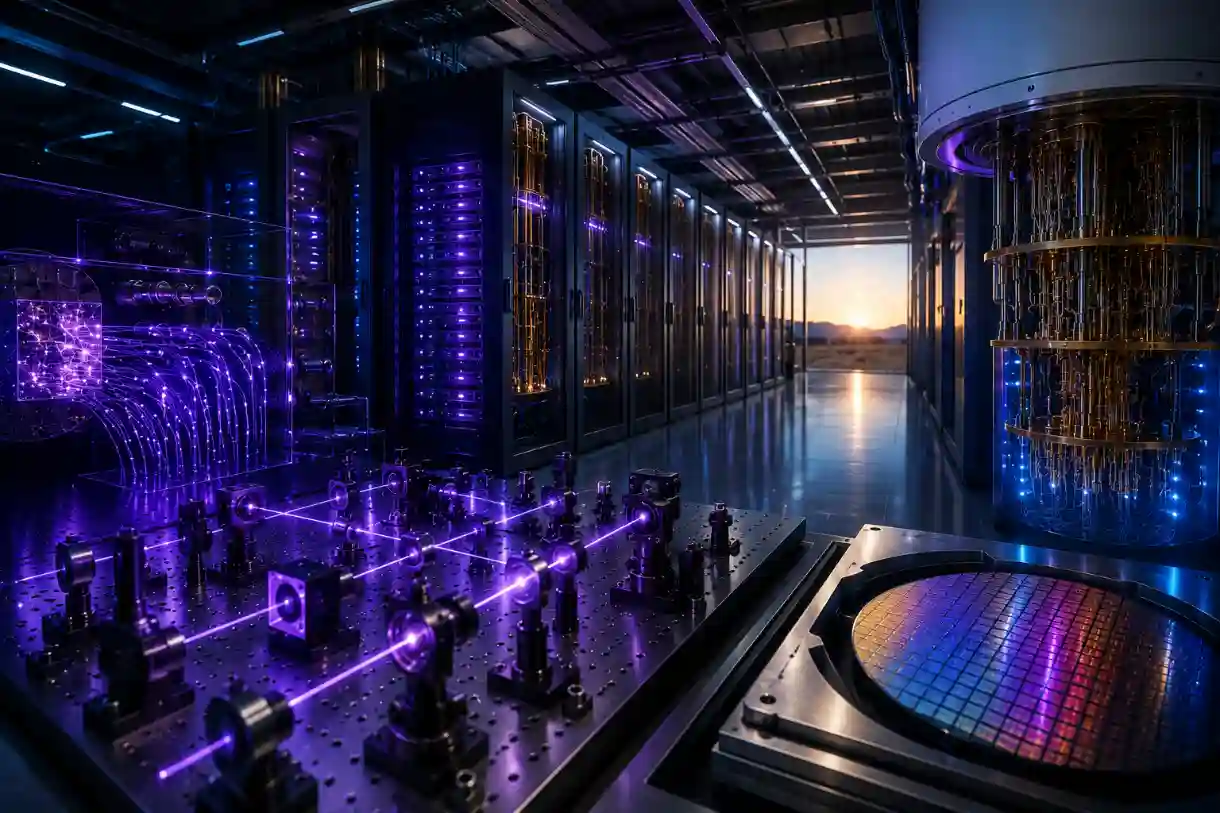
Most quantum computing companies sell you progress in increments. A better chip, a longer coherence time, a paper with the error rate nudged down. PsiQuantum is selling you the ending. The company wants to skip the visible mile markers and arrive, first, at a machine with a million qubits that does something no classical computer can. You may call it the finish-line bet.
It’s the most aggressive strategy in the field, and the hardest one to check. Both of those are worth taking seriously.
Why PsiQuantum is skipping the usual milestones
Start with why the bet is coherent, because it is. Per a July 24 report, PsiQuantum, founded in 2016 by four physicists, builds its qubits out of photons. Light has real advantages here, as photons hold their quantum state for a long time, and they move through optical circuits that look, if you squint, like a high-precision version of the silicon photonics already running in data centers.
There’s a second efficiency most rivals can’t claim. A superconducting machine has to be cooled almost entirely to near absolute zero. A photonic one needs only one part that cold, the detectors that read single photons at the end. Cheaper to refrigerate, in principle, and buildable on existing semiconductor lines. The company fabricates its chips at GlobalFoundries and makes its own exotic light-routing crystal in-house.

The physics had one famous flaw, and PsiQuantum exists because someone found the loophole. Photons barely interact, which for years looked fatal for a qubit that needs to influence its neighbors. A 2001 result showed you could fake those interactions using beam splitters and detectors. PsiQuantum was built to turn that theory into hardware. So far, so directionally correct.
The biggest challenge is proving the roadmap
The weakness is baked into that same strategy. What makes PsiQuantum ambitious also makes it nearly impossible to grade from outside. Google and Quantinuum publish incremental results, systems you can inspect and improvements you can measure. PsiQuantum has aimed past all of that at the commercial endpoint.
“It is very hard for an outsider to evaluate,” the theoretical computer scientist Scott Aaronson told a recent profile of the company, and that’s the whole problem in a sentence. A company showing mile markers can be checked at every marker. A company showing only the finish line asks you to trust the map.
The scale problem is where the map gets specific. At its California test site, PsiQuantum has linked three cabinets, 250 chips each. The full machine needs around 100 cabinets working together, which the company aims to house at an Australian site it says will be “operational” by late next year. Read that word carefully.
Operational means the cooling is in place and hardware can be installed, not that a working computer switches on. Press coverage has repeatedly turned that into a 2027 finish date, and the company keeps correcting it. In an industry judged almost entirely on timelines, the distance between “ready for hardware” and “ready” is not a rounding error.

Where the real-world applications stand
The applications tell the same story: promising on paper, unproven in practice. PsiQuantum has named customers including Lockheed Martin, Mercedes, and Airbus, and it offers software so they can write algorithms for a machine that doesn’t exist yet. That’s less strange than it sounds, since quantum algorithms can be developed before the hardware.
But the demonstrations so far are modest, and the company’s own collaborators say so. On a fluid-dynamics paper with Airbus, the quantum simulation expert Andrew Childs judged the speedup moderate and unlikely to matter practically “until we have very large-scale quantum computers.”
Dominic Berry, whose techniques underpin PsiQuantum’s molecular-collision work, called the results impressive but dependent on faster algorithms and fewer errors than the early machine is expected to have. The pattern repeats. The wins need the big computer, and the big computer is the thing in question.
Why DARPA is taking PsiQuantum seriously
Here’s what keeps the bet from being a fantasy. The best-informed skeptic in the room is the Pentagon, and it’s getting less skeptical. DARPA has been benchmarking quantum companies for years, and PsiQuantum is one of two, alongside Microsoft, to reach the third stage. The program’s former head, who called himself a quantum skeptic, said last year he was more optimistic than at any point in a decade. His successor put a date on it: utility-scale quantum computing, likely, by 2033. That’s not a promise about PsiQuantum specifically. It is a serious institution saying the finish line exists.
So where does that leave the bet. Not as hype, and not as proof. PsiQuantum has made a coherent wager that vertical integration and a photonic shortcut will carry it to a useful machine before anyone else, and it has convinced governments, a major chip fab, and DARPA to take it seriously. At the very least, it has earned the scrutiny. The catch is structural. A finish-line bet stays unfalsifiable right up until the moment it isn’t. That moment starts arriving next year.